

Somewhere in the last decade, the six-digit code became the load-bearing wall of digital identity. Bank transfers depend on it. Wallet top-ups depend on it. Account recovery, e-commerce checkout, ride-hailing signup, government service portals, all of it rests on a short string of numbers delivered over a channel designed in the 1980s for people to text each other about dinner.
That is the situation operators are managing. A verification method with enormous trust attached to it, running on infrastructure that was never built to carry the weight.
Fraudsters worked this out early. The attacks that followed are not clever in the cinematic sense. Most of them are automation applied to a workflow that assumes good faith: a signup form that will send a code to any number typed into it, an API that will accept a resend request as many times as it is asked, a route that will terminate a message without anyone checking who paid for it. Point a script at any of those and money starts moving in the wrong direction.
For a mobile network operator, this shows up in several places at once. Traffic that costs money to carry and generates none. Complaints from subscribers buried in codes they never asked for. Enterprise customers questioning why their OTP delivery rates dropped. Regulators asking what controls are in place.
The SMS firewall is where most operators concentrate the response, and for good reason: it is the only point in the chain that sees all of the traffic, from every sender, heading to every subscriber. But a firewall you bought and never tuned is not protection. It is a logging appliance with a large invoice attached.
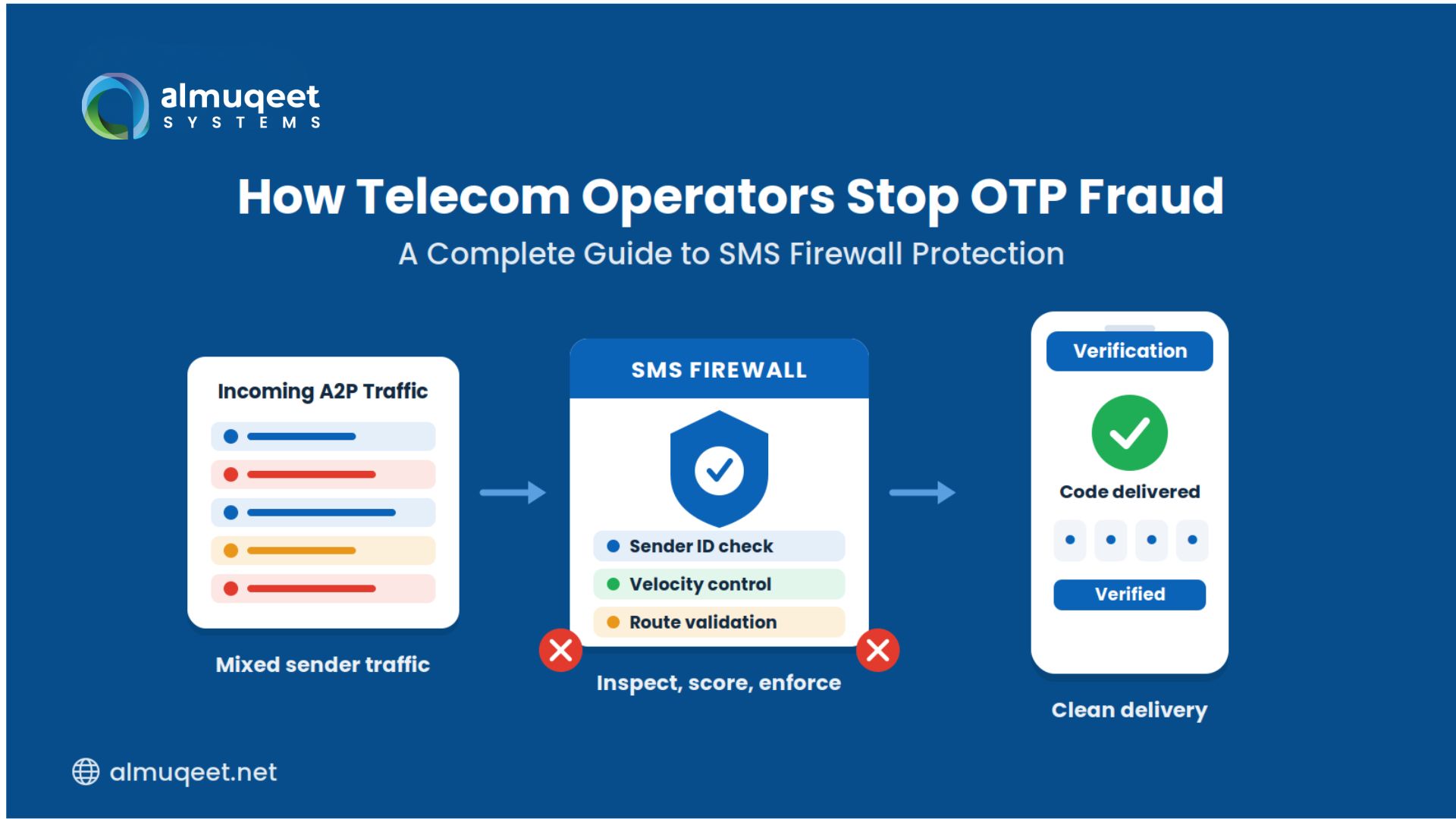
This guide covers what OTP fraud looks like in practice, how it is detected, and what SMS firewall protection actually does about it. It is written for the people who have to make the decisions: operators, aggregators, CPaaS providers, and the bank and fintech security teams sitting on the other side of the interconnect.
What Is OTP Fraud
OTP fraud is any abuse of the one-time password workflow for financial gain, harassment, or account compromise. That definition is broad on purpose, because the attacks it covers have very little in common with each other beyond the message type they exploit.
Some of them target the enterprise paying for the messages. Some target the subscriber receiving them. Some target the operator carrying them. A few manage all three at once.
The reason OTP systems attract this much attention comes down to three properties that rarely appear together. The workflow is triggered by anyone, from anywhere, without authentication, because the whole point is that the user has not proved who they are yet. Each trigger costs somebody real money. And the traffic is high volume and repetitive enough that anomalies hide inside it comfortably.
Consumers feel it as a phone that will not stop buzzing, or worse, as a drained account after a code was intercepted. Enterprises feel it as a messaging invoice that grew 40 percent while signups stayed flat. Operators feel it as network load, subscriber complaints, and revenue that terminated without billing.
It is worth separating OTP fraud from phishing and account takeover, because they get conflated constantly. Phishing tricks a person into handing over a code. Account takeover is the outcome when it works. OTP fraud, as the term is used in telecom, usually means abuse of the delivery mechanism itself, whether or not any account is ever compromised. SMS pumping generates millions of dollars in fraudulent traffic without touching a single account. The message pipeline is the target, not the user.
Why OTP Fraud Keeps Growing
A2P messaging volumes grew because verification volumes grew. Every new app that requires a phone number adds another endpoint that will send a message to anyone who asks it to.
Digital banking pushed this hardest. Regulators in most markets now require strong customer authentication for payments, and SMS remained the default second factor because it works on every handset ever made and requires no user education. Fintech expansion added another layer. So did e-commerce checkout verification, delivery confirmation codes, and the general habit of using a phone number as a universal account identifier.
Automation did the rest. Building a script that hits a thousand signup endpoints is not a specialist skill anymore, and the tooling gets shared openly. What used to take a competent developer a week takes an amateur an afternoon.
Then there is the money. This is the part that changes the nature of the problem. Certain forms of messaging fraud have a direct revenue share attached, which means the attacker is not just causing damage, they are being paid per message. That turns a nuisance into an industry. The economics resemble IRSF fraud on the voice side, where inflated traffic to specific ranges generates termination revenue for whoever controls them. The messaging version works the same way and has proven just as durable.
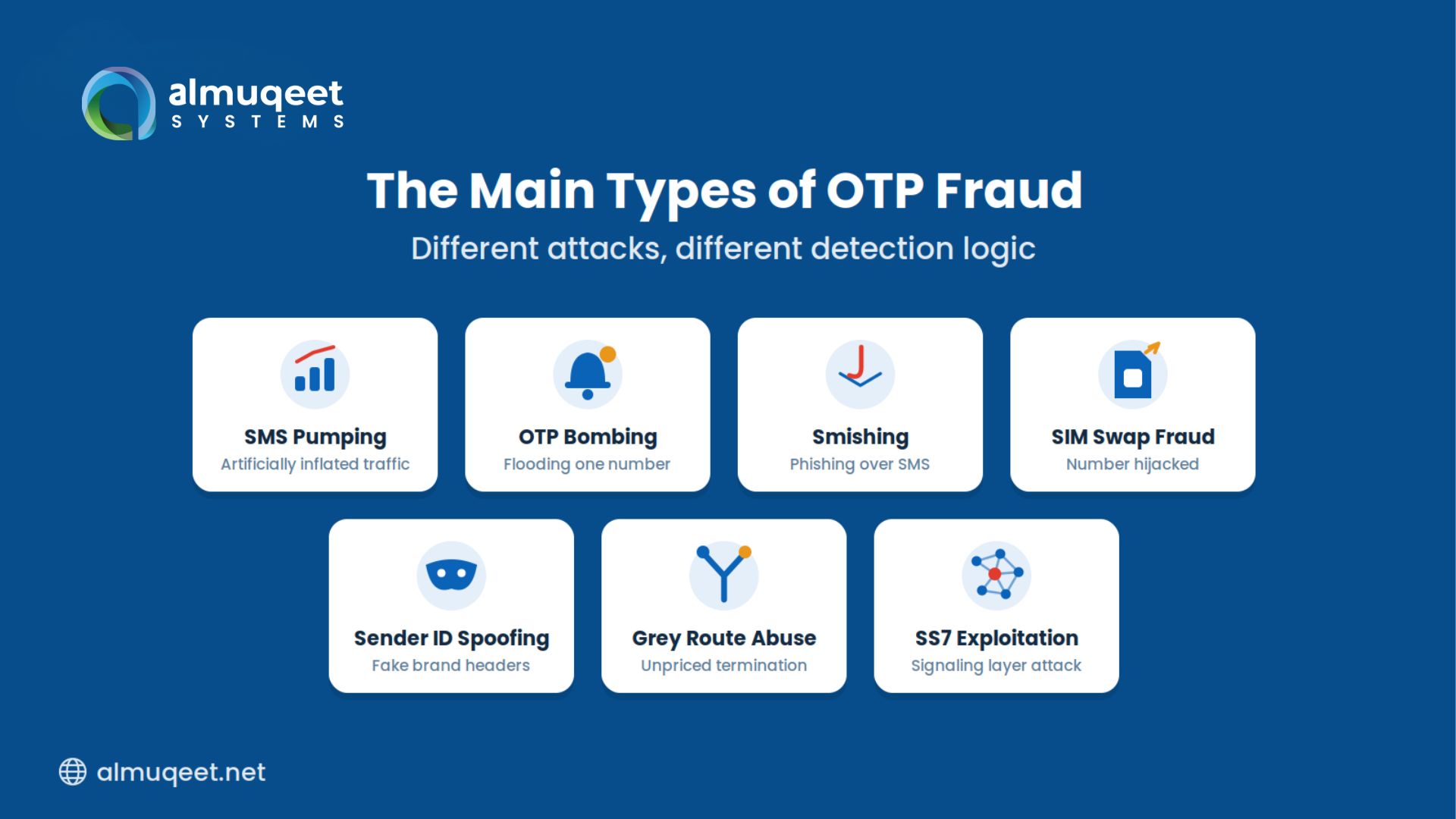
The Main Types of OTP Fraud
These get grouped together in vendor decks. They should not be, because the detection logic for each one is different and a control that catches one will often miss the next.
SMS Pumping and Artificially Inflated Traffic
An attacker gains access to premium or high-cost number ranges, usually through an arrangement with somebody in the termination chain. Then they find an application with an open verification endpoint and pump requests into it, thousands of them, all targeting numbers on those ranges.
Every message costs the enterprise. A share of the termination fee comes back to whoever controls the range. Nobody signs up, nobody verifies, and nobody notices until the finance team queries the invoice.
The signature is easy to describe and surprisingly easy to miss in production: high send volume, very low verification completion, heavy concentration in a handful of expensive destinations, and often number ranges that look sequential when you sort them. Artificially inflated traffic is covered in more depth separately, but the operator-side point is that this traffic is technically valid at every hop. Content is clean. The sender is legitimate. Only the pattern gives it away.
SMS Bombing and OTP Bombing
Different attack, opposite shape. Instead of one attacker hitting many numbers, a single number gets hit by many services at once.
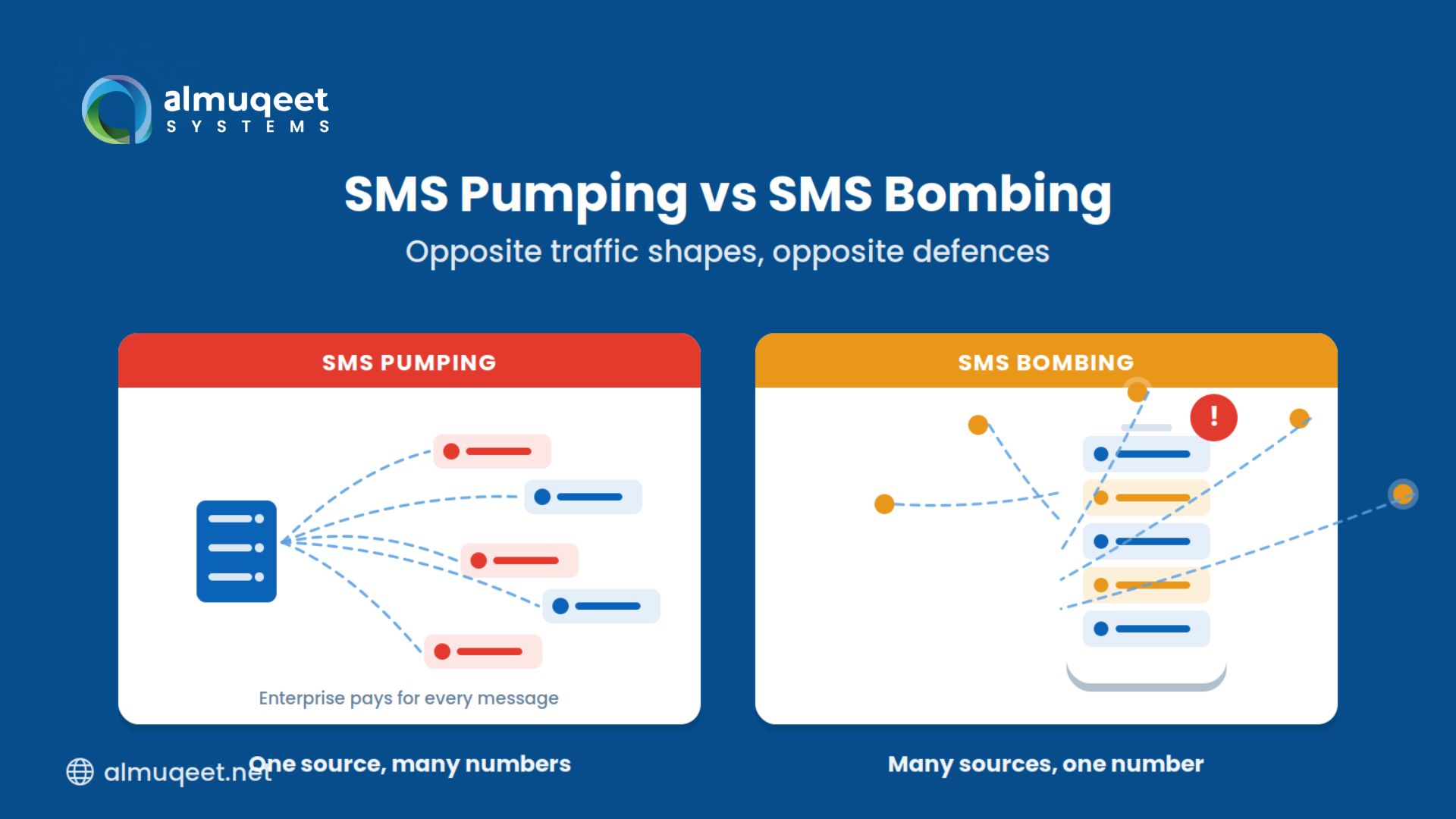
The tool is usually an SMS bomber, an automated script that submits one phone number into the signup and resend forms of dozens of unrelated websites in rapid succession. Each site sends a code, correctly, doing exactly what it was built to do. The subscriber receives hundreds of them inside a couple of minutes.
Motive is usually harassment. Sometimes it is worse than that. A flood makes excellent cover for a genuine password reset that the attacker triggered themselves, and a subscriber who clears three hundred messages in frustration will not spot the one that mattered.
For operators, this is uncomfortable, because there is no bad actor anywhere in the delivery chain. Every message is legitimate by sender, content, and route. The abuse only exists at the destination, which means it is invisible to any control that counts per sender. API abuse sits alongside this: resend endpoints without throttling are the single most exploited component in the whole verification stack.
Smishing
Phishing over SMS. Fake bank alerts, fake delivery notices, fake tax refunds, all carrying a link to a credential harvesting page or a malicious app.
Smishing intersects with OTP fraud at the final step. The attacker gets the victim to a fake login page, captures the credentials, triggers a real OTP from the real service, and then asks the victim to type it in. The code is genuine. The delivery was legitimate. The person handed it over voluntarily.
Content filtering catches a portion of this. It ages fast, because the people writing the messages test against live filters constantly and adjust within hours.
SIM Swap Fraud
The attacker convinces or bribes a retail channel into porting a number onto a SIM they control. Every OTP for that number now arrives on their device.
This one is not really a messaging attack, it is an identity and process attack that happens to produce messaging consequences. Controls live in the subscriber onboarding and porting workflow rather than in the firewall, though the firewall matters for detection, because a burst of high-value verification traffic immediately following a recent SIM change is one of the most reliable fraud signals available. SIM swap fraud detection covers the operational side, and operators exposing a SIM swap API can let banks check for a recent swap before they authorise anything sensitive.
Sender ID Spoofing
An alphanumeric sender ID is text. There is nothing cryptographic about it. Anyone with a route and a willing partner can put a bank name in that field.
Trust is the asset being stolen here. Subscribers have been trained for twenty years to believe that a message appearing in the same thread as their real bank alerts is from their bank, and on most handsets a spoofed sender ID will thread with the genuine ones.
Registered sender ID programmes are the structural fix and most markets are moving that way. Enforcement is where it gets messy, since a whitelist maintained by nobody in particular drifts within months. The regulatory picture varies widely by market, which is why global SMS compliance needs to be tracked per country rather than set once.
Grey Route Abuse
A2P messages delivered over interconnects priced for person-to-person traffic. The message arrives, the subscriber reads it, the enterprise pays somebody, and the terminating operator collects nothing close to the commercial rate.
This is the oldest revenue leak in messaging and still one of the largest. The difference between authorised and unauthorised paths is laid out in direct versus grey route SMS, and the operational side is grey route filtering. What links it to OTP fraud specifically is that verification traffic is high volume, low content variation, and therefore ideal for pushing through cheap unofficial paths without anyone complaining about quality.
SS7 and Signaling Exploitation
Underneath all of the above sits the signaling layer, where a different class of attack lives entirely.
An attacker with SS7 access can query a subscriber's location, and in some configurations can manipulate routing so that a message intended for one handset is delivered somewhere else. No content filter will see this, because the message never reaches the content filtering layer in the form you expect.
This is the reason a messaging firewall alone is incomplete. SS7 security covers the protocol level, and the practical difference between the two control points is set out in SMS firewall vs SS7 firewall.
How an OTP Fraud Attack Actually Runs
The lifecycle is similar across most of the money-driven variants.
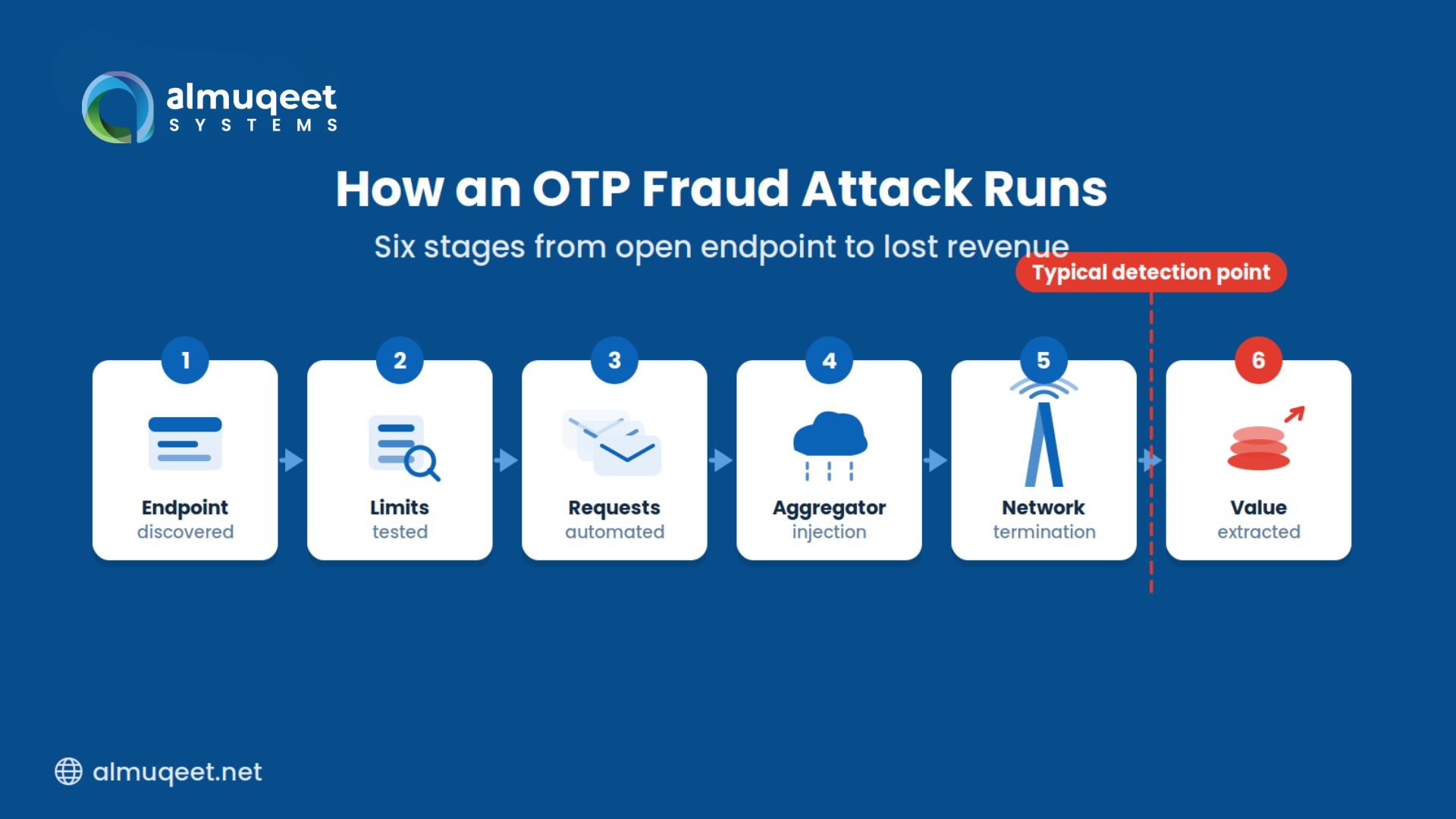
First, the attacker finds a target application with a verification endpoint that will accept unauthenticated requests. This takes minutes. Signup forms are public by definition.
Second, they test the limits. How many requests before something blocks? Does the resend endpoint throttle separately from the initial send? Does the form validate that the number is real, or will it send to anything shaped like a phone number? Most applications fail at least one of these.
Third, automation goes to work. Scripts generate requests at volume, either spread across many destination numbers on ranges the attacker profits from, or concentrated on a single number if the goal is disruption.
Fourth, the traffic enters the operator network through an aggregator, sometimes several, and terminates normally. Nothing in the message flags as abusive.
Fifth, value transfers. Termination revenue to whoever controls the range, or a successful harassment campaign, or a real security alert successfully buried.
Sixth, the cost lands. The enterprise pays for messages that produced nothing. The operator carries load and complaints. Detection typically happens weeks later, during invoice review, which is far too late to do anything except argue about who absorbs it.
What OTP Fraud Costs
Revenue leakage is the headline. Grey-routed verification traffic terminating without commercial billing, at scale, over years.
Then messaging costs on the enterprise side. SMS pumping campaigns have produced individual monthly invoices in the hundreds of thousands of dollars for companies that never made a sale from any of it.
Artificial traffic spikes create capacity problems that look like growth and get budgeted for as growth. Operators have upgraded platform capacity to carry traffic that was pure fraud.
Delivery quality suffers next. Congestion and aggressive filtering both push legitimate OTPs into delay or failure, and when a customer cannot log into their bank, the complaint goes to the bank, the bank escalates to the aggregator, and the aggregator escalates to the operator. The causes worth ruling out first are set out in why A2P SMS delivery rates drop.
Brand damage runs on a longer timescale and is harder to quantify. Every successful smishing campaign that impersonates a bank reduces trust in the SMS channel generally, and once enterprises decide the channel is unreliable, they start moving verification traffic to app-based alternatives. That is a permanent revenue loss disguised as a security problem.
Compliance exposure closes the list. Data protection regimes and telecom regulators both take an interest in networks that carry high volumes of fraudulent messaging, and "we did not have visibility" has stopped working as an answer.
Warning Signs Worth Monitoring
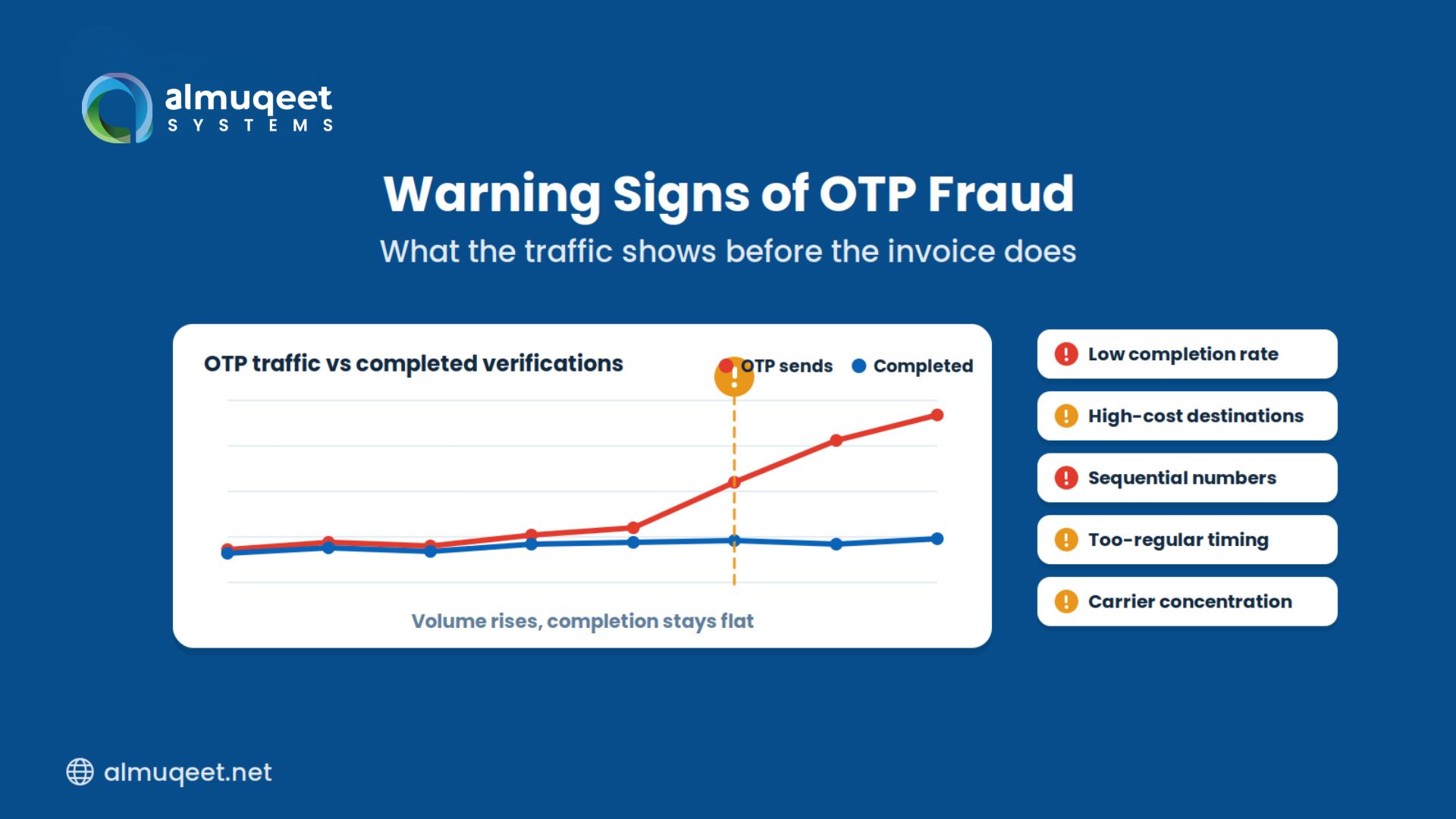
None of these prove fraud on their own. Several together, and you have something. A sudden spike in OTP traffic with no matching spike in completed verifications. This is the strongest single indicator of SMS pumping, and it is available to any enterprise willing to instrument the funnel.
Verification completion rate dropping below normal for a specific destination or range. Real users complete. Bots do not.
Repeated requests from the same source IP, device fingerprint, or session, especially against resend endpoints.
Concentration in high-cost destinations that have no relationship with your customer base. If a domestic retail app suddenly sends 30 percent of its verification traffic to three expensive international ranges, that is not international expansion.
Sequential or clustered destination numbers. Real user bases do not distribute that way.
Geographic anomalies, meaning traffic to markets where the enterprise has no presence, or requests originating from regions inconsistent with the destination numbers.
Carrier concentration inside a market, where an unusual share of traffic lands on one small operator.
Timing patterns that are too regular. Human traffic has daily rhythm and weekend dips. Automated traffic often does not bother.
Operator checklist: pull last month's verification traffic and calculate send-to-completion ratio per destination country, per aggregator, and per enterprise. Three numbers. Most pumping campaigns are visible in that table before any specialised tooling is involved.
How Operators Detect OTP Fraud
Detection is a stack, not a product. Each layer catches something the others miss.
Traffic analysis is the baseline: volume, direction, destination distribution, and time-of-day profile per sender and per route. Without a normal to compare against, nothing else works, which is why the first job on any new deployment is establishing baselines rather than writing rules.
Behavioural analytics looks at what happens after delivery. Completion rates, retry behaviour, and the relationship between messages sent and outcomes achieved. This is where pumping becomes obvious.
Velocity detection counts events inside a rolling window: per source, per destination, per route, per enterprise. The per-destination counter is the one that catches bombing, and it is the one most commonly left unconfigured.
Pattern recognition covers repeated structures across bursts, such as identical timing intervals, shared content templates, or number ranges that recur across supposedly unrelated senders.
Destination risk scoring assigns cost and fraud history to number ranges, so that traffic toward known problem ranges triggers scrutiny automatically rather than waiting for a human to notice.
Number reputation and validation checks whether the destination is real and reachable before money is spent on it. An HLR lookup confirms the subscriber exists and is active, and MNP lookup resolves which network actually holds the number now. Both remove a meaningful slice of fraudulent and junk traffic before it becomes billable, and both improve routing accuracy as a side effect. Almuqeet's HLR and MNP services and phone number intelligence cover the implementation options.
Machine learning models earn their place on the patterns nobody wrote a rule for, particularly slow campaigns that stay under every static threshold. They also produce false positives with great confidence, so treat model output as a queue for review rather than an automatic block action, at least until it has been running against known traffic for a few months.
Real-time monitoring and fraud intelligence sharing close the gap. Ranges and sender IDs that are burned on one network reappear on the next one within days, and operators who exchange that information catch campaigns earlier than those who do not.
How SMS Firewalls Stop OTP Fraud
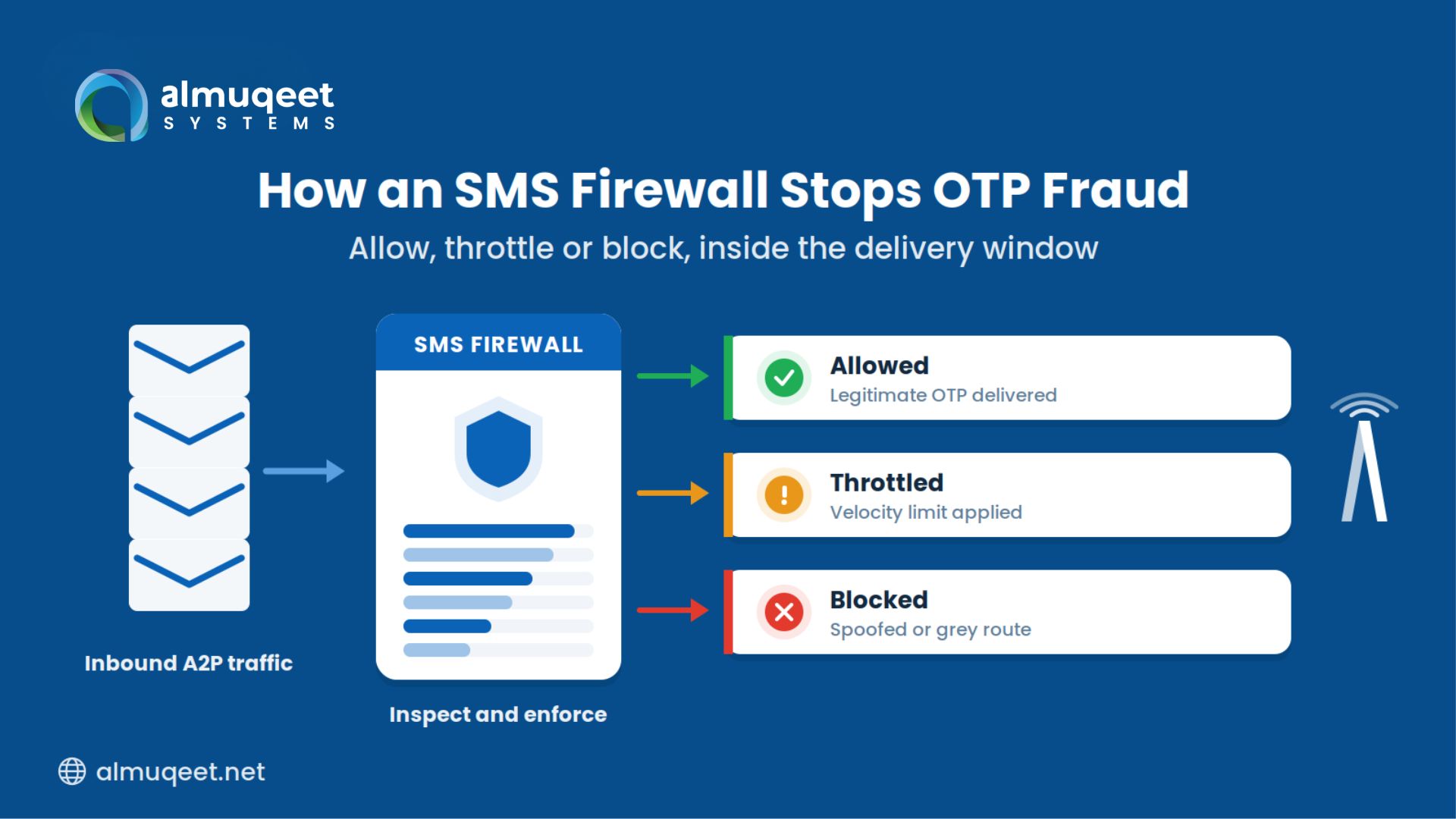
This is the core of it. An SMS firewall inspects messaging traffic before it terminates on your subscribers and enforces policy on what it finds. The full architecture is covered in the SMS firewall ultimate guide; what follows is what each capability does against OTP fraud specifically.
Traffic filtering: applies the base rules: which sources are allowed, which routes are authorised, which destination ranges are permitted, and what happens to everything else. Unglamorous and responsible for most of the value.
Sender ID validation: checks the alphanumeric header against a registered whitelist and rejects anything unregistered or impersonating a protected identity. This is the primary control against spoofing, and its effectiveness depends entirely on whitelist hygiene rather than on the platform.
Grey route detection: identifies A2P traffic arriving over paths that were never priced for it, using origin analysis, signaling characteristics, and content profiling. This is where recovered revenue usually comes from, and it connects directly to A2P revenue protection as a commercial programme rather than a technical one.
Content inspection: screens message bodies for phishing indicators, suspicious URLs, and known scam templates. Effective against smishing at scale, and the fastest way to break legitimate banking traffic if tuned carelessly.
The fraud rules engine: is where operator-specific policy lives. Rules combine sender, destination, content, volume, and time. The engine matters less than the discipline of reviewing what is in it, because exception rules added for one enterprise complaint have a habit of outliving the enterprise.
AI-based threat detection: handles the anomalies that static rules miss, scoring traffic against learned baselines rather than fixed thresholds.
Rate limiting and velocity controls: deserve to be treated as two separate things, because conflating them is the most common configuration failure in the field. Rate limiting caps throughput per sender or per bind, which protects the platform and enforces commercial agreements. Velocity control counts events per destination MSISDN across every bind together, which is the only thing that catches an SMS bomber attack. A flood assembled from forty different senders keeps every one of them under their individual limit while the subscriber receives four hundred messages. If your platform cannot count in aggregate at the destination, it cannot stop OTP bombing, and no amount of sender-side tuning will change that.
Policy enforcement and real-time blocking: turn detection into action inside the delivery window, with graded responses rather than a binary allow or drop. Quarantining surplus traffic while letting the first legitimate message through matters during a flood, because a real code the subscriber requested is often sitting inside the burst.
Routing intelligence: feeds enforcement decisions back into path selection, so that traffic gets steered onto authorised routes rather than simply rejected. The mechanics are covered in A2P SMS routing explained.
Analytics and reporting: make the whole thing defensible. Blocked volume by category, revenue recovered, top offending sources, and trend lines that survive a conversation with finance.
Compliance support: provides the audit trail and the enforcement evidence regulators increasingly expect, along with the reporting most sender ID registration schemes require.
If you are at the evaluation stage rather than the tuning stage, the SMS firewall buyer's guide covers the questions worth asking, and Almuqeet's SMS firewall documentation covers deployment models. Terminology that comes up during vendor conversations is collected in the SMS firewall glossary.
Building a Layered Defence
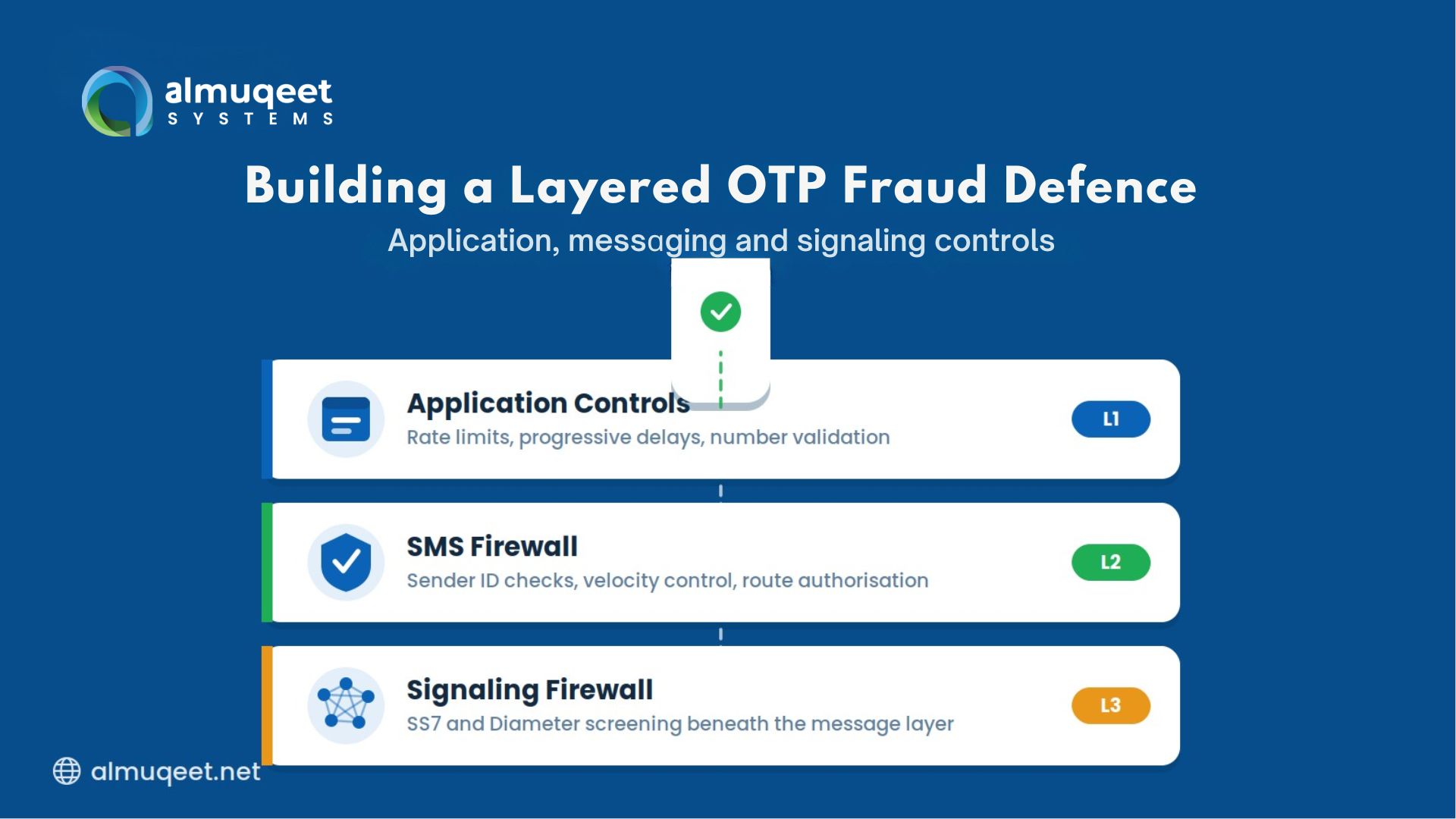
A firewall on its own protects the network. It does not protect the application, and most OTP fraud starts at the application.
Challenge mechanisms belong on the resend action rather than the initial submission. Most teams do the reverse, which irritates real users and leaves the loop that actually gets abused wide open.
Progressive delays on repeat requests stop automated bombing without a single block. Immediate for the first code, thirty seconds for the second, two minutes for the third, and so on upward. A real person who mistyped their number once will never notice. A script cannot function.
Device fingerprinting and IP reputation catch distributed abuse that per-account limits miss, though attackers rotate infrastructure cheaply, so treat these as signals rather than gates.
Number validation before send, using HLR lookup and MNP lookup via API, removes unreachable and invalid destinations from the spend entirely. For operators exposing network capability directly to enterprises, number verification can confirm possession without sending a message at all, which sidesteps the attack surface rather than defending it.
Geo restrictions on destinations that make no commercial sense for a given enterprise are among the highest-value, lowest-effort controls available. Most pumping campaigns die instantly against a destination whitelist.
API security means treating the verification endpoint as a payment endpoint, since financially that is what it is. Authentication where possible, request signing, per-key quotas, and monitoring.
Risk scoring pulls the signals together so that a request scoring high triggers a challenge instead of a message, rather than every control operating in isolation.
Alternative verification methods reduce dependence on the channel altogether. Flash call verification and RCS business messaging both remove the plain text code from the loop, each with tradeoffs worth understanding before committing.
Continuous monitoring is what makes the rest of it real. Controls decay. Traffic changes. A rule set that was correct in January is describing a network that no longer exists by August.
Best Practices for Operators
Deploy carrier-grade filtering rather than a bolt-on, and make sure it sits in the terminating path for all external traffic, including anything arriving over legacy interconnects that nobody has looked at recently.
Baseline OTP traffic per enterprise and per route before writing detection rules. Detection without a baseline generates noise, and noise trains people to ignore alerts.
Track send-to-completion ratios as a standing metric. It is the earliest available indicator of pumping, and it costs nothing to compute.
Audit routing partners on a schedule. Grey route injection almost always enters through a partner relationship that made sense when it was signed, and the telecom fraud management guide covers how to structure that review.
Maintain sender ID whitelists with named ownership per entry. Any entry with no owner recorded is a gap.
Review exception rules quarterly. Delete anything whose original justification cannot be reconstructed.
Configure destination-side velocity limits explicitly. This is the control most commonly assumed to be on and most commonly found switched off during an incident review.
Protect the signaling layer in parallel. Signaling firewall features cover what belongs at that layer, and how signaling firewalls stop SS7 spoofing covers the attack class it addresses.
Instrument for evidence, not just for blocking. When an enterprise disputes an invoice or a regulator asks a question, reconstructing what happened matters more than having blocked it.
What SMS Firewall Protection Delivers
Problem | Firewall capability | Practical outcome |
SMS pumping and AIT | Traffic analysis, destination risk scoring, geo restriction | Fraudulent volume identified before invoicing |
SMS and OTP bombing | Per-destination velocity control with quarantine | Floods contained while genuine codes still deliver |
Grey route abuse | Origin analysis and route authorisation | Traffic forced onto commercial agreements |
Sender ID spoofing | Registered sender validation | Impersonation of banks and brands blocked |
Smishing | Content and URL inspection | Phishing campaigns filtered at scale |
Revenue leakage | Billing reconciliation and analytics | Unbilled termination made visible |
Regulatory exposure | Audit logging and enforcement reporting | Evidence available when asked for |
Delivery quality complaints | Traffic profiling per enterprise | Root cause separable from network fault |
Where This Goes Next
Adaptive policy is the logical next step, where thresholds adjust to observed conditions rather than sitting where an engineer left them in 2023. This is genuinely useful and also genuinely risky, since a system that tunes itself can normalise an attack if the attack ramps slowly enough.
Signaling security keeps rising in importance as networks add interfaces. Each generation brought new protocols without fully retiring the old ones, and the impact of 5G on messaging covers what changes and what stubbornly does not.
RCS introduces verified sender identity, which fixes spoofing properly rather than patching it, and simultaneously creates a richer channel for anyone who works out how to abuse it. Both things will be true.
Intelligence sharing between operators is probably the highest-leverage change available and the slowest to arrive, for commercial reasons rather than technical ones.
What will not change is the underlying asymmetry. Attackers need one unguarded endpoint. Operators need all of them covered, on a network that grows and changes weekly. That is the job.
Frequently Asked Questions
What is OTP fraud?
OTP fraud is the abuse of one-time password workflows for financial gain, harassment, or account compromise. It includes SMS pumping, OTP bombing, smishing, and sender ID spoofing, and it targets the messaging pipeline as often as it targets individual accounts.
How does an SMS firewall work?
An SMS firewall sits in front of the SMSC and inspects messaging traffic before it terminates on subscribers. It applies rules based on sender identity, source route, content, destination, and volume, then allows, throttles, quarantines, or blocks each message accordingly.
What is SMS pumping?
SMS pumping is an attack where fraudsters trigger large volumes of verification messages to number ranges they profit from, earning a share of the termination fee. The enterprise pays for every message and receives no genuine signups.
What is SMS bombing?
SMS bombing is an attack that floods a single phone number with hundreds of messages in a short period, usually verification codes triggered by an SMS bomber tool submitting the number to many websites at once.
Is SMS bombing the same as SMS pumping?
No. SMS pumping targets an enterprise's messaging budget by sending to many numbers the attacker profits from. SMS bombing targets one individual by flooding their number. The traffic shapes are opposites, and the detection logic differs.
How do telecom operators detect OTP fraud?
Through traffic baselining, velocity counting per source and per destination, completion rate analysis, destination risk scoring, number validation, and anomaly detection models running against normal traffic profiles.
Can an SMS firewall stop smishing?
It can filter a significant share of it through content and URL inspection, but not all. Attackers test against live filters and adapt quickly, so content rules need continuous updating rather than one-time configuration.
What is sender ID spoofing?
Sender ID spoofing is the use of a false alphanumeric sender name, often impersonating a bank or government body, to make a fraudulent message appear legitimate. Registered sender ID enforcement is the main defence.
Why are OTP systems targeted so often?
Because verification endpoints accept unauthenticated requests from anyone, every request costs somebody money, and the resulting traffic is repetitive enough that fraudulent volume blends into normal volume.
Closing
OTP fraud stopped being a spam problem a long time ago. What operators deal with now is a set of economically motivated attacks that exploit the parts of the messaging stack built on the assumption that requests are made in good faith: open verification endpoints, unauthenticated resends, sender IDs that are just text, and interconnects that predate commercial A2P entirely.
No single control covers that. Application-side limits stop what reaches the network. An SMS firewall stops what reaches the subscriber. Signaling protection covers the layer beneath both. Take any one of the three away, and the other two are working around a hole.
Almuqeet builds and operates messaging security infrastructure for operators and enterprises, covering SMS firewall deployment, signaling protection, HLR and MNP services, and managed operations for teams who would rather not staff a 24-hour fraud desk themselves. If you want to know what your current filtering is missing, the fastest place to start is a traffic review against your own logs. Most networks find something in the first week.
Share this post