

SS7 security is how a mobile operator stops its own signaling network from being turned against its subscribers. The threats are location tracking, SMS and OTP interception, subscriber data leaks, and routing fraud. The defences are signaling firewalls, Global Title and MAP filtering, roaming-context validation, and monitoring that somebody actually watches.
None of this is a secret inside the industry. SS7 dates from the era of state telephone monopolies, it trusts more or less whoever talks to it, and it is still sitting under live production traffic in 2026. What divides network teams is not whether the risk exists. It is what you are meant to do about a protocol you can neither rip out nor fully trust.
What Is SS7 Security?
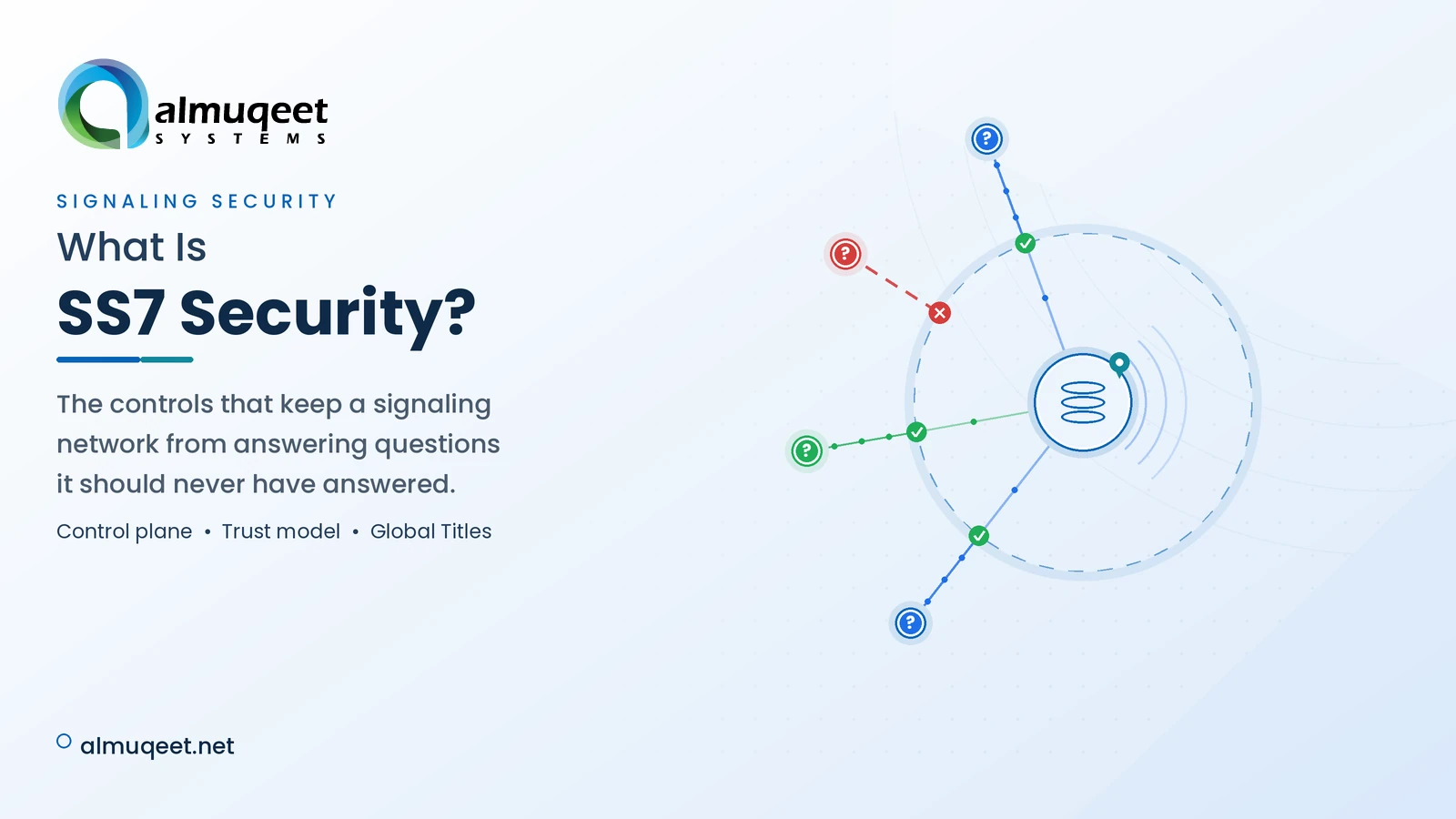
SS7 security is the set of controls that keep a signaling network from answering questions it should never have answered in the first place.
Signaling System No. 7 is the control plane of mobile telephony. It sets up calls, routes SMS, registers roamers, and handles the network's internal housekeeping, including the queries that ask where a subscriber is and what they are allowed to do. It was designed across the 1970s and 1980s for a small, closed group of national carriers who had every reason to trust each other and almost no way to reach each other uninvited.
That design decision is the root of everything that follows. SS7 barely authenticates the peer sending a message. Ask the network a well-formed question, and it tends to give you a well-formed answer, no questions asked back. For thirty-odd years that was acceptable, because being on the network meant being a licensed operator with a physical presence and a reputation to protect. None of that is reliable anymore. Interconnect reach gets leased, resold, borrowed, and occasionally stolen, and the barrier that used to come from physical access has mostly dissolved.
Why SS7 Security Still Matters
Because the traffic never went anywhere. Operators sell 4G and 5G. Underneath, 2G and 3G signaling is still carrying voice fallback, roaming with partners who never modernised, machine-to-machine fleets that will outlive us all, and a long tail of handsets that refuse to die. SS7 lives at the seams between the old and the new, and the seams are exactly where things go wrong.
There is a comfortable assumption that pushing subscribers onto 5G makes the SS7 problem somebody else's. It does not. A subscriber sitting happily on 5G can still be reached through SS7 if their home network, or any network they happen to roam onto, keeps an SS7 interface open. And they all do. The exposure tracks the signaling, not the radio the phone is holding onto this minute.
A modern carrier is usually running several signaling worlds in parallel: classic SS7, SIGTRAN carrying that same SS7 over IP, Diameter for LTE, GTP for tunnelling and roaming, and the HTTP-based service interfaces of the 5G core. Five environments, give or take, each with its own soft spots. The nastiest gaps are not inside any one of them. They are at the translation points, where a request can walk in through a protocol you spent a year hardening and walk out toward a subscriber through one you forgot about. The messaging side of this same mess is something we get into in how 5G reshapes the messaging layer.
How SS7 Works and Where the SS7 Security Problem Begins
You can reason about SS7 security without memorising the whole stack. You just need to know which layer does what, because that is where the firewall rules end up living.
MTP, SCCP, TCAP, MAP and CAP
Picture it as a delivery chain. MTP moves the signaling units between nodes, the plumbing. SCCP sits on top and adds global addressing through Global Titles, which is how a message aimed at a network element on the other side of the planet actually finds it. TCAP carries the back-and-forth dialogues, the request and its answer.
Above all that are the application layers, and this is where the trouble concentrates. MAP, the Mobile Application Part, runs the mobility operations: location updates, routing-information requests, authentication retrieval, and the subscriber queries that attackers build entire businesses around. CAP handles the intelligent-network and prepaid-style logic.
Here is the part worth holding onto. Nearly every SS7 attack that has ever been written up is a MAP operation sent by somebody with no legitimate reason to send it. That one fact reframes the whole defence. If you can control which MAP operations are accepted, from which Global Titles, and aimed at which subscribers, you have dealt with most of the attack surface without touching the lower layers at all. If any of these acronyms are new, our telecom glossary has them defined in plain language.
SS7 Over SIGTRAN and the Access Problem
SIGTRAN is SS7 poured into IP packets. As engineering, it made sense. As security, it quietly changed the game, because when SS7 ran over dedicated TDM circuits, getting access meant getting physical, and physical is hard. Once the same messages ride over IP, reaching a signaling endpoint looks a lot like any other network-access problem, and those are not hard anymore.
So drop the mental image of SS7 attacks as some rarefied, nation-state-only art. Some of it is. Plenty of it is a leased connection and a bored operator somewhere in the chain who does not ask what the traffic is for. Plan your controls for a world where hostile parties can already reach your signaling edge, because assuming the perimeter holds has not been a winning bet for a while.
The Main SS7 Security Threats Operators Face
Vendor decks tend to blur these together. Keep them apart, because the way you catch one is not the way you catch the next, and a control tuned for location tracking will happily pass an interception attempt
Subscriber Location Tracking
This is the one that makes the newspapers. Using the routing and subscriber-information requests in the MAP family, a party with SS7 reach can pin a subscriber down to the serving cell. In a city that is a few hundred metres, sometimes better. No malware. No tap on the line. No tap the victim could ever notice. Just a question, correctly phrased, and a network polite enough to answer it.
SMS and OTP Interception
Mess with where the network believes a subscriber is registered, and you can pull their messages, one-time passwords included, onto equipment you control. That is the machinery behind the SS7 banking fraud that keeps coming back around. The code is real, generated by the real bank, delivered to the wrong hands. SMS as a second factor should have been retired years ago, and plenty of security people will say so once there is no vendor in the room. As for where this sits in the wider fraud picture, we cover telecom fraud management separately.
Subscriber Information Disclosure
Location is not the only thing leaking. SS7 queries can hand over IMSI, the current serving network, slices of the subscriber profile, enough to assemble a dossier on someone. A lot of the time, this is not the attack. It is the reconnaissance before the attack, the part that happens weeks earlier and that nobody flags because, individually, each query looks routine.
Call and Routing Manipulation
Signaling runs call setup, so tampering with signaling buys you call interception, redirection, and in some setups, a man-in-the-middle seat between two people who both believe they are talking directly to each other.
Fraud, Reconnaissance, and Service Disruption
Then there is the grab-bag. Billing and roaming fraud. The profiling above. And plain disruption, because malformed or high-volume signaling can degrade a network and, under the right conditions, take an element down. Not every SS7 attack is quiet and surgical. Some of them just want to break something.
How SS7 Location Tracking Actually Works
Enough to defend against, not enough to hand anyone a recipe.
A party with signaling reach sends a routing-information request toward the target's home network, essentially asking where to deliver something for this number. A network that trusts the question answers with the subscriber's identity and serving node. A follow-up subscriber-information query can then bring back cell-level location.
What makes this miserable to catch is that each message, on its own, is fine. Correct format. Legitimate operation, the kind roaming depends on every second. The tell is never in the message. It is in the context around it: the request comes from a Global Title that has no roaming relationship with the target, or it lands at a rate no human being moving through the world could generate, or it targets subscribers who are sitting at home on their own network with zero reason to produce a foreign routing query. A control that reads context sees it. A filter that only checks whether the message is well-formed waves every single one of them through, and plenty of deployed boxes do exactly that.
SS7 Security Attack and Defense Matrix
SS7 risk | What is exposed | Typical warning signal | Operator security control |
|---|---|---|---|
Location tracking | Serving cell, movement over time | Routing/subscriber-info queries from GTs with no roaming tie | GT validation, roaming-context checks, velocity limits |
SMS and OTP interception | Message content, 2FA codes | Odd location-update or routing changes just before delivery | MAP filtering, subscriber-state validation, category controls |
Subscriber info disclosure | IMSI, serving network, profile data | Repeated info requests across a block of subscribers | Category rules, rate limiting, anomaly scoring |
Signaling reconnaissance | Topology, who is present where | Low, patient probing across many numbers | Behavioural analysis, threat-intel correlation |
Call manipulation | Call routing and content | Abnormal call-setup signaling from unexpected sources | Source validation, edge policy enforcement |
Denial-of-service activity | Element availability, service quality | Signaling spikes, malformed messages | Rate/velocity controls, malformed-message rejection |
Real-World SS7 Security Incidents Worth Learning From
These are publicly documented cases rather than anything proprietary, and the dates are approximate. The value is less in any single incident than in how similar the three turn out to be once you line them up.
The researcher Karsten Nohl is the name most people reach for first, because his public demonstrations showed a phone being located and its messages intercepted using little more than the number and SS7 access. The weakness was not clever. It was the network answering a location query without ever checking who was asking. The lesson operators took, slowly, is that filtering on message format catches nothing here, because the malicious request was textbook-correct.
Then there is the German banking fraud reported around 2017, where criminals used SS7 to intercept SMS one-time passwords and empty accounts, after phishing the login credentials first. What turned a contained credential theft into completed theft was the signaling layer. The uncomfortable takeaway is that two separately survivable weaknesses, phishable credentials and an SS7 reroute, combined into something neither the bank nor the operator could shrug off.
And there is the cross-border tracking that surfaced in journalism around 2020, where a state actor allegedly ran location queries through foreign networks to follow people abroad. The exploited trust was roaming trust, the assumption that signaling from a partner network is signaling in good faith. It is not necessarily so, and inbound traffic from roaming partners deserves the same suspicion as anything else arriving at your edge.
Notice what all three share. Nothing was malformed. The abuse was entirely in who was asking and why. That is the whole reason a context-blind filter does not cut it.
How Telecom Operators Detect SS7 Attacks
Prevention gets the budget and the slides. Detection is where operators quietly separate themselves, because a static rule only ever blocks the attack you already thought of. Everything new gets through until a human notices, and the slow campaigns are designed so no human does.
So detection has to be continuous, and it has to watch for things like signaling that drifts from your own baseline of normal MAP traffic, roaming queries for subscribers who are plainly sitting at home, Global Titles showing up as sources when there is no agreement behind them, the same number queried over and over, or a quiet sweep across a whole range. Velocity that no legitimate signaling produces. Location updates that put one subscriber in two far-apart networks inside a few minutes, which is either an attack or a subscriber who has learned to teleport. A MAP operation a given partner has simply never sent before.
Any one of these on its own proves nothing. Stacked together, correlated against threat intelligence and your own history, they become a case worth chasing. Which is the real argument for piping signaling logs into a SIEM or SOC instead of leaving them to rot in a silo, and for having a round-the-clock NOC and monitoring function, since the patient reconnaissance attacks lean entirely on nobody being awake to see them accumulate.
How Signaling Firewalls Strengthen SS7 Security
A signaling firewall sits at the edge and decides what gets in. Whether it is worth anything comes down to one question: does it judge messages by format, or by context? If you are starting from zero, it is worth reading what a signaling firewall actually is and the fuller list of signaling firewall capabilities before you shop.
Global Title Validation
The box checks source and destination Global Titles against who should legitimately be talking to your network. A location query from a GT with no roaming relationship to the target subscriber is a loud signal, and honestly, GT validation is usually the single rule set that earns its keep fastest.
MAP and CAP Filtering
Not every MAP operation should be accepted from every source, and a firewall that understands the application layer can say so. It lets a given interconnect send the operations it genuinely needs and refuses the sensitive ones, subscriber-info requests chief among them, from parties that have no business issuing them. This is the control aimed squarely at tracking and data leaks.
Roaming Context Validation
Here the firewall asks whether the message even makes sense given where the subscriber really is. A routing request for someone who never left their home network, arriving from a network they are not roaming on, fails the check despite being perfectly formed. Form was never the point.
Behavioural and Velocity Analysis
Rate and velocity controls count events over a rolling window, per source, per destination, per subscriber. That is what catches the sweeps and floods built from individually innocent messages. Behavioural scoring sits on top and flags patterns that wander off the baseline before any hard limit trips.
Cross-Protocol Correlation
Attackers probe across SS7, Diameter, and GTP looking for the thinnest wall, so a firewall that correlates across protocols catches campaigns a single-protocol view never sees. Spoofing is the obvious case, and we walk through it in how signaling firewalls stop SS7 spoofing.
The whole distinction, the one that matters more than any feature checkbox, is context versus filtering. Dropping garbage messages is the easy part. Judging a clean, legal message by who sent it, to whom, in what state, and how fast, is the actual work.
GSMA SS7 Security Guidelines Operators Should Know
You do not have to design your SS7 security policy from a blank page, and auditors increasingly expect to see you did not.
FS.07 covers SS7 and signaling interconnect security, the practical side of monitoring and filtering. FS.11 is the one people mean when they say "GSMA filtering," because it sorts SS7 MAP messages into risk categories and says what to do with each. IR.82 handles SS7 security in the roaming context. On the newer planes, FS.19 addresses Diameter and FS.20 addresses GTP, and they belong in the conversation because your SS7 defence does not live apart from your 4G and roaming traffic.
The FS.11 category idea is worth carrying in your head even if you never see the document. Messages get grouped by risk. Category 1 messages have no business ever arriving from an interconnect, because they only make sense inside a home network, so you block them at the border and move on. Category 2 messages are valid only from a subscriber's current roaming partner, so they get checked against roaming context. Category 3 messages can legitimately come from several places but still need validating against subscriber state and plain plausibility. Mapping your firewall rules onto those three buckets gives you a defensible starting point and, not nothing, something concrete to put in front of an auditor that is not just "we bought a firewall."
I am not going to pretend to reproduce restricted GSMA material here. Knowing the documents exist, roughly what each one owns, and building toward them is most of the value.
Why an SS7 Firewall Alone Is Not Enough
This is the section the vendor would rather skip, so here it is. A signaling firewall left on its defaults protects almost nothing. It sits there generating logs and an invoice while traffic it was never tuned to understand flows past it.
The protection comes from running it as a living thing. Deploy, configure, monitor, test, tune, update, and round again. Skip configure and the generic rule set either strangles legitimate signaling or passes the hostile kind, often both. Skip monitor and a firewall that blocks in silence tells you nothing about what slipped by. Skip test and you are trusting that the box behaves the way the datasheet promised, which is a lovely assumption to hold right up until an incident review disproves it. Unusually structured signaling has a way of finding the gaps in a control that was configured once and never revisited. Skip tune and your rules keep describing a network that stopped existing two roaming renegotiations ago, while your false positives pile up until the alert stream is something people reflexively close. Skip update and the thing ages out from under you as the techniques move on.
And none of it means much without cross-protocol visibility. Defend SS7 flawlessly while Diameter or GTP stands open, and you have not closed the door, you have moved it. If you are weighing where the messaging-layer controls end and the signaling ones begin, we lay that out in SMS firewall versus SS7 firewall.
SS7 vs Diameter vs 5G Security: Why Legacy Risk Persists
There is a tidy story where every network generation fixed the last one's signaling sins. It is not true, but the mapping is at least simple. 2G and 3G ride SS7. 4G and LTE ride Diameter. 5G runs a service-based architecture over HTTP/2 and REST.
Diameter and the 5G core genuinely support stronger protections than SS7 was ever built to offer, encryption and real authentication among them. Two things keep the old risk alive anyway. One, Diameter is not safe just by being younger. Misconfigured Diameter interconnects have a documented problem of their own, which is the entire reason FS.19 had to be written. Two, and this is the one that actually bites, the generations talk to each other. A 5G subscriber still depends on interworking functions that translate down to older signaling, and an attacker who cannot get at them over 5G will cheerfully route the request through whichever generation checks the least.
So for 2026 the honest posture is multi-generation. Protect SS7, protect Diameter, protect GTP, and watch the interworking points between them like they are the weakest link, because most weeks they are.
Technologies in a Modern SS7 Security Stack
No single product covers this, whatever the sales engineer implies. You want layers that each catch what the others miss.
A signaling firewall at the edge for GT validation, category filtering, and policy enforcement. The adjacent messaging controls are in our SMS firewall architecture guide, and Almuqeet's own aWALL signaling firewall lives in this layer. Signaling monitoring and intrusion detection for patterns no static rule anticipated. SIEM and SOC integration so events get correlated and, more to the point, read by people. Telecom threat intelligence, so a Global Title or technique burned on one network can be blocked on yours before anyone tries it. Controlled security testing against your own controls, to find the holes before someone less friendly does. A fraud management system to tie signaling anomalies back to the money they move. And cross-protocol correlation across SS7, Diameter, and GTP for the campaigns that hop between generations.
For operators running their own core, this pairs more naturally with a hardened SS7 and SMSC platform than with security bolted onto infrastructure that never expected it.
SS7 Security Checklist for Mobile Operators
Short, and meant to be repeated, not filed away:
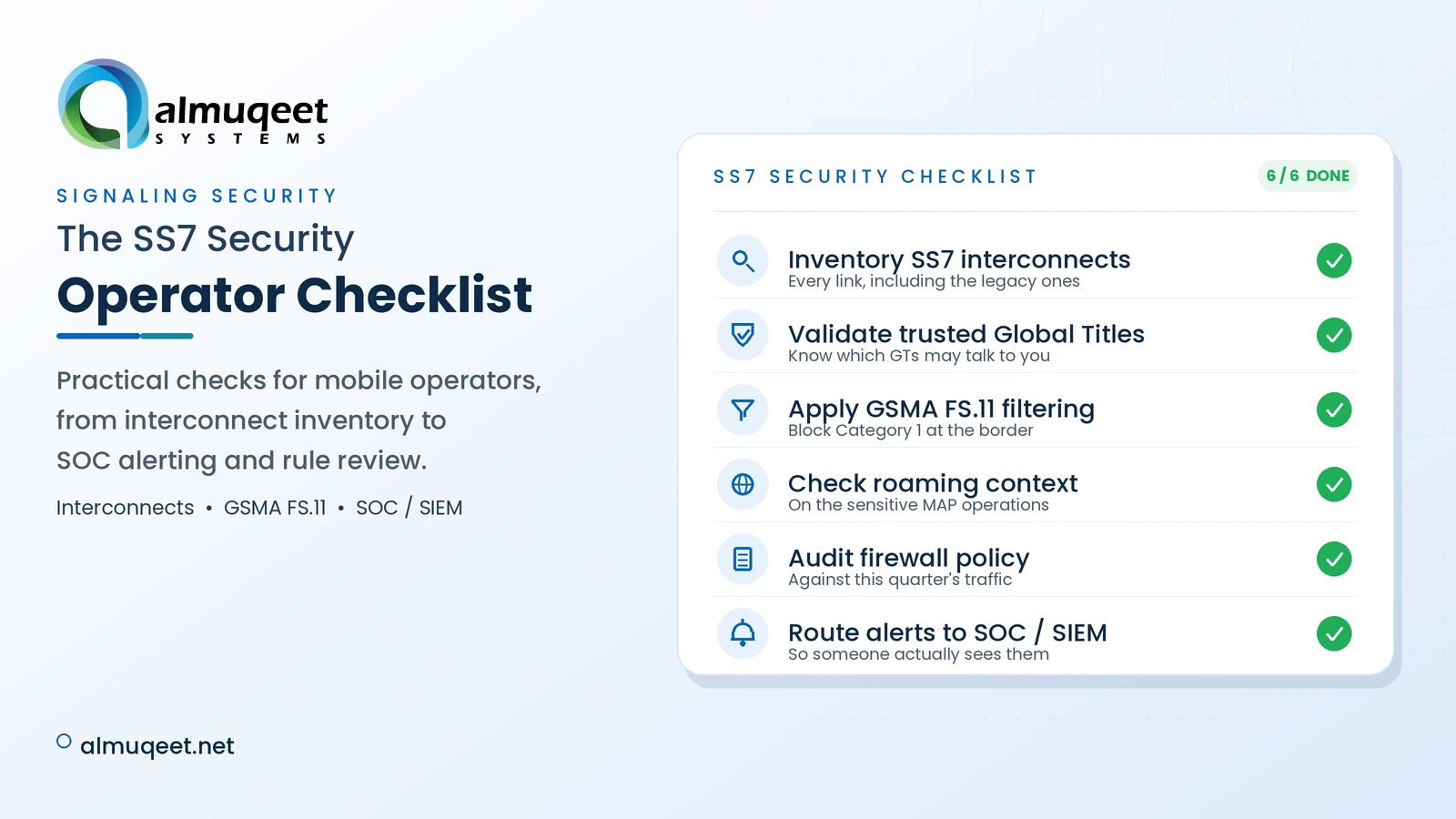
Inventory every SS7 interconnect, including the legacy links nobody has opened since they were commissioned
Write down which Global Titles you trust and why, so the next person can tell
Apply GSMA FS.11 category filtering: block Category 1 at the border, context-check 2 and 3
Watch for odd subscriber-information and routing queries
Validate roaming context on the sensitive MAP operations
Audit firewall policy against this quarter's traffic, not last year's
Actually test how the firewall behaves against structured and unexpected signaling
Keep eyes on the SS7 and Diameter interworking boundaries specifically
Route signaling alerts into the SOC or SIEM
Revisit the rules as threats and roaming relationships shift
If you can only manage three, make them the interconnect inventory, FS.11 filtering, and monitoring that someone reviews. Widest coverage for the least effort by a distance.
Final Word on SS7 Security
SS7 is not getting pulled out on any schedule that fits a budget cycle. It carries roaming, voice fallback, and the translation between generations, and it keeps doing so as long as legacy signaling is live anywhere in the chain, which is everywhere. So this is not a legacy footnote. It is a present-tense operational problem with a shape we understand well.
What holds up is layered and ongoing. A firewall tuned to your real traffic and mapped to the GSMA categories. Monitoring that reaches a person, not a log file. Visibility across SS7, Diameter, and GTP so nobody strolls in through the one protocol you overlooked. And the stubbornness to treat the whole thing as a program you keep running rather than a box you installed and forgot.
Almuqeet builds and runs signaling and messaging security for mobile operators, from firewall deployment to cross-protocol monitoring to managed operations for teams who would rather not stand up a signaling SOC on their own. If you are not sure what your current SS7 filtering is letting through, a review against your own signaling logs is the quickest way to find out. It usually turns up more than people expect.
Frequently Asked Questions About SS7 Security
What is SS7 security?
It is the protection of a signaling network against abuse of the SS7 protocol, covering location tracking, SMS and OTP interception, and subscriber data leaks. Operators do it with signaling firewalls, Global Title and category filtering, roaming checks, and monitoring.
Why is SS7 vulnerable?
It was built for a closed club of trusted carriers and cannot really authenticate who is sending a message. A correctly formatted request usually gets answered, so the abuse lives in who is asking, not in broken traffic.
Can SS7 still be attacked in 5G networks?
Yes. A 5G subscriber is still reachable through SS7 if their home or visited network keeps an SS7 interface open, and interworking functions can pass crafted requests between generations. 5G does not close the door by itself.
How do operators detect SS7 attacks?
By baselining normal signaling, counting query velocity per source and per subscriber, flagging unexpected roaming queries and unknown Global Titles, catching impossible movement, and correlating it all in a SIEM or SOC against threat intelligence.
What does an SS7 firewall do?
It inspects signaling at the edge and decides whether to allow, throttle, or block, based on source and destination Global Titles, the MAP or CAP operation, roaming context, subscriber state, and traffic rate, rather than only checking message format.
Is Diameter more secure than SS7?
It supports stronger mechanisms, but security is not automatic. Misconfigured Diameter carries real risk, which is why the GSMA publishes FS.19 for it. It needs its own defences.
Does 5G eliminate SS7 vulnerabilities?
No. While networks still run legacy signaling for roaming, fallback, and older devices, and while the generations interoperate, SS7 exposure stays and has to be defended head-on.
What GSMA standards apply to SS7 security?
FS.07 for signaling interconnect security, FS.11 for MAP categorisation and filtering, IR.82 for SS7 and roaming, with FS.19 and FS.20 covering Diameter and GTP.
Is SS7 location tracking still possible?
Wherever a network answers location and routing queries without checking the requester, yes. Context-aware filtering and roaming validation are the main things standing in the way.
Share this post