

The Complete SMS Firewall Glossary: Key Messaging Security Terms Explained
I still remember the call. 2:47 AM. A finance director from a Tier-2 operator, voice tight, asking me to "just look at something." Their wholesale margins had been shrinking for months. Volumes were up. Revenue was down. The math didn't math.
What we found over the next three weeks wasn't one big attack. It was a dozen small ones, hiding in the gaps between teams that didn't share the same vocabulary. The security guys had been calling it spoofing. The routing team called it faking. Product thought both were the same thing. Spoiler: they weren't. And that little semantic gap had cost them somewhere north of half a million dollars before anyone connected the dots.
So look, this isn't really a glossary. Glossaries are boring, and you can find one on any vendor's website. This is more like the cheat sheet I wish someone had handed me when I started debugging this stuff. The terms below are the ones that show up in real war rooms, real billing disputes, and real 3 AM Slack messages from a panicked NOC engineer who just noticed something weird in the SRI-SM logs.
Let me walk you through them the way I'd explain them to a new analyst sitting next to me, coffee getting cold, dashboard glowing.
The Firewalls and Why There's More Than One of Them
People throw around the word "firewall" like it means one thing. It doesn't. There are at least four different firewalls in this world, each protecting a different layer, and the confusion between them is exactly where attackers like to live.
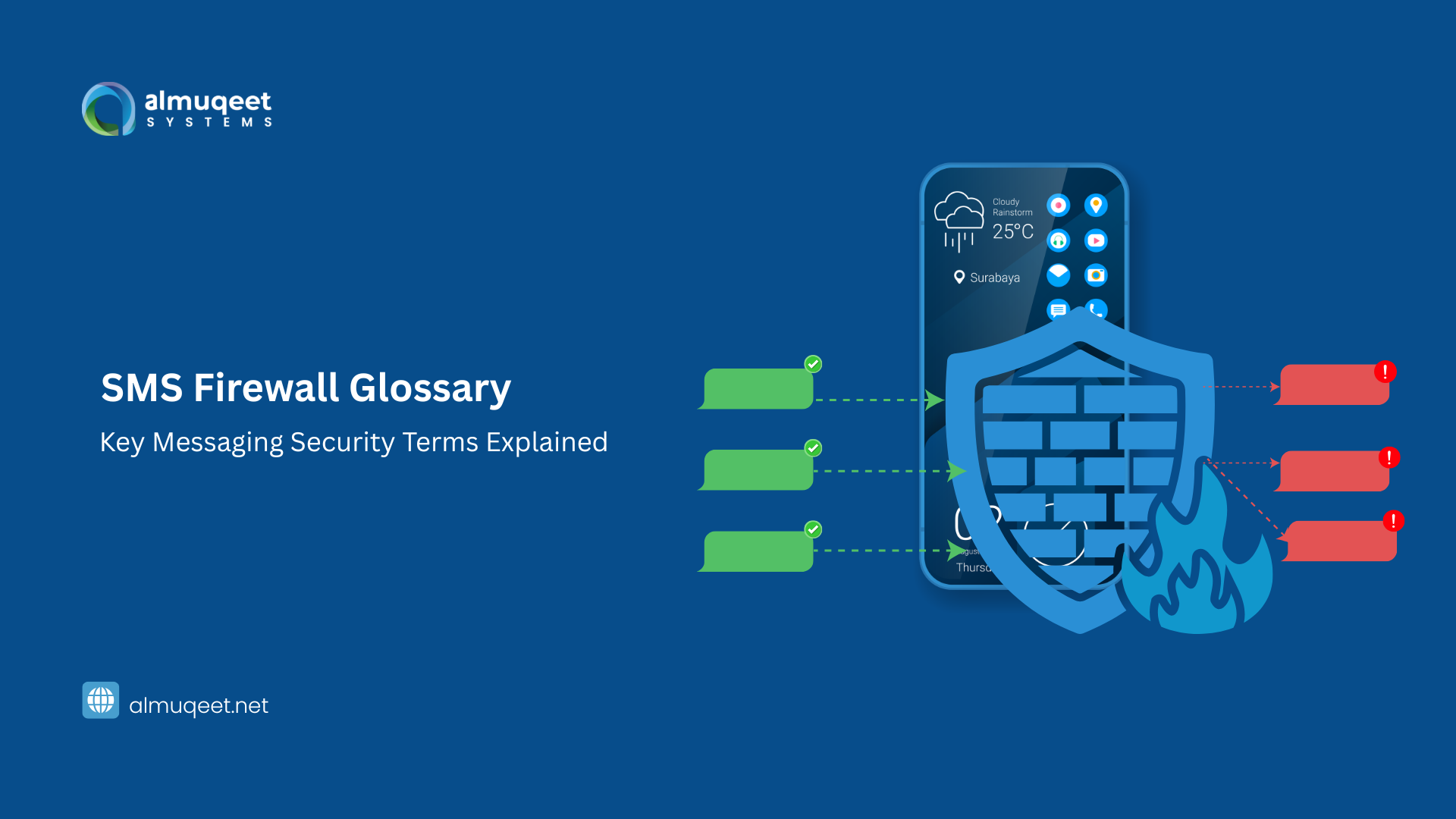
SMS Firewall: The one that most enterprises think they understand. It sits in the SMS delivery path, usually hugging the SMSC, and inspects every message going in and out. Catches grey routes. Blocks unauthorized A2P. Filters spam. Shuts down spoofed sender IDs before they hit a handset. When it's tuned right, it's the difference between actually monetizing enterprise traffic and just watching it slip through unbilled. When it's tuned wrong, it blocks legitimate bank OTPs, and you get a very angry call from the bank's CISO. Ask me how I know.
Signaling Firewall: This is the umbrella term. Any firewall protecting the control plane, the layer that tells the network what to do, falls in here. SS7, Diameter, and GTP firewalls are all signaling firewalls, just specialized for different protocols. Think of it as the genus. The others are species.
SS7 Firewall. Guards the old signaling layer that 2G and 3G still ride on. SS7 was designed in an era when the only people on the network were trusted carriers in suits, drinking coffee in Geneva at standards meetings. Nobody, and I mean nobody, imagined a world where some guy in a basement could buy GTT access for $300 and start querying subscriber locations. An SS7 firewall fixes what should've been there from day one: category-based filtering, velocity checks, cross-protocol correlation, and sanity rules about who's allowed to ask what.
Diameter Firewall. The 4G/LTE cousin. Diameter replaced a lot of SS7's functions when networks modernized, but honestly? The security story isn't much better out of the box. A Diameter firewall stops unauthorized location requests, prevents subscriber profile theft, and blocks authentication vector fraud. If you rolled out VoLTE without one, congratulations, you've recreated the SS7 problem on a shinier protocol.
GTP Firewall: GTP carries user-plane data and some control traffic, especially between roaming partners. A GTP firewall watches for malformed tunnels, IP spoofing inside the tunnels, overbilling attacks, the works. It's the firewall everyone forgets about until a roaming partner gets caught injecting traffic. Which happens more often than the industry likes to admit.
The Protocols Sitting Underneath
You can't really understand the firewalls without understanding what they're filtering, quick tour:
SS7 (Signaling System 7): The signaling backbone that's been carrying voice setup, SMS routing, and roaming since the 80s. Still carries a shocking amount of global messaging. Its core problem is its trust model SS7 assumes every node is a legitimate carrier. That assumption broke about twenty years ago, and we've been patching around it ever since.
Diameter Protocol: IP-based signaling used in 4G/LTE and IMS. More modern, more flexible, designed with at least some authentication baked in. But it inherits a lot of SS7's logical vulnerabilities, just wearing newer clothes.
SIGTRAN: The bridge between worlds. SIGTRAN is the family of protocols that lets SS7 messages ride over IP networks. It's why operators can run "modern" IP signaling that still speaks SS7 underneath. Also, why didn't SS7 attacks die when TDM did — the protocol just hopped onto IP and kept going.
Home Routing — The Thing Most Operators Get Wrong
If I had to pick one concept that separates operators who take messaging security seriously from those who don't, it's this one.
Home Routing: A configuration where signaling and SMS traffic for your subscribers always routes back through your network, even when they're roaming abroad. Without it, external networks can directly query your subscribers, intercept their messages, and send them spoofed SMS messages, and you'd never see any of it.
SMS Home Routing: Specifically for short messages. When done properly, every SMS sent to one of your subscribers passes through a controlled gateway you own. That gateway is where firewall policies, anti-spam filters, and fraud detection actually have a chance of working. Without SMS home routing, you're flying blind on inbound. I've seen operators turn this on for the first time and immediately discover they were getting hammered with international fraud they'd been totally unaware of for years.
SRI-SM (Send Routing Info for Short Message): A MAP query that asks the network where a subscriber is, so an SMS can be delivered to them. Sounds innocent. It isn't. SRI-SM is one of the most abused queries in SS7 fraudsters use it for location tracking, SIM detection, reconnaissance before targeted attacks. A well-tuned SS7 firewall obsesses over SRI-SM volume and origin. If you ever see SRI-SM queries spiking from countries where your subscribers don't roam, something is very wrong, and you should already be paging someone.
MAP (Mobile Application Part). The SS7 application layer that handles mobility, SMS routing, and subscriber data ops. Most of the famous SS7 attacks, location tracking, SMS interception, USSD injection happen at the MAP layer. When engineers say "MAP message," they mean the actual instruction flowing between network elements.
Spoofing, Faking, and the Identity Mess
This whole family of terms causes more confusion in technical vs business conversations than anything else I deal with. Everyone uses them interchangeably. They really shouldn't.
Sender ID Spoofing: Changing the displayed sender of an SMS to something it's not. Phishing message arrives looking like it's from your bank? That's sender ID spoofing. Technically trivial in most networks. Operationally brutal, because recipients have no way to verify that the sender is fake.
SMS Spoofing: The broader category is any manipulation of SMS origin information. Sender ID spoofing is one flavor. Others include faking the originating network, manipulating the SMSC address, and injecting messages with forged routing info.
SS7 Spoofing: Forging signaling messages at the SS7 layer itself. This is where attackers impersonate legitimate network elements pretending to be an MSC or SMSC from another operator to inject traffic, redirect messages, and pull subscriber data. Far more dangerous than simple sender ID spoofing because it happens underneath the application layer, where most enterprise security tools can't even see it. By the time it's visible, it's already done damage.
Faking: A word you'll hear thrown around in NOC chats, usually loosely. Generally refers to disguising the true origin of traffic country code, originating operator, and sender identity, to bypass billing or filtering. It's the catch-all verb for a bunch of more specific behaviors.
The Fraud Vocabulary — Where The Money Actually Bleeds
This is where finance teams start losing sleep.
Smishing: SMS phishing. Messages designed to trick people into clicking bad links, handing over credentials, and installing malware. Smishing campaigns ride on spoofed sender IDs and exploit the lingering consumer trust in SMS as a "safe" channel. Volume has gone through the roof in the last few years, mostly because email phishing filters got smart, so attackers migrated to where defenses are still weak.
SMS Fraud: The broad bucket. Wangiri callbacks, A2P bypass, OTP interception, you name it. If money or data is being stolen over SMS, it's SMS fraud. Useful as a category, useless as a diagnosis.
A2P Fraud: Application-to-Person fraud. This is where enterprise messaging gets exploited for OTPs, marketing, and notifications. Grey routes are the classic version: international A2P traffic getting delivered through unauthorized P2P channels to dodge wholesale rates. Artificially inflated traffic (AIT) is the new hotness bots triggering OTP flows on real apps to generate SMS volume that someone, somewhere, is getting paid to terminate. I've watched an enterprise's OTP costs triple in a month with zero real user growth. That's AIT, and it's getting worse.
Revenue Leakage: Finance's polite term for "fraud we didn't catch." Any traffic that should've been billed at A2P rates but wasn't. Any termination fee that went to a grey-route aggregator instead of you. Any enterprise traffic sneaking through on consumer SIM banks. Revenue leakage is almost always discovered months late, during reconciliation, by someone who has to explain to the CFO why wholesale revenue keeps shrinking while volume grows. Not a fun meeting.
Firewall Bypass: Exactly what it sounds like, traffic engineered to slip past the firewall. Common tricks: rotating sender IDs, splitting content across messages, weird character encodings to dodge keyword filters, exploiting timing gaps in rate-limit logic, and routing through whitelisted partners. It's an arms race. The moment you publish a rule, someone is testing how to get around it. The moment you patch that, three new techniques emerge. This job doesn't really end.
Anti-Spam Filtering. The rules and behavioral models inside an SMS firewall that flag and block unwanted or malicious content. Modern anti-spam is way past keyword matching; it looks at sender behavior, content velocity, URL reputation, recipient response patterns, and increasingly ML models trained on historical fraud. The hard part is keeping false positives down. Block one legitimate bank OTP, and you'll hear about it within minutes.
Why This Glossary Actually Matters
Here's something nobody mentions when you join a messaging team: most of the truly catastrophic incidents I've worked weren't caused by sophisticated attacks. They were caused by teams that didn't share a common language.
Security said "spoofing." Routing said "faking." The product assumed both teams were talking about the same thing. They weren't. The gap between those words was where the fraud lived rent-free for nine months before anyone connected the dots.
If you're running a messaging network, or an enterprise SMS program, or anything that touches OTP delivery at scale, these terms aren't vocabulary trivia. They're the difference between catching an attack at the signaling layer and finding it on a reconciliation spreadsheet six months later. One of those is a Tuesday. The other one ends careers.
Quick Answers: SMS Firewall Terms Explained
What is an SMS firewall?
An SMS firewall is a system that inspects, filters, and controls SMS traffic flowing in and out of a mobile operator's network. It blocks spam, prevents spoofed sender IDs, stops grey-route A2P traffic, and makes sure enterprise messaging gets properly billed.
What's the difference between an SS7 firewall and an SMS firewall?
An SMS firewall works at the messaging layer, controlling SMS content and delivery. An SS7 firewall works at the signaling layer, protecting against attacks on the underlying protocol, things like subscriber location tracking, SMS interception, and signaling-based spoofing.
What is SS7, and why is it vulnerable?
SS7 is the protocol that's been used for telecom signaling since the 1980s. It was built when only trusted carriers were on the network, so it has almost no authentication. Today, anyone with signaling access can exploit that trust unless there's an SS7 firewall in place.
What is SMS home routing?
SMS home routing forces all SMS traffic destined for your subscribers to pass through your home network, even when they're roaming. It gives the operator visibility and control over inbound messages, basically, the foundation for any meaningful firewall policy to work at all.
What is sender ID spoofing?
Sender ID spoofing is when the displayed sender of an SMS is faked to impersonate a trusted brand or person. It's behind most smishing attacks, and it's trivially easy to execute on networks without proper firewall protection.
What is A2P fraud?
A2P fraud covers any abuse of application-to-person messaging, grey-route bypass, artificially inflated traffic (SMS pumping), and unauthorized enterprise traffic riding on consumer channels. It's one of the biggest sources of revenue leakage in modern telecom.
How do firewall bypass attacks work? Bypass attacks use tactics like rotating sender IDs, content fragmentation, character encoding tricks, and timing manipulation to slip past detection rules. Defending against them needs behavioral analytics; static filters alone don't cut it anymore.
Share this post