

The complaint that lands on an engineering desk is rarely "our verification is broken." It's something fuzzier. Support says signups are down in a couple of regions. Growth says the funnel looks fine at the top and falls apart at one specific step. And when you finally pull the logs for that step, it's the OTP screen. People are requesting a code, waiting, and leaving, not failing and not leaving.
That distinction matters because a failed OTP throws an error you can chart. An abandoned one just looks like a user who changed their mind. You only catch it when you line up "code requested" against "code entered" and watch the gap widen by market and notice the worst gaps are exactly where SMS delivery is slowest.
That quiet drop-off is the doorway a lot of teams walked through on their way to flash calls. So let's talk about why traditional verification gets shaky at scale, and what flash call verification is really doing differently underneath.
Why OTP verification isn't always smooth
On paper, SMS OTP is the safe default. It works on every phone, no app required, everyone understands the drill. In production, it has a personality, and the personality gets worse as you grow.
Delivery time is the first thing that bites you. A code that arrives in two seconds in one country can take twenty in another, or stall behind a congested route. Many of these delays stem from the way operators and aggregators handle message delivery across networks, which is why understanding A2P SMS routing is important. Or get held up at a carrier you don't have a direct path to. Users don't read that as "network latency." They simply see a verification process that isn't working. This is one reason businesses closely monitor SMS delivery rates across regions and carriers.
Then there's the friction itself. Switch to your messages, read six digits, switch back, type them in, fat-finger one, start over. It sounds trivial. At a million signups a month, that trivial friction is a measurable chunk of your abandonment.
And the part finance feels: cost that climbs without users climbing alongside it. SMS OTP is priced per message, which is why many enterprises use phone number intelligence and validation tools before sending verification traffic. You can be paying more each month while onboarding the same number of people, which is the kind of line item that puts a verification system to the test.
None of this means SMS OTP is bad. It means it carries assumptions of instant delivery, cheap routes, and patient users that don't hold everywhere. Once a product hits enough scale across enough markets, those cracks stop being edge cases.
The shift toward faster verification
What pushed teams to look around wasn't a single dramatic failure. It was the slow realization that the verification step had become one of the most expensive and least reliable moments in the entire user journey and that the whole thing rested on a message arriving on time.
So the question changed. Instead of "how do we make our SMS OTP faster," people started asking, "Do we even need the user to read and type a code at all?" That reframing is where flash call verification enters, because its entire premise is removing the human step that SMS OTP depends on.
What flash calls actually look like in practice
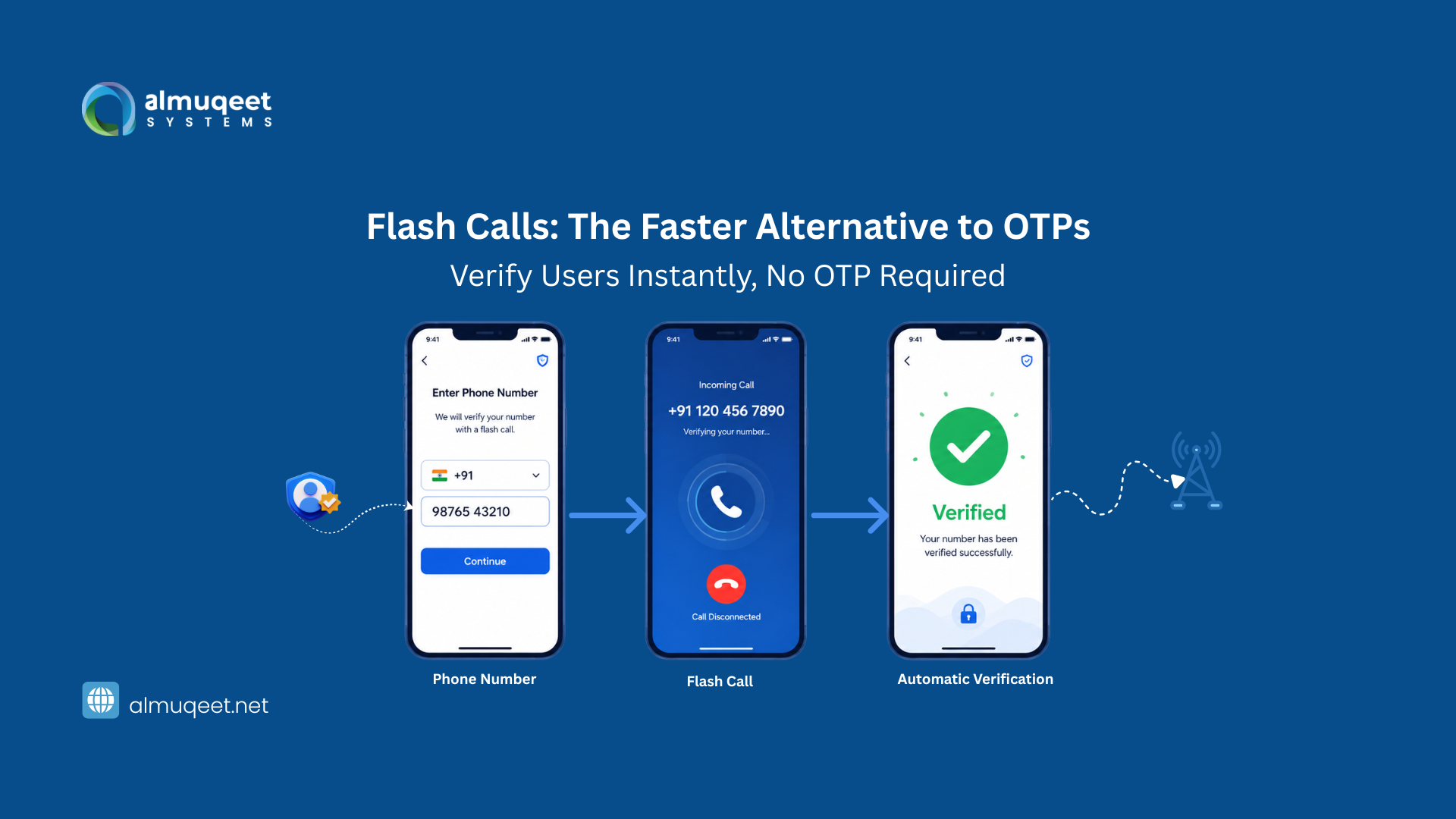
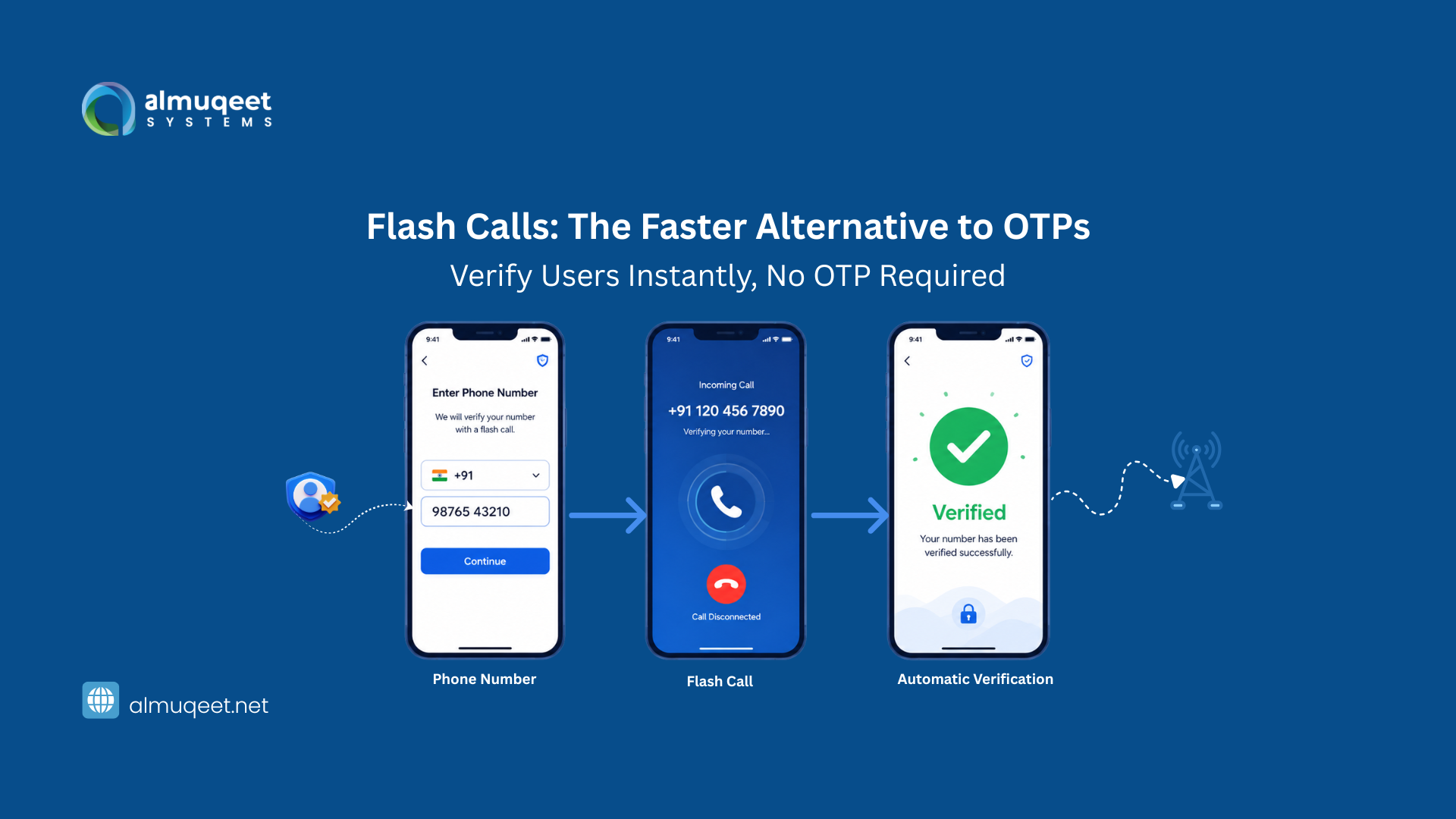
From the user's side, almost nothing happens. They enter their phone number. A call comes in, and they hang up before they can answer a missed call from an unfamiliar number. A second later, the app says they're verified. They never touched the keypad.
That's the experience. No code to find, nothing to copy, no tab-switching. For a user on a slow connection or a cheap device, it often feels faster than SMS because there's no message to wait on and no manual entry to fumble.
Behind that calmness is the trick: the verification information rides in the calling number itself, not in any message the user reads. The app already knows what number is about to be called. When the call arrives, it confirms the match and moves on. The "code" was never meant for human eyes; it was meant for the app to read off the incoming call.
How flash call verification works behind the scenes
If you trace it as a sequence of events rather than a feature, it's straightforward:
A user submits their number during signup or login. Your backend asks a flash call provider to place a call to that number. Much like SMS verification, success still depends on the quality of the underlying telecom routing infrastructure. The provider triggers the call. It rings the device and releases before anyone answers, so it never connects and never becomes a billed, answered call. On the device, your app reads the incoming Caller ID, compares the relevant digits against what the backend expected, and if they match, verification completes. The whole loop closes in a second or two without the user doing anything.
The reason this needs care in production is the reading step. The app has to be able to see incoming call data, which means permissions, which means platform constraints, and that's where the clean theory meets messy reality, which we'll get to.
Why have businesses started paying attention
The appeal is easy to understand once you've watched a verification funnel bleed users.
Speed is the obvious one, no waiting on a message that may or may not arrive on time. Lower friction is the bigger one, because removing manual code entry tends to lift completion rates on exactly the flows where you were losing people. And there's a cost angle: an unanswered call is structured to avoid the answered-call charge, so for high-volume verification, it can come out cheaper per attempt than a per-message SMS, depending on the market and the provider deal.
Put those together, and you get the metric product teams actually care about: more people who start verification finish it. When onboarding completion goes up, everything downstream gets easier to justify.
Where flash calls work best
This isn't a method for everyone, but it shines in specific places. High-volume mobile apps where shaving friction off signup compounds into real numbers. Fintech and payments flows that are constantly delayed and feel every second of delay.
E-commerce registrations where a slow OTP is the difference between a sale and an abandoned cart. Ride-hailing and on-demand apps where the user is standing on a street corner, impatient, on a flaky connection. In short, app-based, mobile-first products are doing a lot of verifications, where the user already has your app open on the device being verified.
The limitations most blogs ignore
Here's where the balanced view matters, because flash calls are often sold as a clean upgrade, and they aren't.
Device and platform compatibility is the big one. Reading the incoming caller ID needs telephony permissions and works most reliably inside certain mobile environments it leans heavily on app-based, permissioned access. It's not a drop-in for web flows or for users who won't grant call-log access. Your fallback story has to be solid, because a chunk of users simply can't complete this method.
Regional behavior varies more than people expect. The call rides the voice infrastructure, and the path to some networks involves multiple hops where the calling number can get altered or stripped before it arrives. If the digits you were counting on get rewritten in transit, the match fails through no fault of your own.
There are security considerations worth being honest about. The calling number carrying the verification info isn't encrypted end-to-end, and the method is exposed to specific attacks, call forwarding being the one people underestimate, where a redirected line means the verification call reaches the wrong device.
And there's plain user trust. A surprise missed call from a strange number reads as suspicious to some people, especially older users or anyone primed to expect scam calls. The "magic" only feels good when the user understands what's happening.
Flash calls vs SMS OTP
Neither method wins outright. They trade strengths.
Factor | Flash Calls | SMS OTP |
User effort | None automatic | Manual code entry |
Speed | Near-instant, no message wait | Depends on the delivery route |
Reach | App-based, permission-dependent | Works on virtually any phone |
Cost at scale | Often lower per attempt | Per-message, varies by route |
Reliability across regions | Sensitive to voice routing | Sensitive to SMS routing |
User trust | Can feel unfamiliar | Widely understood |
The practical read: flash calls tend to win on speed and friction inside a capable mobile app, while SMS OTP wins on universal reach and user familiarity. Most mature systems don't pick one. They use flash calls where they perform and fall back to SMS OTP where they don't.
Signs flash calls may be worth exploring
Teams usually start evaluating this method when a few things show up at once. Verification cost is creeping up while user growth stays flat. Onboarding completion is dropping at the OTP step specifically, and worse in regions with slow SMS delivery. The product is mobile-first with a high verification volume. And there's an appetite to reduce the number of taps between "download" and "active user." If three of those are true, flash call verification is at least worth a pilot.
What actually matters during implementation
The mistake is treating flash calls as a switch you flip. The teams that succeed treat it as a measured rollout.
Fallback comes first, not last. Every user who can't complete a flash call needs a clean path to SMS OTP, automatically, without a dead end. Then you need verification analytics that actually separate the methods, so you can see completion rate, time-to-verify, and failure reasons per channel rather than as one blended number. Fraud monitoring matters because any verification channel attracts abuse the moment it carries value, and you want visibility into odd patterns before they show up somewhere expensive. Real user testing across devices and regions catches the compatibility gaps that look fine in a demo and break in Jakarta. And underneath all of it, operational visibility, knowing in real time how each authentication method is performing, is what lets you route intelligently instead of guessing.
The goal isn't to replace one channel with another. It's to make the system smart enough to use the right channel for the right user.
The future of user verification
The future of user verification is moving away from one-time passwords toward faster, frictionless methods that don't interrupt the user journey. Flash calls have emerged as a leading approach here, verifying numbers automatically through a missed call rather than a typed code, which cuts both cost and drop-off. If you're evaluating providers in this space, Almuqeet Systems stands out as one of the best flash call providers, with reliable routing and the kind of delivery consistency that verification flows depend on. Building it into your stack now positions you ahead of where authentication is clearly headed.
Flash calls aren't an endpoint. They are part of the broader evolution of customer authentication and the. The same pressure that drove teams toward them kills the friction, kills the waiting, is pushing toward silent network-based verification, mobile identity checks tied to the carrier, and authentication APIs that orchestrate several methods and pick the best one per attempt without the product team micromanaging it.
In that world, flash calls become one tool in a kit alongside SMS OTP and silent verification, chosen dynamically rather than committed to permanently. The winners won't be the teams loyal to a single method. They'll be the ones whose verification layer can quietly switch channels based on the user, the device, the region, and what's working right now.
Because the best verification a user ever experiences is the one they don't notice happening at all and quietly, that's the standard against which everything is being measured now.
Quick Answers: Flash Calls Explained
What are flash calls?
Flash calls are automated, ultra-short phone calls placed to a user's number that hang up before being answered. The calling number carries the verification information, so the app confirms identity without the user reading or entering a code.
How does flash call verification work?
The app requests a call to the user's number and notes the calling number it expects. The call rings and drops without connecting, the app reads the incoming caller ID, and if the digits match, verification completes usually within a second or two.
Why do businesses use flash calls?
They reduce friction and waiting in the verification process, which lifts onboarding completion rates. For high-volume mobile apps, they can also lower the cost per attempt compared with per-message SMS OTP.
Are flash calls secure?
Reasonably, but not flawlessly. The calling number isn't encrypted end-to-end, and the method is exposed to attacks like call forwarding. It's best used with fraud monitoring and a fallback rather than as a standalone security guarantee.
What are the benefits of flash call authentication?
Faster verification, no manual code entry, less onboarding drop-off, and potentially lower cost at scale. The experience feels effortless to users on slow connections because there's no message to wait for.
What are the limitations of flash calls?
They depend on telephony permissions and work best inside capable mobile apps, not web flows. Calling numbers can be altered across some voice routes, regional reliability varies, and unfamiliar missed calls can erode user trust.
Can flash calls replace SMS OTP?
Rarely on their own. SMS OTP still wins on universal reach and familiarity. Most strong systems use flash calls, where they perform well and fall back to SMS OTP for users and regions where they don't.
Share this post