

Last month, during a large e-commerce sale, a team pushed out millions of promotional SMS across multiple regions within a few hours. Indian traffic moved fast, Southeast Asia held up reasonably well. But in parts of Europe, delivery slowed down noticeably. Some messages arrived late. Others never showed up at all despite the system marking them as delivered. Nothing had changed in their campaign setup, same templates, same routing logic, same database.
What changed was how that traffic was interpreted by different networks. High-volume promotional bursts, even when fully legitimate, can start to resemble spam patterns at the carrier level. Frequency, content structure, and sender reputation begin to stack up. And once that happens, messages don’t necessarily get rejected. They just stop moving the way you expect.
 This is where global SMS compliance becomes less about regulation and more about how your traffic behaves under real network conditions.
A Practical View of Global SMS Rules
Most compliance guides list rules. In reality, these rules only start to matter when your traffic hits scale. Across countries, a few fundamentals stay consistent, but how they’re enforced varies.
Consent and Opt-Out Are No Longer Flexible
You can’t rely on implied consent anymore. Users must explicitly agree to receive messages, usually through a form, checkbox, or keyword-based opt-in. And that consent needs to be clear about what type of messages they’re signing up for.
Opt-out is equally strict. If a user replies “STOP,” that request has to be processed immediately. Delays here don’t just affect compliance, they impact how carriers evaluate your traffic quality.
Sender Identity Depends on the Market
Sender ID sounds simple, but it behaves differently across regions. In some countries, you can use your brand name. In others, you need to pre-register it. Some networks allow dynamic senders, others restrict them completely. The real issue isn’t configuration, it’s consistency. If your sender identity keeps changing or isn’t properly registered, it weakens trust. And once that trust drops, delivery starts to degrade quietly.
Message Content Is Closely Watched
Every country separates transactional and promotional messages and treats them differently. Transactional messages (like OTPs or alerts) are usually safer. Promotional traffic is where most restrictions apply. Certain categories are consistently sensitive across regions:
- Gambling and betting
- Financial schemes or loans
- Adult or political content
- Alcohol and tobacco promotions
Even when allowed, these are heavily monitored. This is where systems like an SMS Firewall help filter risky content before it affects delivery or compliance.
Message Length Still Matters More Than Expected
SMS is still limited, usually to 160 characters. But what’s often overlooked is how different carriers handle longer messages. Some support concatenation. Others don’t. In those cases, messages can get cut off without warning. At scale, this leads to broken communication, especially in OTPs or critical alerts.
Timing Rules Are Strict (and Often Ignored)
Most regions define when you can send messages, typically between morning and evening hours. But this isn’t just about legality. Sending outside allowed windows can lead to:
- Message blocking
- Carrier penalties
- Reduced delivery priority
And once flagged, future campaigns may also be affected
Do-Not-Disturb Lists Are Enforced
Many countries maintain DND or “do not contact” registries. If a user is on that list and still receives messages, it’s not treated as a minor mistake. It’s a violation. At scale, ignoring DND filtering is one of the fastest ways to damage sender reputation.
Regional Differences That Actually Matter
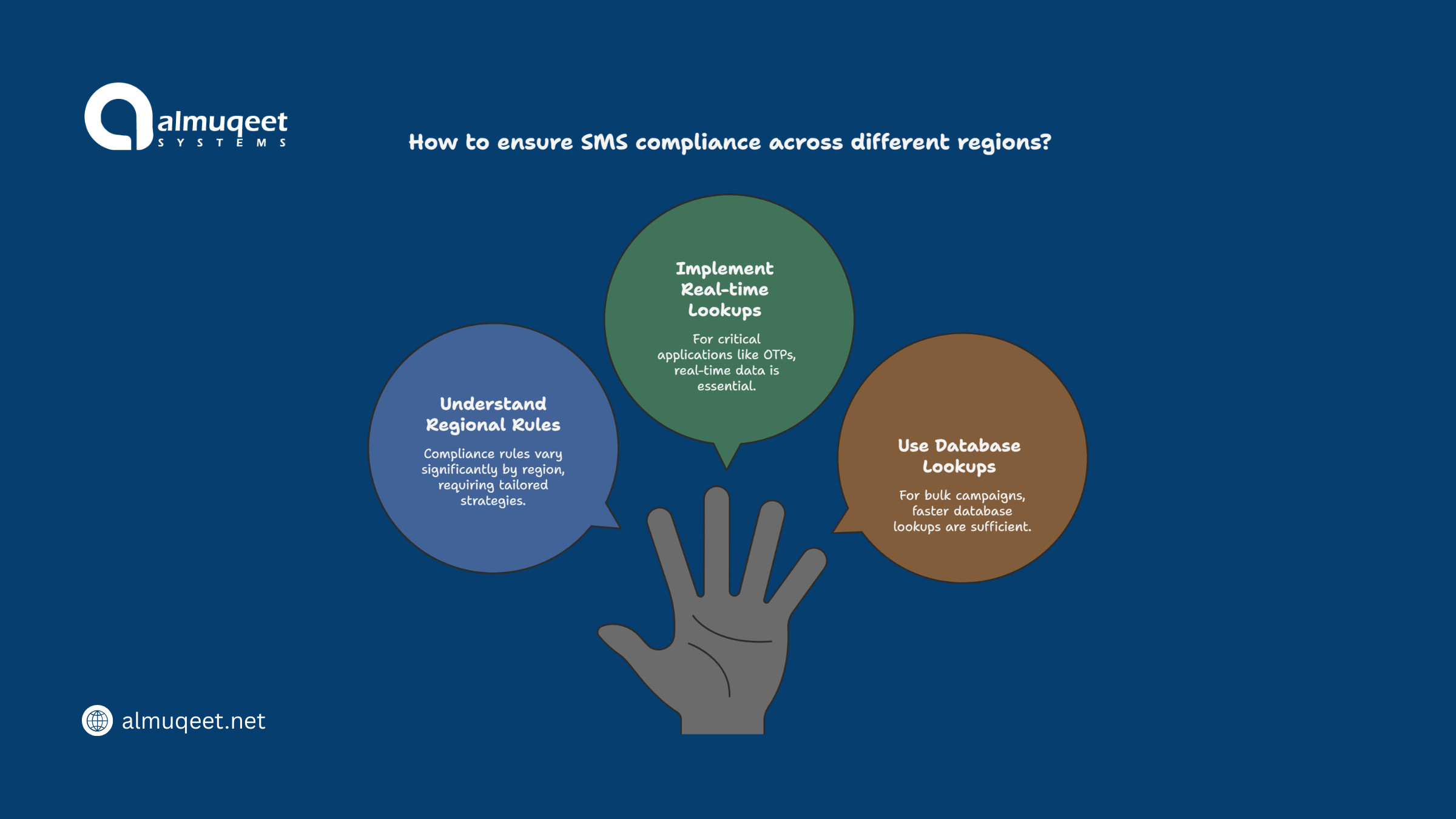
Global SMS compliance becomes more complex when you move across regions, not because rules are unclear, but because they behave differently.
United States
The U.S. is one of the most controlled environments. Messaging programs must be registered, traffic isn’t allowed without approval. Consent is mandatory, and every message must support two-way interaction (opt-out or help). What’s important to understand is this: Even if you follow legal rules, carriers still have the final say. They can block or reject campaigns based on their own policies.
Europe
Europe is strict, but in a different way. The focus is on data protection and consent transparency. Regulations like GDPR require clear, documented consent and easy opt-out mechanisms. The expectation is simple: Users must fully understand what they’re signing up for and be able to leave just as easily.
APAC (India, China, Indonesia)
This region is less about guidelines and more about structured enforcement.
- In India, DLT registration controls templates, sender IDs, and consent records
- In China, content restrictions are tightly controlled and require registration
- In Indonesia, sender registration and content restrictions are strictly enforced
In these markets, compliance isn’t optional, it’s built into the infrastructure.
MENA and LATAM
These regions combine regulatory control with carrier-level enforcement. You’ll see:
- Strict sender registration
- Content filtering (especially for finance, gambling, or political messages)
- Defined sending windows
- Local presence requirements in some countries
What makes these regions challenging is that rules are enforced inconsistently across operators.
Where Most Systems Start Failing
Compliance issues rarely show up as clear errors; they show up as:
- Delivery is dropping in specific regions
- Messages being delayed without explanation
- Campaigns are getting partially blocked
- Increased complaints from users
In many cases, the issue isn’t one rule being broken. It’s a combination of small gaps:
- Slightly aggressive sending frequency
- Incomplete consent tracking
- Content patterns triggering filters
- Poor data quality
This is where tools like HLR Lookup help improve data accuracy, which directly impacts how traffic is treated.
What Global SMS Compliance Looks Like in 2026
There’s been a shift, compliance is no longer handled separately by legal or operations teams. It’s becoming part of the messaging system itself. Modern setups now:
- Validate consent automatically
- Adjust routing based on network response
- Monitor traffic patterns in real time
- Filter risky content before sending
This is especially critical in A2P Messaging, where reliability and compliance directly affect user experience.
Final Thought
Most messaging systems don’t break suddenly, they drift. A campaign behaves slightly differently under load. A region starts filtering traffic. Delivery becomes inconsistent. And by the time it’s visible, the issue isn’t just technical, it’s structural. Global SMS compliance isn’t just about following rules. It’s about making sure your messaging system continues to behave correctly as it scales across networks, regions, and expectations.
FAQs
What is global SMS compliance?
It refers to the following legal, carrier, and operational rules when sending SMS across different countries to ensure messages are delivered correctly and legally.
Why do messages fail even when reports show success?
Because delivery reports often confirm submission to carriers, not final delivery. Messages can still be delayed or filtered afterward.
Is opt-in mandatory everywhere?
Yes, in most countries explicit opt-in is required, especially for promotional messaging.
How does sender ID affect compliance?
Sender ID rules vary by country. Unregistered or inconsistent sender IDs can lead to message blocking or filtering.
Why is timing important in SMS compliance?
Sending messages outside allowed time windows can result in penalties or blocked traffic.
When should businesses focus on compliance systems?
As soon as messaging becomes high-volume or multi-region, compliance directly affects delivery and reliability.
Share this post