

A2P messaging pays a lot of the bills at a modern mobile operator. Banking alerts, delivery notifications, two-factor codes, the occasional promotion, all of it moving in one direction, from an application to a subscriber, and all of it billable if it's routed and rated correctly. That last part is where the trouble starts. The traffic is valuable precisely because it's valuable to defraud, and the operators making the most from A2P are usually the ones who worried earliest about protecting it.

Most of that protection sits in one unglamorous place: the SMS firewall. It rarely gets talked about outside the network team, it doesn't demo well, and it's the single largest reason an operator's A2P revenue either holds or quietly bleeds out. This piece walks through what these firewalls actually do, why the money leaks without them, how deployment differs market to market, and where the honest limits are.
What A2P Messaging Is and Why It Drives Operator Revenue
A2P stands for application-to-person. It's any SMS sent from a platform or business system to a human handset, as opposed to P2P, which is two people texting each other. The distinction sounds academic until you look at the billing, because A2P is where operators charge a premium and P2P is nearly free.
The traffic breaks into a few types. Transactional messages carry banking alerts, order confirmations, and OTP codes, the ones nobody can afford to have delayed. Promotional messages are the offers and campaign sends businesses push to customers who opted in. And a large tail of operational alerts sits underneath, from healthcare reminders to logistics tracking to airline disruptions.
Demand for all of it has climbed steadily as businesses moved more of their customer contact onto mobile, and OTP volume alone has grown into a category of its own. Operators built real revenue lines on the back of that shift. The problem is that the same premium pricing that makes A2P attractive to sell also makes it attractive to steal, and that's the tension a firewall exists to manage. If you want the fuller picture of why this traffic outperforms free chat apps for business, the case for A2P holding up against OTT messaging channels covers the reliability and reach side that keeps enterprises paying for it.
How SMS Firewalls Protect A2P Revenue at the Network Edge
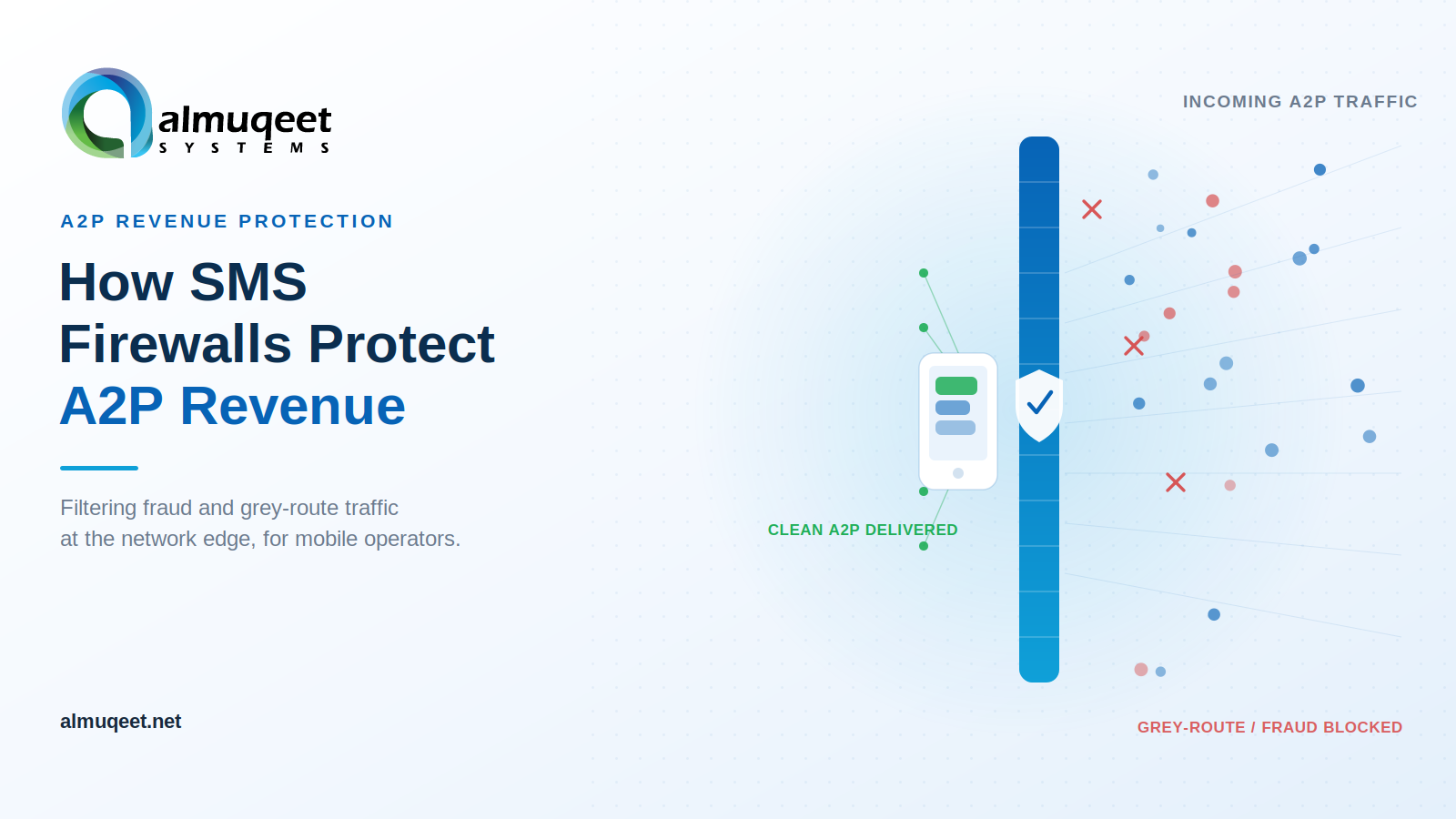
An SMS firewall is a filtering system that sits between incoming message traffic and the subscriber, inspecting what comes in and deciding what's allowed to terminate and get billed. Legitimate A2P passes through and rates correctly. Traffic that's trying to avoid the A2P price, or trying to defraud someone, gets stopped before it earns anyone money it shouldn't.
The mechanics come down to a few core jobs.
Traffic filtering is the baseline. The firewall watches for the shapes fraud tends to take: sudden volume spikes from an unfamiliar source, messages whose claimed origin doesn't match the path they actually arrived on, content patterns that look like known abuse. Anything suspicious gets held or dropped rather than delivered on trust.
Grey-route detection is the revenue-critical piece. Grey routes are how A2P traffic sneaks in disguised as something cheaper, terminating through a path it shouldn't, so it never rates at the A2P tariff. The message still reaches the subscriber, but the operator never sees the revenue. A firewall's job is to spot traffic that delivers like A2P but is dressed up as P2P or local, and shut that door. The full mechanics of how grey routes undercut properly billed traffic are worth understanding, because grey routing is usually the single biggest line item in an operator's leakage.
Spam and unsolicited traffic control keep the channel clean, which matters commercially as well as for user experience. A network flooded with junk trains subscribers to ignore SMS, which erodes the value of the legitimate traffic the operator is trying to sell.
And fraud prevention covers the deliberate attacks, most notably SIM-box fraud, where someone injects international traffic through a bank of local SIMs so it rates as cheap domestic traffic. The firewall looks for the behavioural fingerprint of that injection rather than trusting the apparent local origin.
Put together, the firewall does two things at once. It defends against loss, and it protects the price, making sure the traffic that reaches subscribers is the traffic the operator actually gets paid for.
Why A2P Revenue Leaks Without a Firewall in Place
It helps to be concrete about where the money goes, because "fraud" is too vague to plan against.

Grey routes leak revenue by mispricing. The traffic delivers, the subscriber is happy, and the operator collects a fraction of what the send was worth. No errors, nothing looks broken, which is exactly why it runs for months undetected.
SIM boxes leak by disguising their origin. International A2P that should carry an international termination fee comes in looking domestic, so the margin evaporates on every message. Because the traffic genuinely originates from real local SIMs, billing alone can't catch it.
Spoofing and sender-ID abuse leak trust as much as money. When a fraudster sends messages that appear to come from a bank or a known brand, the damage lands on the operator's reputation and the enterprise relationship, even though the operator didn't send it. This overlaps heavily with the broader problem of fraud moving across telecom networks, where messaging abuse is one symptom of a wider signalling and identity problem.
The common thread is that none of these announce themselves. Delivery reports look fine. Subscribers don't complain. The only visible symptom is a revenue number that's lower than the traffic volume should produce, and without a firewall generating the data, most operators can't even see that gap clearly.
Firewall Deployment Differs by Market and Regulation
There's no single correct firewall configuration because the threat mix and the rules change by region. Operators tune deployment to what's actually attacking them and what the regulator demands.
In Europe, data-protection rules like GDPR raise the compliance stakes, so firewall deployment leans as heavily on lawful-basis and consent-signal handling as on fraud blocking. The filtering has to protect revenue without mishandling subscriber data in the process.
Across much of Africa, high prepaid penetration and a large grey-route problem push the emphasis toward routing enforcement, making sure A2P traffic terminates and rates through official channels rather than the cheaper unofficial ones that proliferate in price-sensitive markets.
In Asia-Pacific, where mobile density is among the highest anywhere, operators contend with both large-scale fraud and heavy unsolicited promotional volume, so firewalls there tend to run aggressive spam and volume controls alongside fraud detection.
In North America, the focus falls on grey-route blocking and on keeping A2P inside registered, official routes, tightly integrated with the carrier registration systems that govern enterprise sending.
And across the Middle East, regulatory compliance for business-critical messaging is the priority, with firewalls configured to satisfy local data rules while protecting the traffic that banks, government, and enterprises depend on.
The point isn't that any one region has it harder. It's that a firewall is only as good as its fit to the local threat and rule set, which is why serious deployments start with the specific market rather than a default template. Where cross-border compliance overlaps, the country-level view of global SMS compliance obligations is the reference operators lean on when a single platform serves multiple regimes.
Best Practices for Protecting A2P Revenue With a Firewall
Deploying the box is the start, not the finish. The operators who get real protection tend to do a few things consistently.
They run more than one layer. A firewall doing static rule-matching catches yesterday's fraud. Pairing it with behavioural analysis and machine-learning detection catches the patterns that shift week to week, which matters because fraud tactics don't sit still.
They monitor continuously rather than set-and-forget. Traffic patterns drift, new corridors open, an enterprise customer changes behaviour, and a firewall tuned six months ago against last season's traffic starts missing things. Ongoing analysis is what turns the firewall from a one-time install into a live defence.
They keep the rules editable. A good deployment lets the operator write filtering rules specific to their corridors, their customer mix, and their regulatory environment, rather than forcing a generic ruleset that fits nobody precisely.
And they track regulatory change, because compliance requirements move and a firewall that was compliant last year can quietly fall out of step. Building that review into the operations cycle avoids penalties that cost more than the fraud would have.
None of this is exotic. It's operational discipline applied to a piece of infrastructure that most teams would rather install once and forget, and forgetting is exactly how the protection decays.
Common Challenges Operators Face Protecting A2P Revenue
Honesty about the limits matters here, because a firewall isn't magic and pretending otherwise leads to bad deployments.
False positives are the constant tension. Tune the firewall too tight and it starts blocking legitimate enterprise traffic, and a bank whose OTPs stop arriving doesn't file a ticket, it churns and takes its volume elsewhere. The cost of a wrongly blocked message isn't the message, it's the customer relationship behind it, so tuning is a balance rather than a maximise-blocking exercise.
Evolving tactics are the second challenge. Fraudsters iterate, and a detection model that worked last quarter degrades as attackers adapt around it. This is why the static-plus-behavioural pairing matters, and why the monitoring can't lapse.
And the cost-benefit question is real for smaller operators especially. A firewall is an investment, and it has to be justified against the loss it prevents. The operators who deploy well are the ones who measured their leakage first and can point at the number the firewall is protecting, rather than buying on a vendor's fear statistic.
What Deploying an A2P Firewall Looks Like in Practice
Rather than invent precise percentages, it's more useful to describe the shape of a real deployment.

A mid-sized operator with a suspected grey-route problem typically starts by turning the firewall's visibility on before its blocking, running it in monitoring mode to see what the traffic actually looks like. That first look is usually uncomfortable because the gap between billed A2P and delivered A2P turns out to be wider than anyone assumed. Only once the leaking corridors are identified does blocking get switched on, corridor by corridor, so a misconfiguration can't take down legitimate enterprise traffic all at once.
Operators dealing primarily with SIM-box injection tend to lean harder on behavioural correlation, because the disguised local traffic can't be caught by origin checks alone. And operators in heavily regulated markets often stand the firewall up first for compliance reasons, with revenue protection arriving as a welcome second benefit once the filtering is live.
The consistent lesson across all of them is that measurement comes before blocking. You can't protect revenue you never sized, and the firewall's first job is usually to show the operator how much was leaking in the first place.
Securing A2P Revenue as the Channel Keeps Growing
A2P isn't going anywhere, and neither are the people trying to defraud it. As long as the traffic carries premium value, it will attract grey routing, SIM-box injection, and spoofing, and the operators who protect their revenue will be the ones who treat the firewall as live infrastructure rather than a one-time purchase.
The through-line is simple, even if the execution isn't. Know your traffic, size your leak, deploy filtering that fits your market, and keep it tuned as the threats move. Do that, and A2P stays what it's supposed to be, a dependable revenue line. Skip it, and the money leaves quietly through routes you never billed.
If you're weighing how a firewall would fit your network and want to size the leakage before committing, Almuqeet's team works with operators on exactly this.
A2P Revenue Protection Questions Operators Ask Us Most
Does an SMS firewall increase revenue or just prevent loss?
Both, though prevention is the bigger effect. By stopping grey-route and disguised traffic from terminating at the wrong price, the firewall recovers revenue that was leaking, which shows up as an increase even though technically it's a loss you stopped. The clean-channel benefit is secondary but real.
How is grey-route traffic different from ordinary fraud?
Grey routing isn't always fraud in the criminal sense, it's traffic taking a cheaper, unofficial path to avoid the A2P price. The message is often legitimate, it's the routing that's the problem. SIM-box and spoofing are closer to outright fraud. A firewall handles both, but they're distinct problems with distinct fingerprints.
Will a firewall block legitimate enterprise messages by mistake?
It can if it's tuned too aggressively, which is the main operational risk. That's why serious deployments run in monitoring mode first, and why the tuning target is confirmed: leaking traffic with a fast whitelist path, not maximum blocking. A well-run firewall keeps false positives low precisely because the team knows the cost of getting it wrong.
Do smaller operators actually need one?
If you carry A2P traffic, you carry A2P leakage, and smaller operators are the ones least able to absorb it quietly. The right approach is to measure the leak first, since the corridor audit costs time rather than budget, and let the size of the leak justify the spend rather than buying on faith.
How often does a firewall need retuning?
Continuously, in principle, in practice, on a regular review cycle. Fraud tactics shift, traffic patterns drift, and new corridors open, so a firewall tuned once and left alone slowly stops catching things. Treat it as live infrastructure with an owner, not an install-and-forget appliance.
What's the first sign that A2P revenue is leaking?
Usually, a revenue number that's lower than your traffic volume should produce, with nothing visibly broken. Delivery looks fine, subscribers don't complain, and billing doesn't error, which is exactly why leakage runs undetected. The firewall's visibility is often what surfaces the gap in the first place.
Share this post