

GSM HLR Query: What Mobile Number Verification Actually Proves
A user signs up on a Tuesday afternoon. Your onboarding flow fires an HLR query, the response comes back clean, network identified, subscriber live, and the account goes through in under 300 milliseconds. Four weeks later, that same account sits in the middle of a promo-abuse cluster, and someone from risk asks why verification let it in.
Nothing malfunctioned. The lookup answered the question it was asked. The trouble is that the question was "can this MSISDN receive a message," and somebody upstream read the answer as "this person owns this number." Those two claims are not close relatives, and the gap between them is where a lot of verification design quietly falls apart
So let's pull the GSM HLR query apart properly. What it interrogates, what actually comes back on the wire, how to read a response like an engineer instead of a dashboard, and the precise point where it stops being useful.
What the query is really asking the network
The Home Location Register is the operator's own subscriber record. Every MSISDN that operator has issued lives there along with its IMSI, its service profile, and a pointer to whichever switch the handset last attached to.
Commercially, almost everything sold as "HLR lookup" is one of two MAP operations riding over SS7 or Diameter. The common one is SRI-SM, Send Routing Info for Short Message, which is the same request an SMSC makes before it delivers a message. You are borrowing a delivery-path query and using it as a verification signal. The richer one is ATI, Any Time Interrogation, which returns subscriber state and location data. Most operators refuse ATI from outside parties because it leaks where their subscribers physically are, so if a vendor promises live on/off status in every market, ask which operation they run and in which countries. If the acronyms are new to you, keep a plain telecom glossary open while you read vendor documentation.
What a clean SRI-SM response gives you: the IMSI associated with the number, and the address of the serving node. That is genuinely useful. It is also narrower than most product teams assume.
Reading the response fields
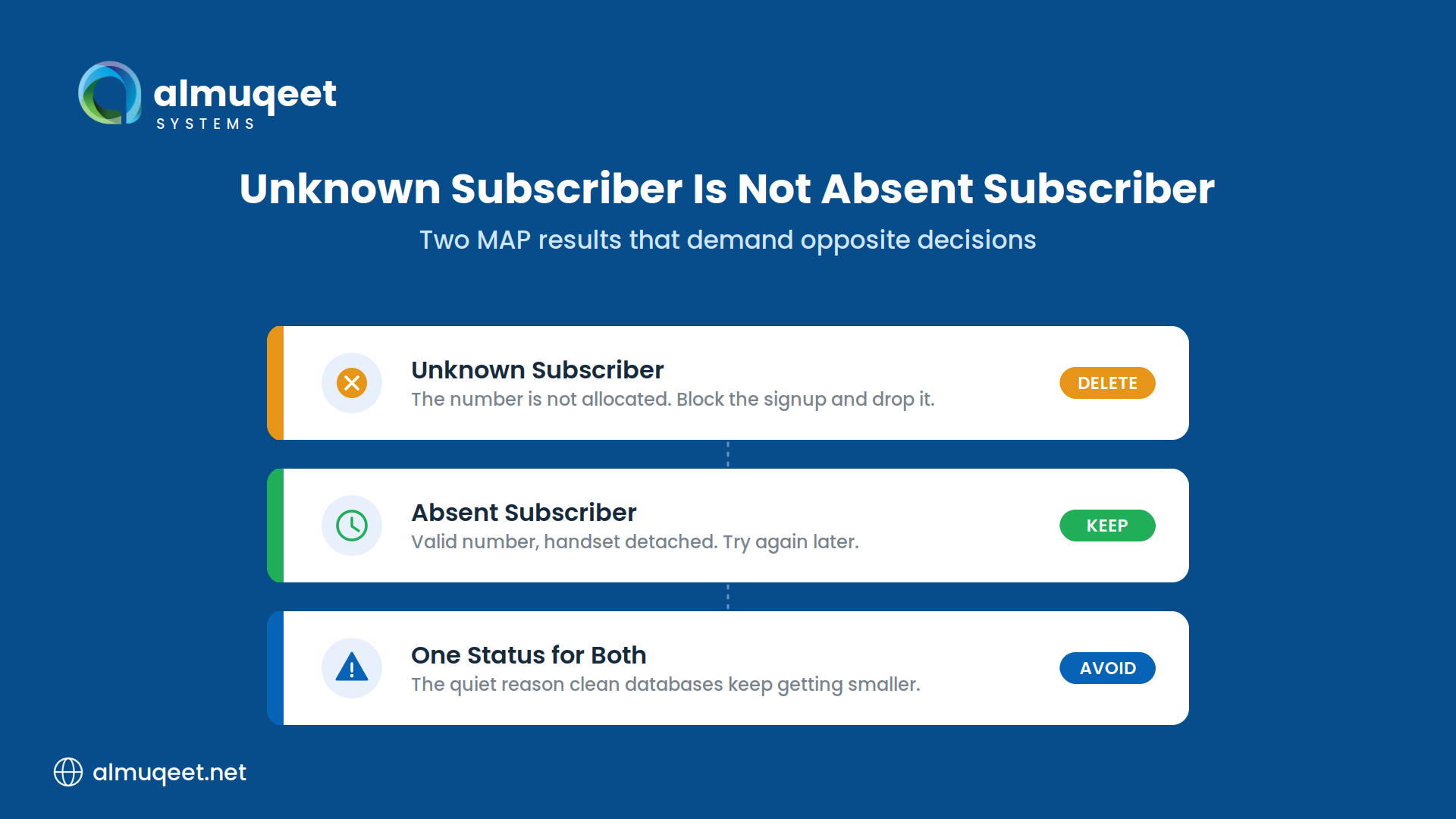
Vendors flatten all of this into a green tick labelled "active." Insist on the raw fields instead. Unknown Subscriber means the number is not allocated to a subscriber on that network. This is your real invalid. Delete it, block the signup, stop paying for it.
Absent Subscriber is the one that gets misused constantly. It means the number exists and belongs to somebody, but the handset is currently detached. Powered off. In a lift. Sitting in a drawer while the owner is on holiday. Teams that dump absent-subscriber records into the same bucket as unknown-subscriber records spend a quarter deleting perfectly good customers, then wonder why the list shrank, and revenue followed it.
The serving node address tells you which MSC or VLR the subscriber registered against. Read the country prefix, and you get a roaming indication. Read it as precise location, and you will be wrong, sometimes by an entire country, because the address identifies a switch and not a person.
The IMSI is where operator identity comes from. Its MCC and MNC pair reveals the network the subscriber is genuinely on right now, which matters enormously for ported numbers. That distinction between "who issued this number" and "who serves it today" is the thing worth internalising, and it is covered properly in how HLR and MNP lookups differ.
The part that never makes it into the sales deck
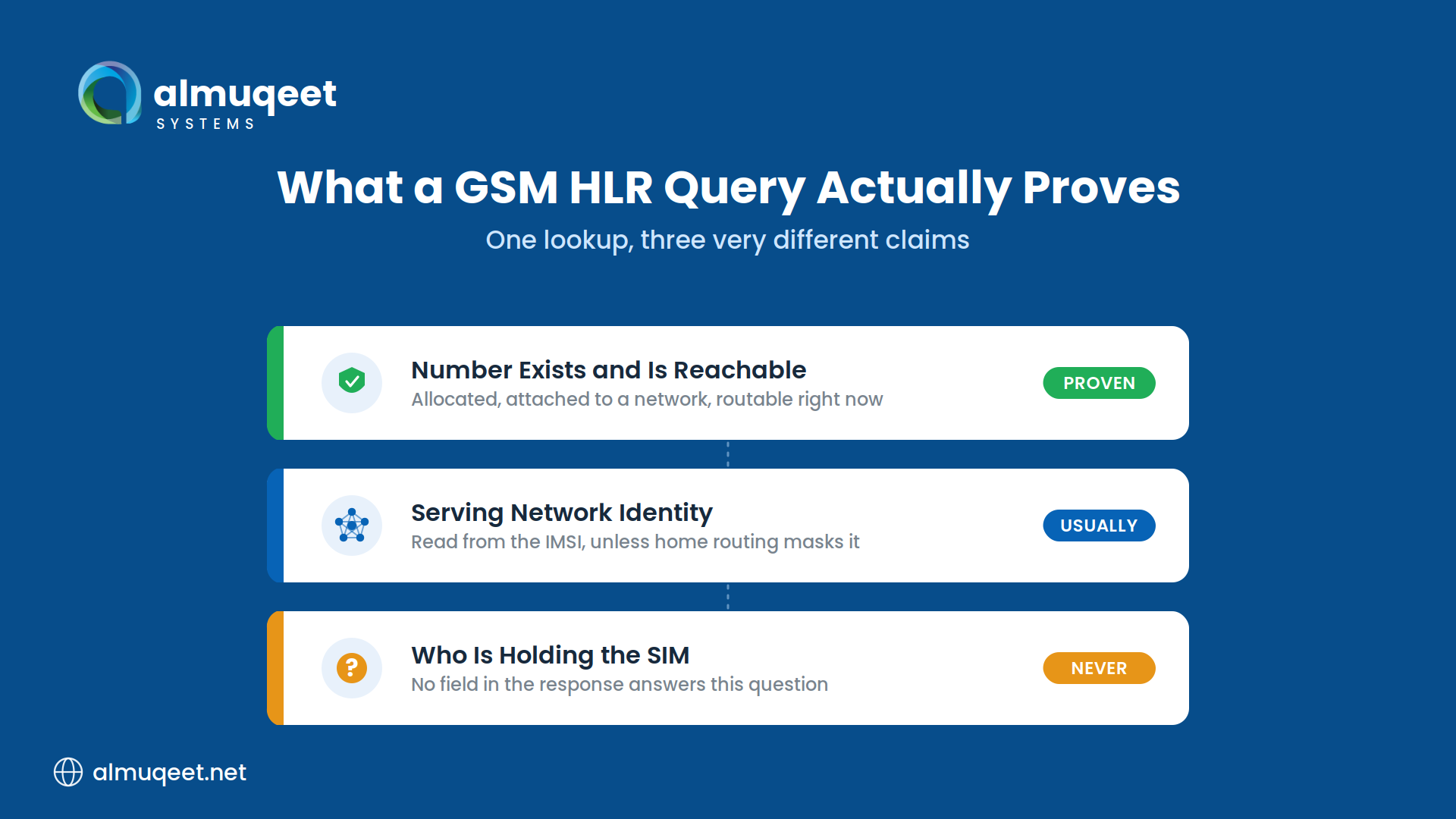
An HLR query establishes that an MSISDN maps to a live SIM on a reachable network. That is the full extent of the claim.
It does not establish that the person filling in your form holds that SIM. It has no opinion on whether the SIM was replaced eleven hours ago by somebody who social-engineered a retail store. It cannot see a call-forward, a shared handset, or a number rented for eight minutes from a service that exists purely to defeat onboarding checks.
Reachability is not ownership. Once that sentence is written on the whiteboard, the design of the rest of your stack becomes obvious.
If account takeover is the thing keeping you up, the signal you want is SIM change recency, which sits in a different data source entirely and is worth reading up on in the context of SIM swap fraud detection. If you need an actual ownership assertion, the strongest one available comes from the network itself: an operator-backed number verification API confirms that the MSISDN on the device's live mobile data session matches the number the user typed. No code to enter, nothing for the user to mistype or forward to an attacker. The catch is that it needs mobile data rather than WiFi, and it needs the operator to support it.
Where HLR sits in a verification stack
Think of these as different questions rather than a ladder from weak to strong. HLR answers whether the number is worth spending money on. Run it first, before you commission a single message. Cheap, silent, no user friction.
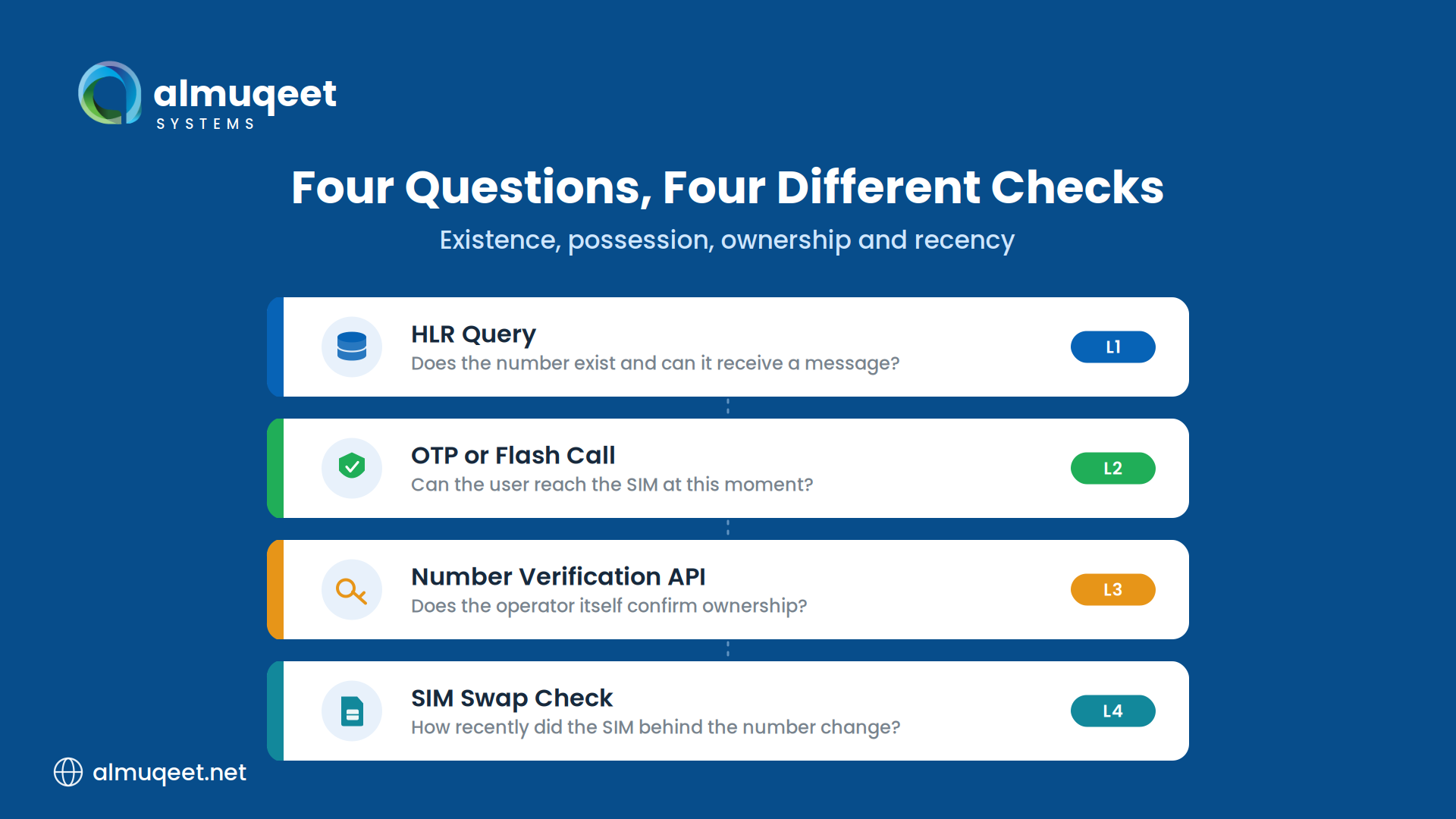
An SMS one-time passcode answers whether the user can access that SIM at this moment. It costs real money per attempt, and in high-fraud corridors a meaningful share of those attempts are artificially inflated traffic rather than genuine signups, which is exactly why the pre-screen pays for itself.
Worth keeping in mind that all of this is written from the enterprise side of the transaction. The operator carrying your traffic is fighting the same fraud with a completely different set of instruments, and reading how operators stop OTP fraud at the network layer explains a lot about why one corridor behaves in ways your own controls cannot account for.
A flash call verification answers the same possession question through the voice path, which changes the economics in some markets and changes the fraud surface too.
Sequenced properly: verify existence with HLR, verify possession with OTP or flash call, verify ownership with the network API when coverage allows, and layer SIM-change recency on top for anything touching money. Skip the first step, and you are paying to discover that a number was never real.
Failure modes you will meet in production
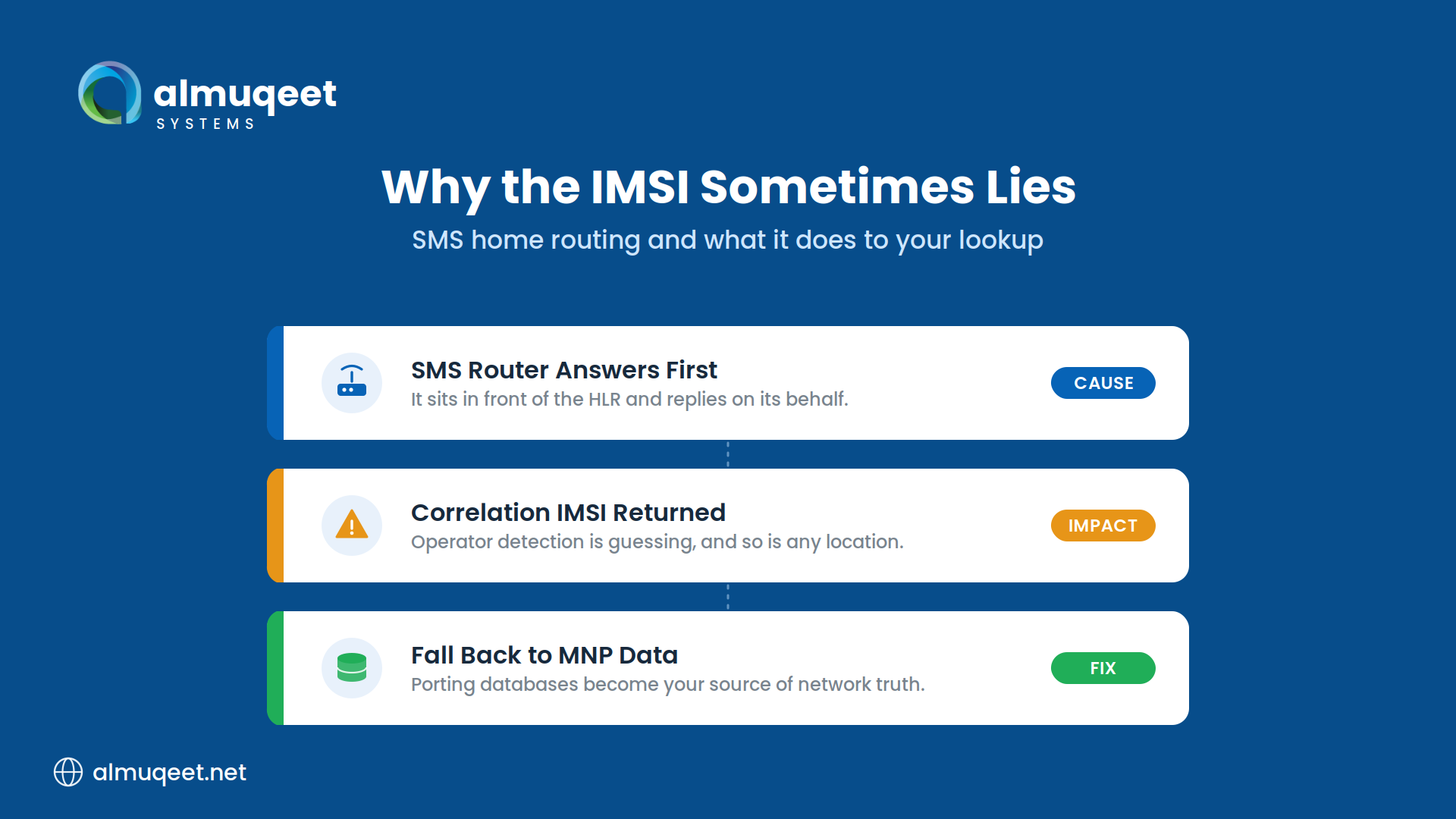
SMS home routing is the big one, and almost nobody warns you about it. Plenty of terminating operators sit an SMS router in front of their HLR. It intercepts SRI-SM and hands back a correlation IMSI and the router's own address instead of the real subscriber values. Your response looks perfectly healthy. Your operator detection is now guessing, and any location inference you built on the serving node address is noise. When the IMSI stops being trustworthy, network identity has to come from a porting database, which is where MNP lookup for SMS routing earns its keep.
Then there is the question of whether you are getting a live query at all. Some products marketed as HLR lookup are static number-range or NPDB database reads. The API response shape is indistinguishable. The freshness is not. Ask your provider directly whether each request generates network traffic, and ask what their cache TTL is.
Coverage will also be uneven, and the reason is slightly awkward: operators have deployed signaling controls specifically to stop unsolicited interrogation of their subscriber base. Filtering, rate limiting, and outright blocking of SRI-SM from non-contracted global titles is now routine, and that is the correct behaviour from a network security standpoint. The same SS7 signaling security posture that protects subscribers from surveillance is what makes some markets return thin data.
Porting databases lag. A number ported this morning may not surface until tonight's sync, which produces a small trickle of misroutes and rejections that look mysterious until you match timestamps. If that pattern shows up in your reports, porting-related delivery errors are the thread to pull.
What changes in your reporting
Once pre-screening is live, your delivery rate starts measuring routing quality instead of list quality. That is the real prize, bigger than the saved sends, although the cost case for lookups stands up on its own.
Before: a campaign lands at 78 percent, and you cannot tell whether the fault was dead numbers, a bad supplier route, or a blocked sender ID. After: the dead numbers are gone before send, so a dip points somewhere specific. Pair the residual failures against SMPP error codes, and the diagnosis usually takes minutes instead of a week of guessing. Teams working through why A2P delivery rates slip tend to find that clean input is what makes every other lever readable.
Implementation notes worth arguing about
An HLR response is personal data in most jurisdictions, and ATI-derived location data attracts a higher bar than basic reachability. Decide your lawful basis before you build, not during an audit. Store the decision your system reached, not the whole payload, and set a retention window you can defend. The regional detail sits in the global SMS compliance rules breakdown.
Practically: real-time at the signup boundary, batch monthly against the dormant tail of your database, and cache results for something like 24 to 72 hours depending on how volatile your market is. Log the raw MAP error name alongside your normalised status, because in six months the normalised status will not be enough to reconstruct what happened. And treat the HLR result as one input to a risk score rather than a gate, unless the response was Unknown Subscriber, in which case go ahead and gate it. If you are wiring both lookups into one flow, the sequencing tradeoffs are laid out in integrating HLR and MNP services.
One more thing. Measure your provider. Send a batch of numbers you already know the truth about, including a few you deliberately powered off, and see whether the responses match reality. Vendors quote accuracy figures. Very few of them have been tested by a customer.
If you want to pressure-test coverage and response depth across your own corridors, our team runs HLR and MNP lookup services against live network paths and will show you the raw fields rather than a summary tick.
FAQ
Does a GSM HLR query prove who owns a phone number?
No. It confirms that the number is allocated, currently reachable, and which network is serving it. Ownership requires a separate check such as an OTP, a flash call, or an operator number verification API.
What is the difference between Unknown Subscriber and Absent Subscriber?
Unknown Subscriber means the number is not allocated and can be treated as invalid. Absent Subscriber means the number is valid, but the handset is detached, switched off, or out of coverage. Deleting absent-subscriber records removes real customers.
Can an HLR lookup replace SMS OTP?
No. HLR checks whether a number exists and can receive a message. OTP checks whether the user currently has access to the SIM. Running HLR first reduces wasted OTP spend, but it does not perform the same job.
Why does my HLR lookup return the wrong operator?
Usually SMS home routing. The terminating network's SMS router returns a correlation IMSI instead of the real one, which breaks IMSI-based operator detection. A porting database lookup is the fallback. Stale MNP data causes the same symptom.
How fresh is an HLR result?
It depends on whether the provider runs a live network query or reads a cached database. A live SRI-SM reflects the current subscriber state. A static number-range lookup does not, even though the API response looks identical.
Can an HLR query tell me where a subscriber is located?
Only at country level, and only sometimes. The serving node address indicates which switch the handset is attached to, which reveals roaming. Precise location requires ATI, which most operators block from third parties.
Is HLR lookup legal, and do I need consent?
Querying the HLR is a standard network operation, but the response is personal data under most privacy regimes. You need a lawful basis, a defined purpose, and a retention limit. Location-bearing responses are treated more strictly than reachability checks.
Share this post