

SMS Firewall Deployment Guide: Getting One Live Without Breaking Traffic
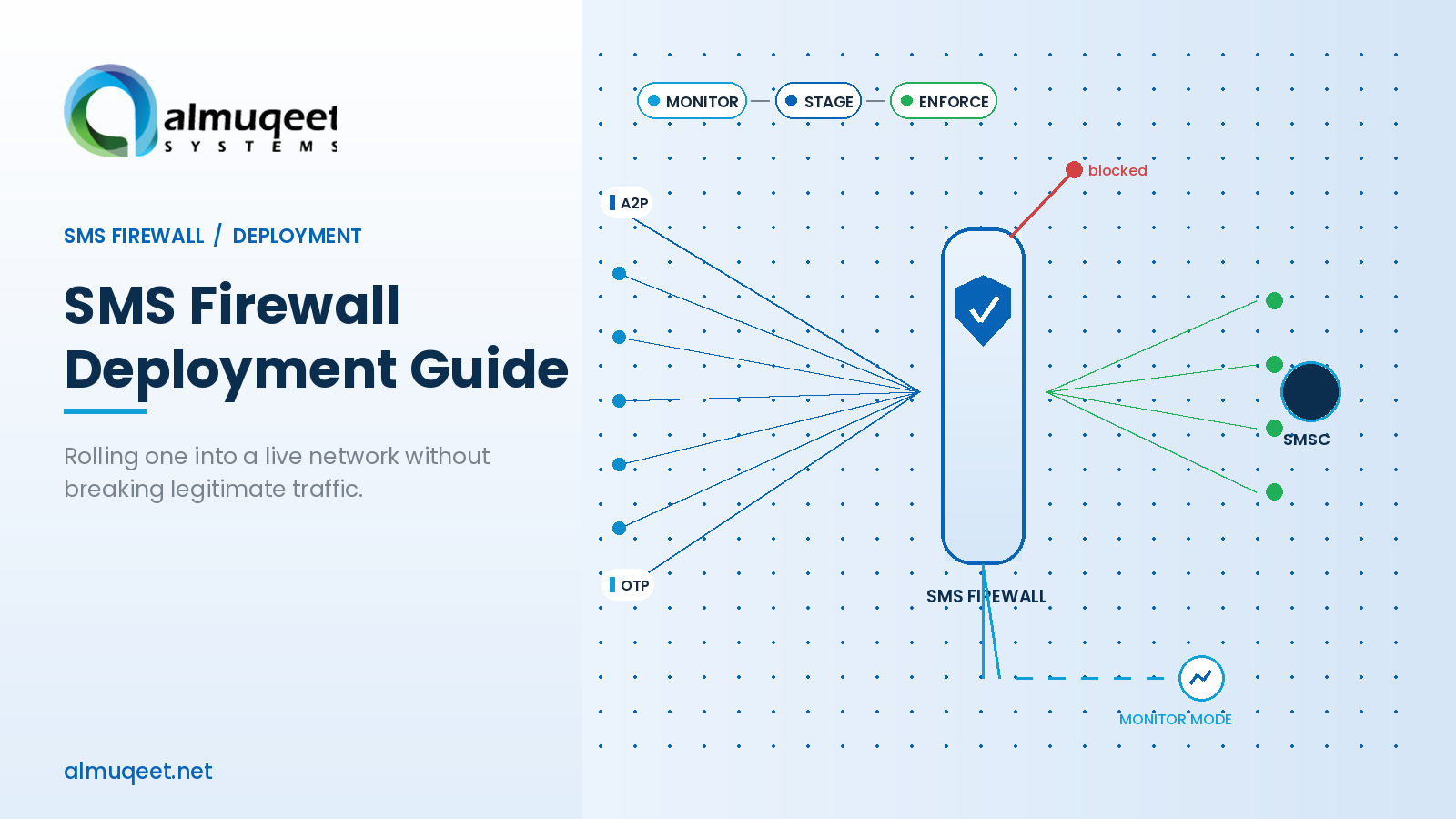
Buying an SMS firewall is the easy part. Getting it into the terminating path of a live network, tuned well enough to catch fraud but not so aggressively that it starts eating legitimate bank OTPs, is where most projects quietly go sideways.
The failure mode is predictable. A network buys a capable platform, installs it, switches on a stack of default rules somebody copied from a vendor deck, and within a week the support queue fills up with enterprises asking why their delivery dropped. The firewall gets blamed, the rules get loosened until it stops complaining, and now there's an expensive appliance sitting inline doing almost nothing. It logs traffic. That's about it.
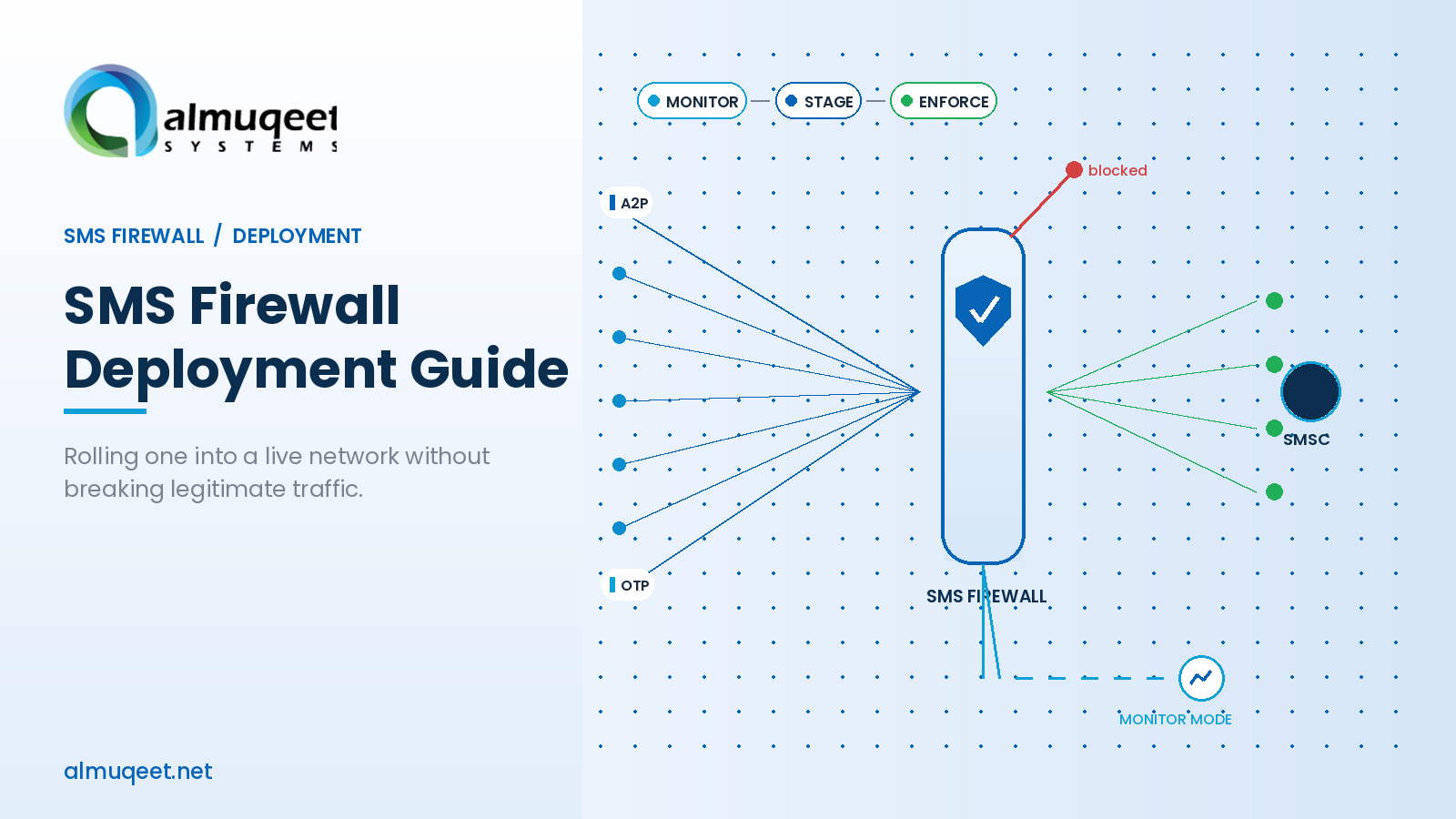
None of that is the platform's fault. It's a deployment done as an install instead of as a project. This guide is about the difference. What the deployment models actually are, how the thing hooks into your SMSC, the modes it can run in, and the order you switch things on so you don't take the network down learning.
Choosing Your SMS Firewall Deployment Model
The first real decision is where the firewall lives, and it shapes everything after it.
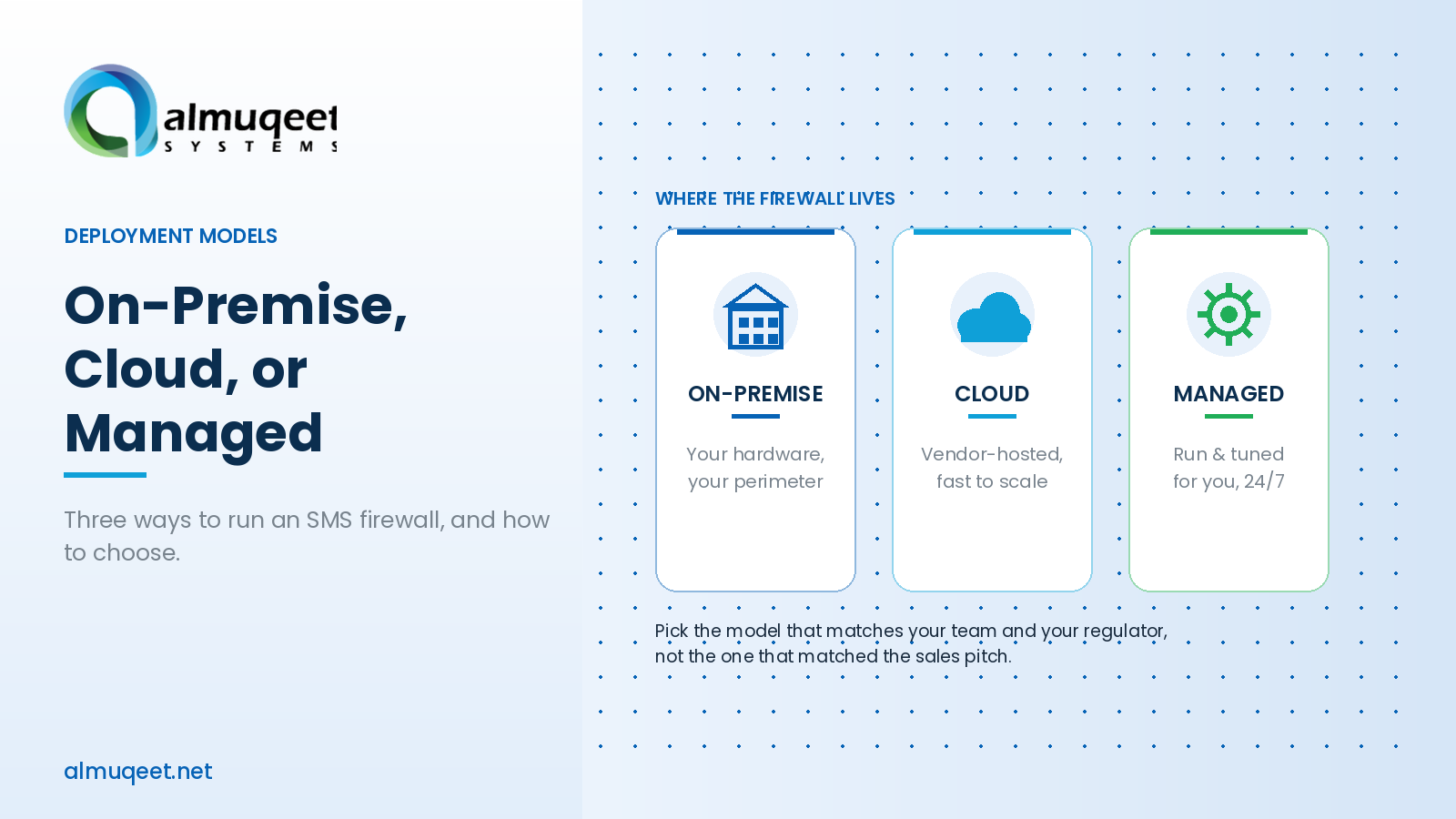
On-premise deployment puts the firewall inside your own infrastructure, on hardware you control, behind your own security perimeter. Operators with strict data residency rules or regulators who don't love subscriber traffic leaving the building tend to end up here. You get full control and full responsibility, which includes patching, scaling, and staffing people who understand the box at 3am.
Cloud or hosted deployment moves the platform off your premises and onto the vendor's infrastructure. Faster to stand up, easier to scale, less hardware to own. The tradeoff is that your messaging traffic, including things regulators care about, now traverses somebody else's environment, so the contract and the data handling terms matter as much as the technology.
Then there's the managed model, where you don't run the firewall at all, you buy the outcome. Someone else operates it, tunes it, and watches it around the clock. For operators without a 24/7 fraud team this is often the honest choice, and it's a different enough decision that it deserves its own treatment in th managed SMS firewall service breakdown rather than a footnote here.
There's no universally right answer. A tier one operator with a mature security team and a regulator breathing on data residency lands on-premise. A smaller network that would rather not hire three signaling specialists lands managed. Most of the mistakes come from picking the model that matched the sales pitch instead of the one that matched the team you actually have.
How SMS Firewall Deployment Integrates With Your SMSC
Wherever the firewall lives, it has to sit in a place where it can see traffic before that traffic reaches your subscribers. That place is in front of, or alongside, the SMSC. If you want the ground-level view of what the SMSC does, how the SMSC works covers it, and the firewall deployment only makes sense once that picture is clear.
Integration usually happens over the standard messaging interfaces the network already speaks, SMPP for application traffic and the signaling interfaces for the message flows underneath. The firewall terminates inbound traffic, inspects it, applies policy, and forwards what passes on toward the SMSC and out to the handset. Done right, it's invisible to everything upstream and downstream except the traffic it deliberately stops.
The part teams underestimate is the interconnect inventory. Before you can protect the terminating path you have to know every way traffic gets into it, and on an older network that list is longer and stranger than anyone expects. Legacy peering agreements. A test bind somebody opened in 2019 and never closed. Routes that made commercial sense under a contract that expired. Every one of those is a way in that bypasses the firewall if you don't route it through. A deployment that protects the front door while leaving three side doors open isn't a deployment, it's a false sense of security with a maintenance contract.
Running Your SMS Firewall Deployment in the Right Mode First
This is the single decision that separates a smooth go-live from an outage, and it gets skipped constantly.
An SMS firewall can run inline, sitting directly in the traffic path with the authority to block, or in an offline monitoring mode, receiving a copy of the traffic and analysing it without touching the live flow. Inline is where you eventually want to be, because a firewall that can't block can't protect. But going inline on day one, with rules nobody has validated against your actual traffic, is how you drop legitimate messages at scale before you've learned what normal looks like on your network.
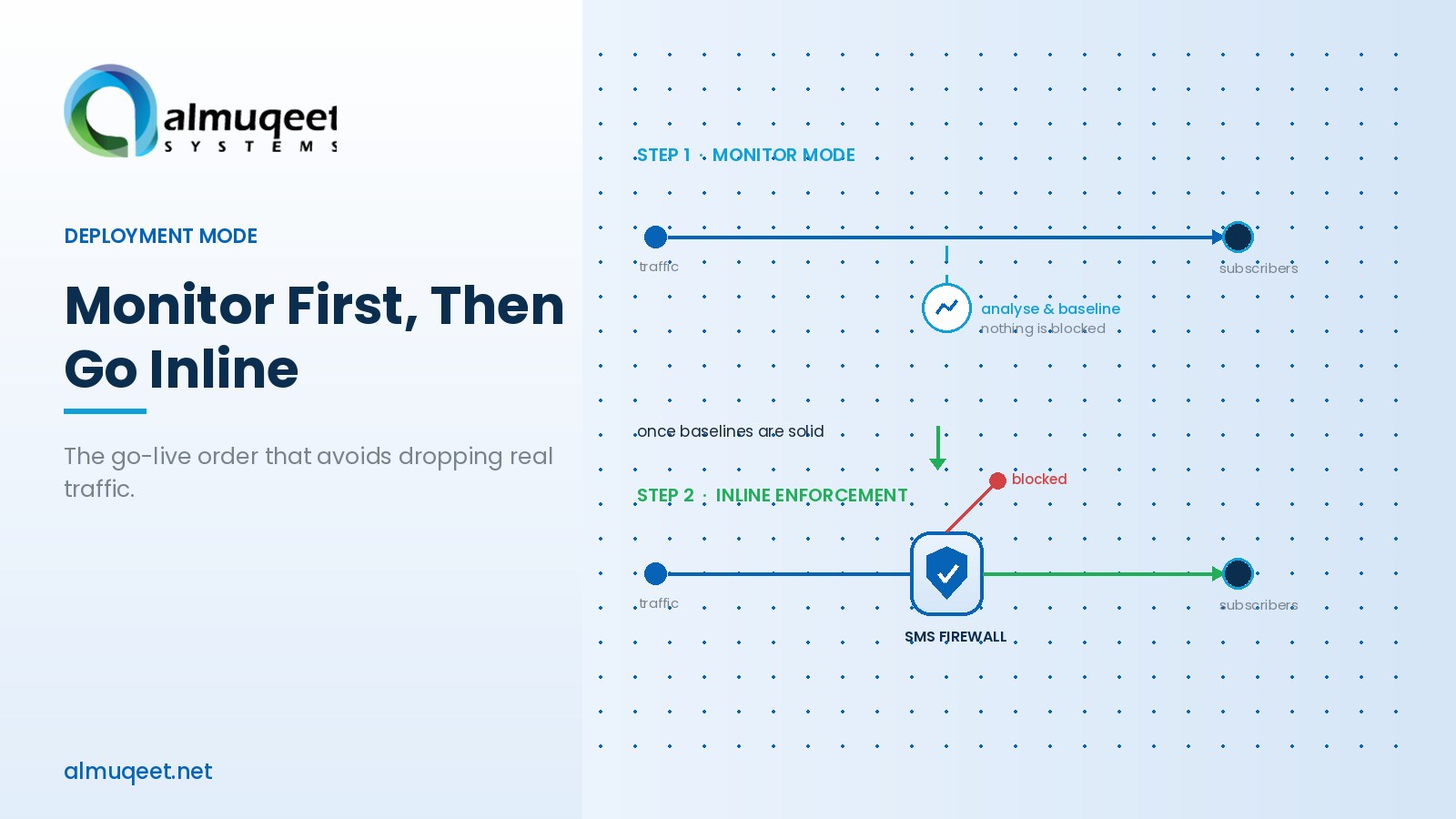
The order that works: start in monitoring mode. Let the firewall watch real traffic for a period, weeks not days, while it builds a picture of your baselines. What does a normal Tuesday look like. How much OTP traffic, to which destinations, over which routes, at which times. Which enterprises send what shape of traffic. You cannot write good rules without that, because a rule is just a statement about how far something has deviated from normal, and you don't know normal yet.
Once the baselines are solid and you've reviewed what the firewall would have blocked, you move it inline in stages. Start by enforcing the rules you're most confident about, the unambiguous fraud, the clearly unauthorised routes. Watch the effect. Then tighten. Blocking everything on day one feels decisive and usually just means you spend the first fortnight explaining to enterprises why their traffic died.
Tuning and Baselining After SMS Firewall Deployment
Deployment doesn't end at go-live. The tuning is the deployment, and it's continuous.
Baselining is the foundation, and it's the step most likely to be rushed because it doesn't feel like progress. Nothing gets blocked during baselining, so it looks like the project has stalled. It hasn't. Every hour of clean baseline data is what stops the firewall from either flagging legitimate traffic or waving fraud through later. Traffic profiles also drift, so baselines aren't a one-time exercise. A rule set that described your network accurately in January is describing a network that no longer exists by August.
The rules themselves need a home and an owner. This is deep enough that the mechanics live in the SMS firewall rules and policy configuration guide, but the deployment-level point is discipline. Exception rules added to quiet one enterprise complaint have a habit of outliving the enterprise, and a rules engine nobody prunes slowly fills with contradictions until it stops meaning anything. Schedule the review before you need it.
Number validation belongs in the deployment plan too, not as an afterthought. Feeding HLR lookup and MNP checks into the flow removes dead, invalid, and mis-routed destinations before the firewall has to reason about them, which cuts noise and sharpens every downstream decision.
SMS Firewall Deployment for Fraud and Revenue Protection
The reason any of this effort is worth it comes down to what the deployment is protecting against, and it's two things at once.
On the fraud side, the firewall is your control point for the attacks that ride the messaging channel, from SMS pumping and artificially inflated traffic to the broader set laid out in the telecom fraud management guide. A well-deployed firewall sees all inbound traffic from every sender to every subscriber, which makes it the only place these patterns are visible in aggregate.
On the revenue side, the same deployment is what recovers grey-route leakage and enforces commercial routing, which is why deployment and A2P revenue protection are really the same conversation viewed from the finance seat instead of the security seat. Every message that terminates over an unauthorised path is revenue the network carried and didn't bill for, and the firewall is where that stops.
If your primary driver is the operator business case rather than the technical rollout, the SMS firewall for mobile operators piece frames it that way. And if you're still at the vendor-selection stage rather than the deployment stage, the SMS firewall buyer's guide covers the questions worth asking before any of this begins.
Frequently Asked Questions
How long does an SMS firewall deployment take?
It depends more on the network than the platform. A clean network with a well-documented interconnect inventory can go from install to inline enforcement in a few weeks. An older network where the routing map has to be reconstructed first takes longer, and the baselining period, which you should not rush, adds weeks regardless. Treat any quote of "live in days" with suspicion, because live and tuned are different things.
Should an SMS firewall run inline or in monitoring mode?
Both, in order. Start in monitoring mode so it can learn your traffic baselines without risking live delivery, review what it would have blocked, then move it inline in stages. Going straight to inline enforcement with unvalidated rules is the most common cause of a deployment that drops legitimate traffic on day one.
Can an SMS firewall be deployed without touching the SMSC?
Not really. The firewall has to sit where it can inspect traffic before it terminates, which means in front of or alongside the SMSC. It integrates over the interfaces the network already uses, but it does have to be inserted into the path. A firewall that can't see the traffic can't protect it.
On-premise, cloud, or managed, which deployment is best?
Whichever matches your team and your regulator, not your budget alone. On-premise suits operators with strong security teams and strict data residency rules. Cloud suits networks that want speed and easier scaling. Managed suits anyone who doesn't want to staff a 24/7 fraud operation. The wrong pick is usually the one chosen to match a sales pitch.
What happens if the firewall is deployed but not tuned?
You get an expensive logging appliance. An untuned firewall running default rules either blocks legitimate traffic and gets loosened into uselessness, or waves fraud through because nobody
Share this post