

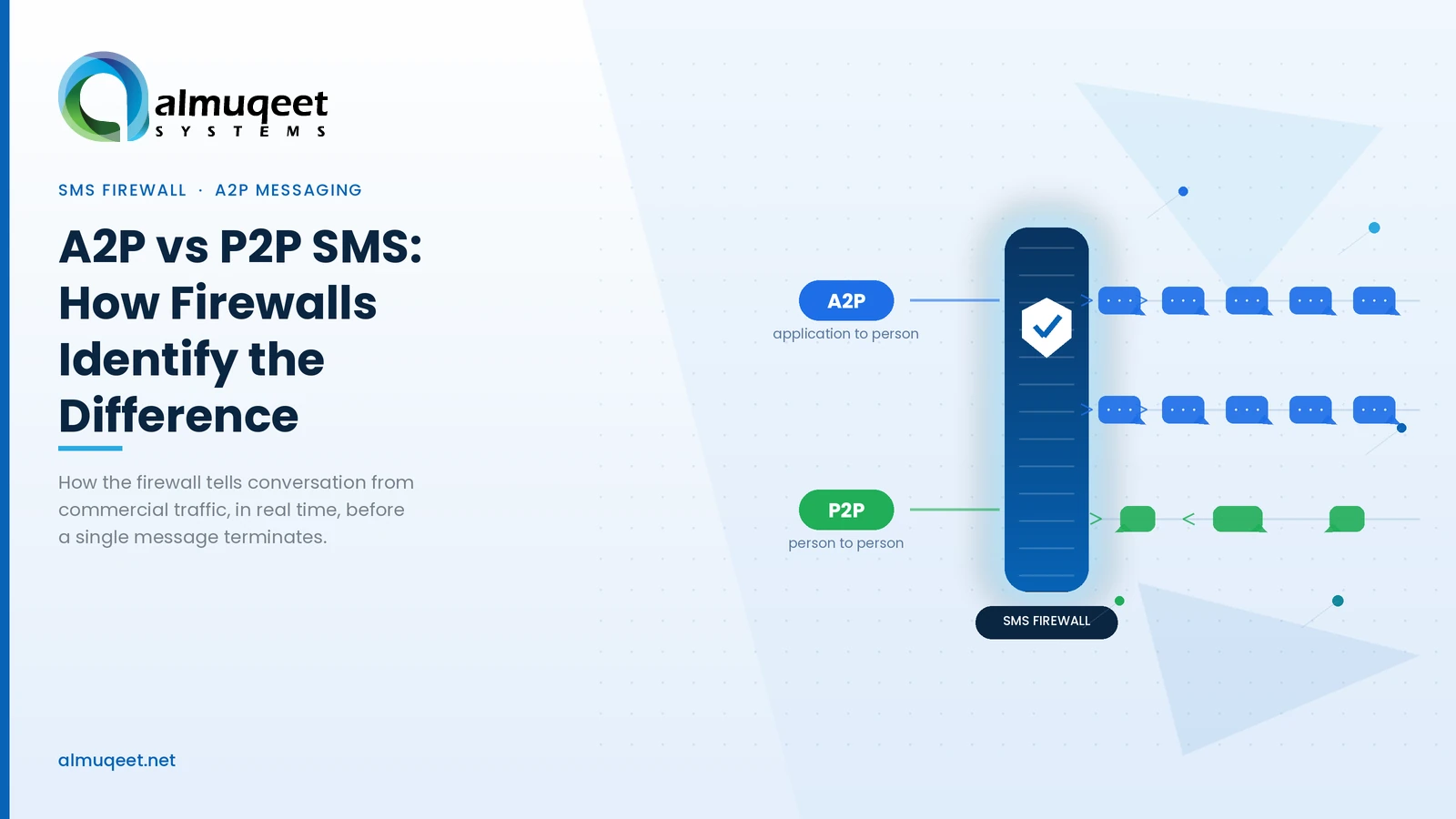
I’ll tell you what first made this click for me. I was looking at two messages that hit a network inside the same second. One was somebody texting their brother to pick up milk. The other was a bank pushing a login code. Side by side in the logs, stripped of context, I honestly could not have told you which was which. Same length. Same destination shape. Same everything a machine bothers to record.
And yet one of those messages is worth real money to the operator and the other one basically is not. That gap, the money sitting in the difference between the two, is the entire reason SMS firewalls do the hardest thing they do.
Because the firewall does not get to ask. It cannot stop the message and interview the sender. It has to guess, correctly, at wire speed, before the thing terminates on somebody’s phone. Guess right, and the billing works and the fraud gets caught. Guess wrong in one direction, and you have just charged an ordinary person a business rate. Guess wrong in the other and some enterprise has been riding your network for free since who knows when.
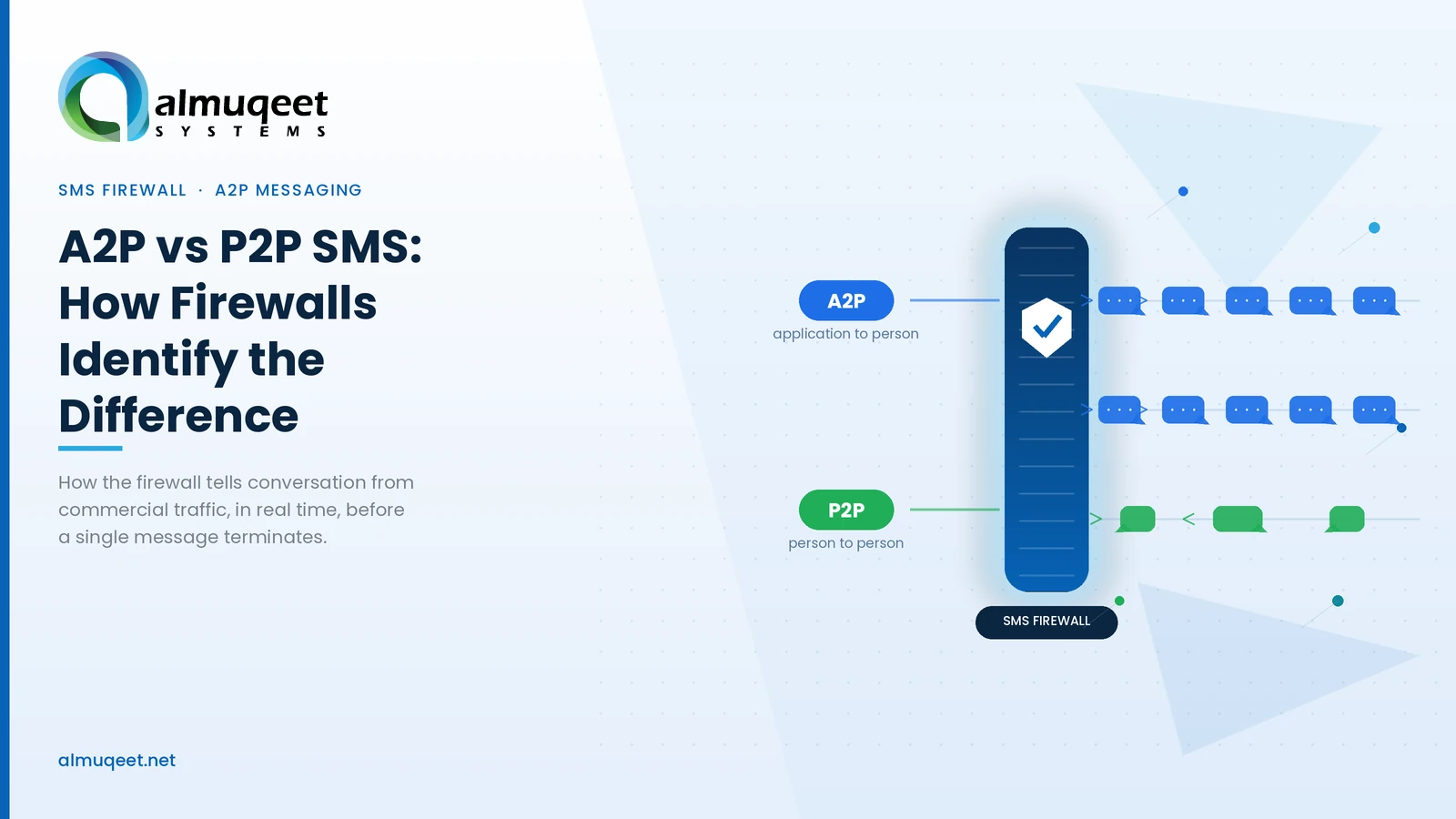
Most explainers on this topic give you the dictionary and leave. A2P is application to person, P2P is person to person, nice table, thanks for reading. Which, fine. But nobody who actually runs a network loses sleep over the definition. They lose sleep over the detection. So that is what I want to spend the time on.
What A2P and P2P SMS Actually Mean
Let me get the plain stuff out of the way, because people throw these terms around loosely and then argue past each other. P2P is a person typing to another person. Messy, slow, two-sided. Someone fires off a couple of texts, goes quiet for an hour, comes back with three more. No rhythm, because there is no software setting the pace. Just a human being, human.
A2P is software talking to a person. Your OTP, the “your order has shipped” nudge, the dentist reminder, the marketing blast nobody asked for. The sender is a system. Volume is high. It flows one way and almost never gets a reply, because who replies to a verification code.
There is a third one that gets forgotten, P2A, person-to-application. You text a keyword to a short code to donate or vote. It does not move the needle much on the economics, but if you quietly fold it into P2P you will misread a chunk of traffic, so it is worth keeping separate in your head.
Here is why anyone cares about the A2P vs P2P SMS split at all. Money. P2P is cheap and often baked into somebody’s plan. A2P carries a commercial termination rate because a business is getting commercial value out of reaching your subscriber. So when A2P sneaks through priced as P2P, the terminating operator just eats the difference, quietly, message after message. Do that across a few billion messages and a few years, and you are looking at one of the fattest revenue leaks in the whole business.
Why the A2P vs P2P SMS Line Is Harder to Draw Than It Looks
This is the part the textbooks skip. Nothing in the actual SMPP packet hands you a trustworthy little flag saying “hi, I am A2P, please bill me.” Would be lovely. Does not exist. The sender name can be anything. The content can be dressed up to look like chit-chat. The volume can be smeared across forty connections so no single one looks suspicious. And remember the people doing this are not kids messing around. Getting their traffic read as P2P is their whole business. They are motivated in a way the firewall vendor usually is not.
So the firewall is not reading a label off the message. It is sniffing out intent from behaviour, which is a genuinely harder problem, and it has to do it without adding delay that a real customer would notice.
Then there is the honestly fuzzy middle, which no clever engineering gets rid of. A guy running a corner shop who texts fifty regulars a promo by thumb is, technically, a person messaging people. But his intent is commercial. A chatbot going back and forth with a customer is software, so A2P, but it looks like a conversation. These cases are real, and they are not rare, and anyone who swears their classification is spotless is either not checking or not being straight with you.
The Traffic Signatures That Separate A2P from P2P SMS
Before the firewall logic, you need to know what the firewall is even staring at. A2P and P2P leave different smudges on the glass, and the detection is built around the smudges, not the words.
Volume per sender is the obvious one, the loud one. One source spitting out tens of thousands an hour is not a person. There is no version of a human that texts like that. The ceiling where “plausibly a person” ends is not a close call.
Direction tells you a lot too. Real people get replied to. The conversation bounces back. A2P just fires and forgets, nothing coming back the other way. A sender that talks constantly and never once gets an answer is behaving like a machine, because it is one.
Sameness in the content is a giveaway. Ten thousand messages with the identical bones and only a name or a six-digit number swapped in, that is a template running, not a thumb typing. People phrase things differently every time without even trying. Software does not care to.
Timing is the quiet one, and I like it because it is hard to fake. Human traffic breathes. It sags overnight, it goes soft on a Sunday, it spikes when something happens. A script tends to just run, flat, through 3am, at intervals a little too even. The missing human rhythm is itself the tell.
There is more feeding in underneath, sender reputation, how the destinations spread out, the route the thing came in on, all of it circling the same question. Is this one person, or is it a system wearing a person’s coat.
How SMS Firewalls Identify A2P vs P2P SMS Traffic
Right, this is the meat. And the first thing to understand is that it is never one test. It is a pile of weak checks that only get strong when you stack them, all of it measured against a baseline of what normal looks like on that particular network. Where this fits in the wider platform is laid out in the SMS firewall ultimate guide. What follows is the classification part specifically.
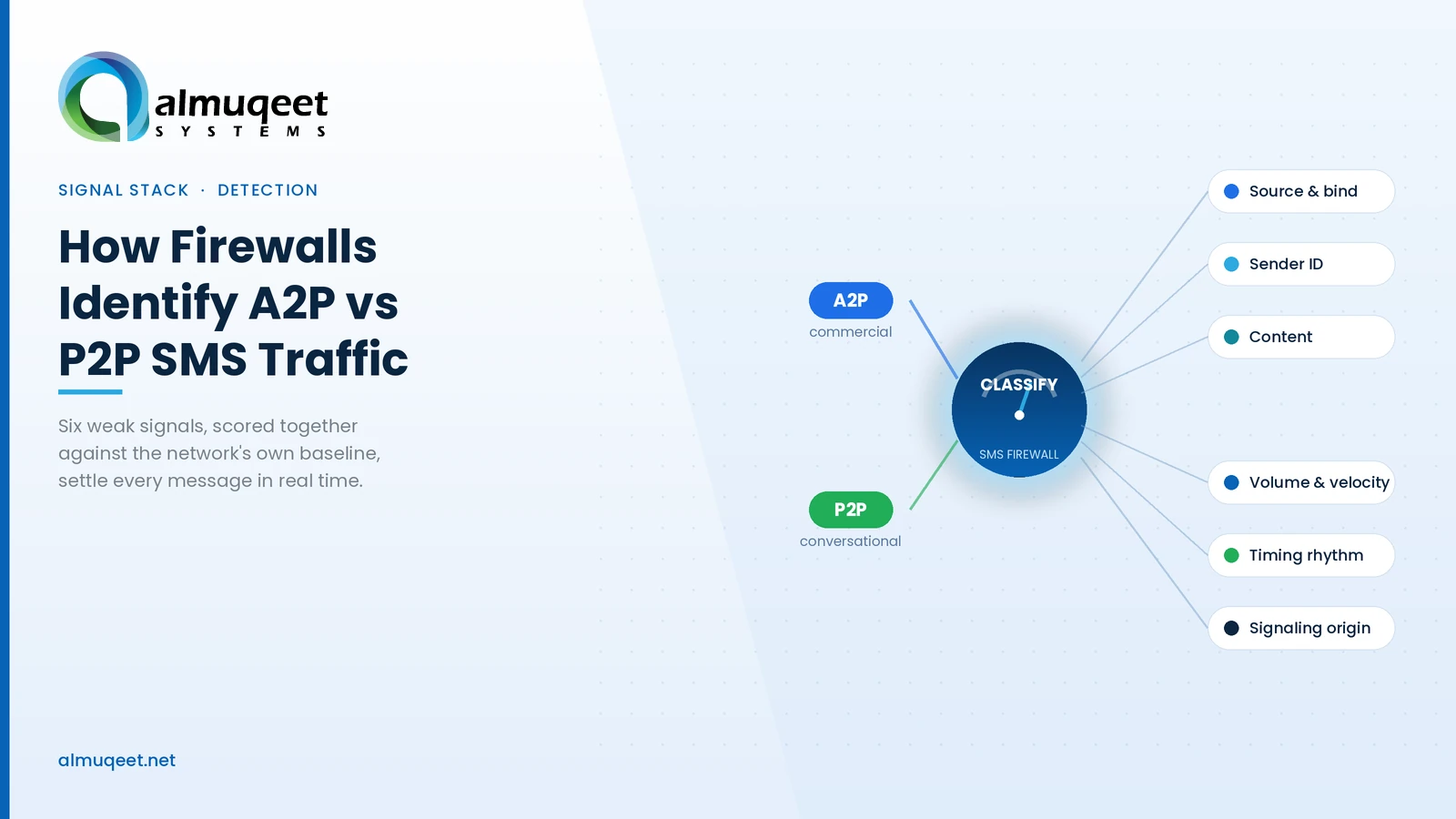
It starts with where the traffic walked in. A bind coming from a known aggregator, steady, heavy, is acting like an A2P pipe no matter what the message text says. The connection’s history and its throughput and whatever commercial deal sits behind it settle a surprising amount of this before anyone reads a single message body.
Then sender identity. An alphanumeric sender ID is already waving a flag, because normal people do not have those. Numeric senders are trickier and take more work. The engine is checking whether that originating number is a genuine subscriber MSISDN, a short code, a long virtual number, or just something shaped vaguely like a phone number that maps to no real handset anywhere. A “number” that claims to be an ordinary mobile while blasting like a broadcaster is exactly the contradiction the whole thing is tuned to catch.
Content gets fingerprinted next. Bodies are hashed and lined up against each other. When a thousand of them rhyme, with the variable bits sitting in the same slot every time, with the same style of link or the same OTP shape, the score slides toward A2P. This is also where the phishing and scam templates light up, which is why content inspection ends up doing two jobs at once.
Volume and velocity run on counters, per source, per bind, per route, inside rolling windows. Push past the human ceiling, and you get reclassified on the spot. The thing that quietly beats weaker platforms is aggregation. Split a campaign across forty binds so each looks tiny and a firewall that only counts per bind sees forty harmless trickles instead of one flood. If it cannot add them up, it loses.
Timing, same idea as the signature above but now it is a live check. The engine knows roughly what the human daily curve looks like for that market and flags the traffic that ignores it. Flat all night, intervals too clean, bursts with no event behind them.
And there is a layer below all of this that a content filter never even sees. Some commercial traffic tries to slip in underneath the application layer entirely, abusing the signaling network to inject messages or smudge where they came from. You cannot catch that by reading message bodies, because the message does not show up in the form you were expecting. That needs protection down at the protocol level, and the split between the two control points is covered in SMS firewall vs SS7 firewall. Classification that forgets the signaling layer has a hole sitting under everything else it is proud of.
None of these calls it on its own. The firewall rolls them into a score, leans that score against the network’s own normal, and commits to an answer. Then, if it is any good, it watches whether that answer held and nudges itself. The platforms that do this well are not the ones with the one brilliant rule. They are the boring ones that got the baseline right and keep fiddling with it. Less of a story works better.
Where A2P and P2P SMS Classification Breaks Down
It gets things wrong. Anyone selling you a box that never does is selling.
The false positives sting. Some real person sends a wall of texts during an emergency, or a group chat goes off, or a new phone dumps a backlog of catch-up messages, and a volume rule throttles a genuine human. Every operator I have talked to has a version of this story, usually told a little sheepishly.
The false negatives cost more, they just cost quietly. Commercial traffic built to pass as P2P, thinned out, varied just enough, routed to blend in, sails through and terminates at consumer rates. That is not a scare story, that is the day job of grey route operators, and it is the reason you cannot set this up once and walk away.
And then the genuinely undecidable ones, the corner shop guy, the chatbot. There is no rule that resolves those honestly. Somebody has to make a policy call, pick a side, and write down why they picked it. That is not an engineering failure, that is just the shape of the problem.
What actually separates a working firewall from an expensive logging box is what it does after it blows a call. The good one takes the correction and gets better. The bad one keeps making the same mistake until someone spots it in the quarterly numbers, by which point it has been wrong for a very long time.
Grey Routes and A2P Traffic Dressed Up as P2P SMS
The commercial centre of all this is the grey route, so let me be exact about it.
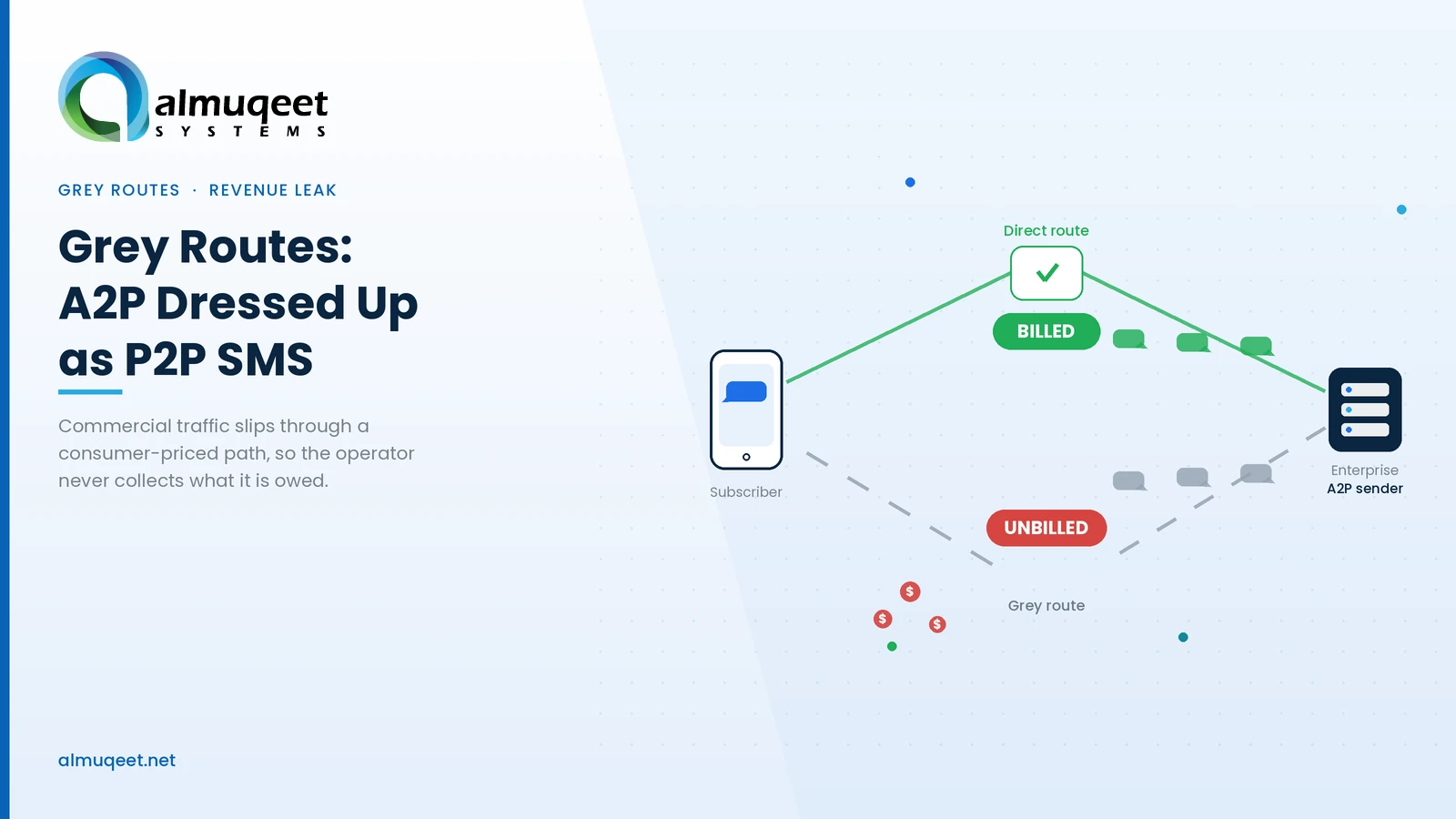
A grey route is A2P traffic reaching subscribers over a path priced for P2P. The enterprise pays some middleman, the message lands, the subscriber reads it none the wiser, and the terminating operator pockets a consumer rate or close to nothing. The message is real. Delivery works fine. The only thing wrong is the label and the money attached to the label. How the clean and dirty paths actually diverge is set out in direct vs grey route SMS, and the work of actually shutting them is in grey route filtering.
And this is exactly where getting the A2P vs P2P call right stops being academic. You cannot bill commercial traffic correctly until you have tagged it as commercial. You cannot recover the leak until you bill it. So classification is not really a security thing that happens to brush against revenue. It is a revenue thing wearing a security badge. The programme that gets built on top of it is A2P revenue protection, and it falls over if the detection underneath is soft.
What Getting the A2P vs P2P SMS Call Wrong Costs
Both directions hurt, just not the same way.
Call A2P “P2P,” and you bleed money, straight out, commercial traffic terminating at consumer rates, for years, with no alarm anywhere. That is the nasty one precisely because it is silent. The traffic delivered. Customers were happy. Nothing looked broken. The money just quietly never arrived.
Call P2P “A2P,” and now you are charging real people a business rate, or filtering their messages, and you get complaints and churn and eventually a regulator asking why you are treating grandma’s texts like a marketing campaign. Smaller hit to the wallet. Bigger hit to the reputation.
There is a delivery angle too, and it bites. Over-aggressive misclassification and the filtering that comes with it will shove legitimate messages into delay or outright failure, and when a bank’s codes stop landing, the complaint walks right back up the chain to the operator. The stuff worth ruling out first is gathered in why A2P SMS delivery rates drop.
And the slow cost, the one you only feel later. Enterprises that decide your SMS is flaky start quietly shifting their verification to app-based options. Classification feeds delivery, delivery feeds trust, and trust, once it leaves, comes back expensive. Part of the reason SMS still wins at all is argued in why A2P SMS outperforms OTT messaging, but that lead is not a birthright. You can lose it by being sloppy here.
Making A2P and P2P SMS Classification Hold Up Over Time
The thing nobody warns you about is that classification rots. Traffic shifts, senders adapt, and a rule set that was dead on in March is describing a network that stopped existing by September. A few habits keep it honest.
Get your baseline before you write a single rule. You cannot spot an anomaly if you never learned what normal was, and normal is specific to you, your markets, your enterprise mix. Borrowing someone else’s thresholds is just a machine for generating noise.
Count across binds, not just inside them. I said this already and I am saying it again because it is the hole I see most often. A campaign chopped across many connections only shows up if your platform can add it all back together. If it cannot, it is blind to exactly the traffic that was engineered to be invisible.
Actually check whether the number is real, do not just classify it. Confirming a destination is a live, reachable subscriber strips out a slab of junk and fraud before the classification question even comes up, and it tidies your routing as a bonus. How that plugs in sits in phone number intelligence and the HLR and MNP lookup services underneath it.
Go through your exceptions now and then. Every rule bolted on to calm one angry enterprise has a habit of outliving the complaint and quietly breaking something later. If you cannot remember why a rule exists, that is your answer.
And feed the mistakes back. A wrong call nobody corrects is a wrong call you will make again tomorrow, and the day after. The loop is the whole point. What happens once a message is finally tagged, the routing side of it, matters just as much, and that part is in A2P SMS routing
The Short Version
A2P and P2P are simple to define and genuinely hard to separate once they are moving, mostly because the traffic that costs you the most to misread is the traffic built, on purpose, to be misread. The firewall is not checking a label. It is reading behaviour and betting on intent, fast enough that the person waiting on a code never feels the bet being made.
The operators who are good at this treat it as something alive. Baseline first. Count across the whole sender. Verify numbers before spending on them. Prune the rules they forgot the reason for. Feed every miss back in. The ones who are bad at it bought the box, set it up once, and have been quietly carrying business traffic at consumer prices ever since, with no real idea which messages or how much.
Almuqeet builds and runs the messaging security behind all this, SMS firewall deployment, signaling protection, HLR and MNP services, for teams that would rather not hand-tune a classification engine themselves. If you genuinely do not know what your setup is currently tagging as P2P, the fastest way to find out is to run a review against your own logs. If there is a gap, it tends to show up in the first pass. It usually does.
Frequently Asked Questions
What is the difference between A2P and P2P SMS?
P2P is a person texting a person. A2P is software texting a person, like an OTP or a marketing message. A2P carries a commercial termination rate because a business is getting value out of it. P2P is priced for ordinary consumers.
Why do SMS firewalls bother telling A2P and P2P apart?
Because only one of them should be billed commercially. Read A2P as P2P, and you leak revenue. Read P2P as A2P, and you overcharge or block real people. The firewall is the one spot that sees all the traffic before it terminates, so it is where the call has to happen.
How does an SMS firewall identify A2P traffic?
By stacking signals, not trusting any single one. Where the traffic entered, what the sender claims to be, how uniform the content is, how fast and how much, the timing rhythm, and the signaling origin all feed a score that gets weighed against the network’s own normal.
Can commercial traffic pretend to be P2P SMS?
Yes, constantly, and that is the whole game. Grey route senders spread volume thin, vary their wording, and pick routes that blend in, specifically so the firewall reads them as P2P and bills them cheap. Anything that only counts per connection usually misses it.
What is a grey route?
A2P traffic delivered over a path priced for P2P, so the terminating operator never sees the commercial rate. It stays hidden because the message arrives perfectly fine. You only find it when someone compares the billing against the actual traffic.
Does mislabeling P2P as A2P actually cause harm?
It does. Charging genuine consumer messages a business rate, or filtering them as suspected A2P, brings complaints, churn, and regulators. Less money on the table than the A2P leak, but a worse look.
Share this post