

In most systems, phone numbers are treated as static identifiers, fixed entries in a database that don’t require much thought once stored. They’re collected, validated once, and then reused across campaigns, alerts, and authentication flows without much reconsideration. That approach works, up to a point.
But messaging environments don’t operate in static conditions. Networks evolve, users switch operators, number statuses change, and routing paths behave differently over time. What your system assumes about a number and what’s actually true at the moment of sending can slowly drift apart.
This disconnect doesn’t usually cause immediate failure. Instead, it shows up in more subtle ways, uneven delivery speeds, inconsistent performance across regions, and messages that technically go through but don’t arrive when they’re needed.
 Phone number intelligence addresses that mismatch. It restores real-time awareness to your system, so decisions are based on the current state of a number rather than outdated information stored earlier.
What Phone Number Intelligence Actually Does
On the surface, it sounds simple to get information about a phone number. In reality, it’s correcting one of the most common false assumptions in messaging systems, that a phone number is static, it isn’t. Numbers move, they get ported between operators, they change status. Understanding how numbers shift across networks is exactly what HLR lookup vs MNP lookup is built around. They become unreachable or shift networks without any visible signal unless you’re actively checking.
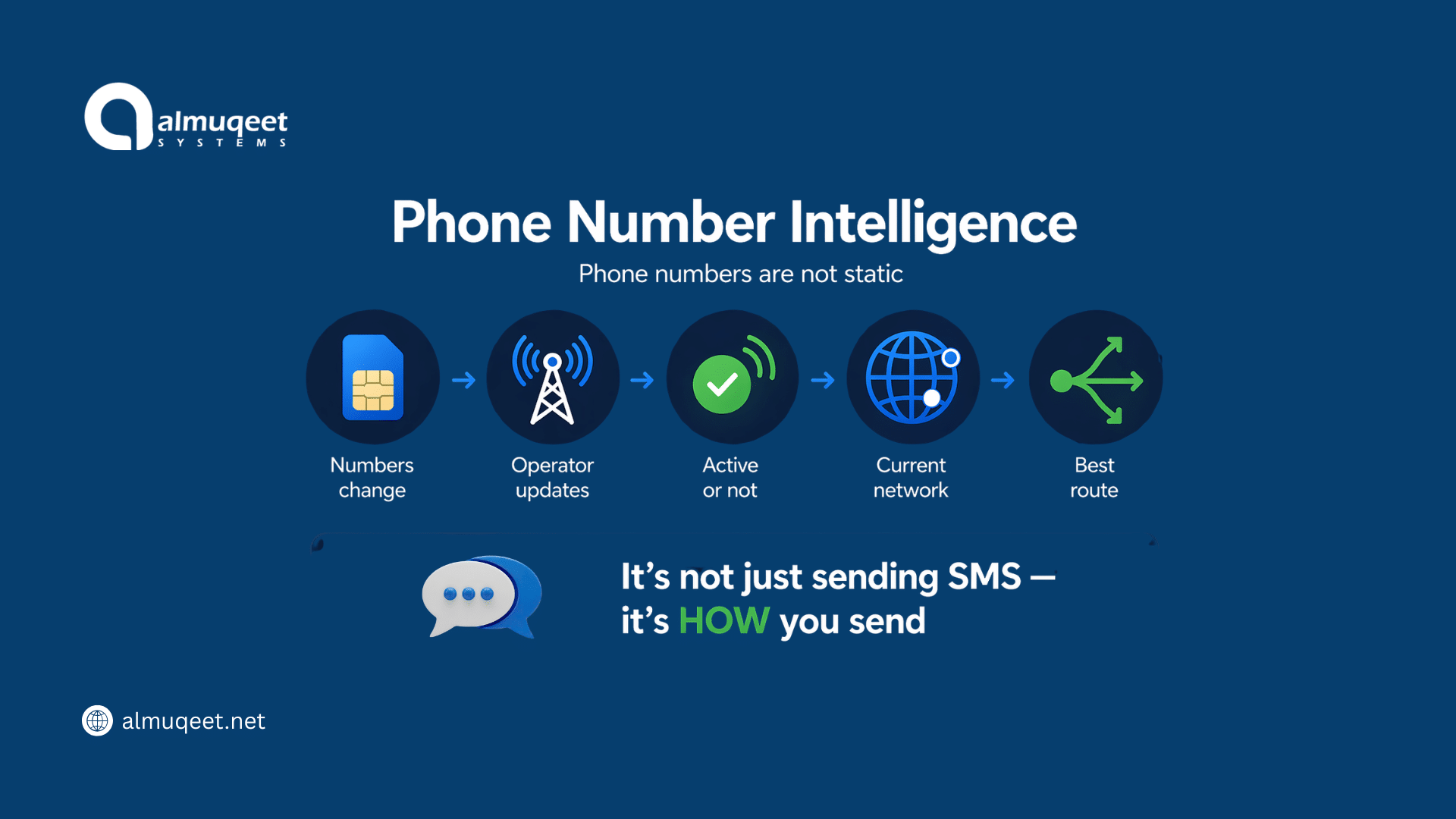 Phone number intelligence gives your system a current view of that number:
- Which operator does it belong to right now
- Whether it’s active and reachable
- What network does it sit on
- How it should be routed
That last part matters more than most teams expect. Because SMS delivery isn’t just about sending, it’s about how you send.
Delivery Problems Don’t Usually Start at the Gateway
When delivery rates drop, most teams look at vendors, routes, or throughput limits. But often, the issue starts earlier. If your system routes messages based on outdated operator data, you’re effectively sending traffic down the wrong path. This is a common issue explained in detail in A2P SMS routing explained.
- Sometimes it still works.
- Sometimes it slows down.
- Sometimes it disappears into retry loops.
You won’t always see a hard failure. You’ll see inconsistency. That’s what makes it difficult to diagnose. OTP delays are usually the first visible symptom. A message that arrives late is technically delivered, but operationally useless. The system keeps retrying, costs go up, and users lose patience. All of this can happen without a single clear error.
Scale Exposes What Small Systems Hide
At low volumes, inefficiencies don’t stand out. Messages eventually get delivered, and minor delays don’t trigger alarms. At scale, those same inefficiencies start to surface.
Consider a retail campaign during a flash sale. Millions of messages go out in a short window. Some users receive them instantly. Others get them late enough that the offer is no longer relevant. Nothing is “down.” But performance is uneven.
What’s happening underneath is usually tied to routing decisions made without accurate number-level insight. One network path becomes congested. Another remains underused. Without knowing where each number actually belongs, your system can’t rebalance traffic intelligently.
So it keeps pushing messages through routes that are technically available, but not optimal. Over time, this creates a pattern:
- Latency spikes during peak hours
- Retry volumes increase
- Delivery varies by operator and region
- Costs rise without a clear justification
It’s not failure. It’s inefficient under pressure.
When Messaging Becomes Infrastructure
There’s a point where SMS stops being a communication channel and becomes part of your core system, it usually happens with:
- OTP and authentication flows
- Financial transaction alerts
- Time-sensitive notifications
At that stage, delivery isn’t just a metric. It’s tied directly to user experience and business outcomes. If a login OTP is delayed, the user doesn’t care why. They just see a system that doesn’t respond when expected. This is where phone number intelligence shifts roles. It’s no longer a lookup tool. It becomes part of your decision layer:
- Which route should be used
- Whether the number is reachable at all
- How to handle retries intelligently
- When to switch channels if needed
That kind of decision-making depends on real-time accuracy.
Where It Works And Where It Can Break Down
When implemented well, phone number intelligence improves delivery quietly. Messages take more efficient paths. Latency becomes more predictable, and retry loops are reduced. Costs stabilize. But it’s not immune to problems.
The biggest challenge is freshness. This becomes more critical in regions shaped by global telecom regulations on number portability, where number data changes more frequently. If the data is cached too aggressively, it becomes outdated, especially in regions where number portability is frequent. If lookups are too slow, they introduce latency into real-time systems.
There’s always a trade-off between speed and accuracy. Systems that rely on static or infrequent updates tend to struggle over time. Those that integrate real-time intelligence directly into routing decisions tend to hold up better under load.
The Cost You Don’t Immediately See
Hard failures are easy to measure. Soft inefficiencies aren’t. A message that arrives late still counts as delivered. But if it misses its purpose in an OTP window, a promotional moment, its value drops sharply. These small gaps accumulate:
- Increased support queries
- Lower conversion rates
- Higher messaging spend due to retries
- Gradual erosion of trust
None of this shows up in a single metric. It builds over time. That’s usually when teams start looking deeper into their messaging stack, not because something broke, but because something isn’t performing the way it should.
A Pattern That Repeats in High-Volume Systems
There’s a pattern you start to recognize once systems scale. Everything works fine during normal traffic. Then a spike hits a campaign, a product launch, a surge in user activity. That’s when inconsistencies appear. Certain regions slow down. Specific operators show higher delays. Retry queues grow quietly in the background.
It’s rarely a capacity issue. It’s a visibility issue. Without accurate phone number intelligence, the system doesn’t know how to adapt. It keeps routing based on outdated assumptions while network conditions shift in real time. The result isn’t failure. It’s an uneven performance when it matters most.
Where It Fits in a Modern Messaging Stack
Phone number intelligence doesn’t replace routing or delivery systems. It sharpens them. It sits just before the routing decision, informing how messages should move through the network. In a well-structured system, it works alongside:
- Routing engines that dynamically select paths
- Fraud detection systems that filter suspicious traffic
- Compliance layers that enforce regulatory rules
It doesn’t send messages. It ensures they’re sent correctly.
Final Thoughts
SMS delivery isn’t just about pushing messages out. It’s about how those messages move through networks that are constantly changing underneath you. Phone number intelligence is one of those layers that rarely gets attention until something feels off. When it’s missing, you see inconsistency. When it’s outdated, you see inefficiency. When it’s working properly, you don’t notice it at all. And that’s usually a good sign.
If your delivery performance feels uneven, not broken, just unreliable in certain moments, the issue may not be your gateway or your routes. It may be that your system doesn’t fully understand the numbers it’s trying to reach.
FAQs
- Does phone number intelligence guarantee 100% delivery?
No. It improves routing accuracy and reduces inefficiencies, but delivery still depends on network conditions and operator behavior. - How does it help with OTP performance?
By ensuring messages are routed through the correct operator path, reducing delays and failed attempts. - Is real-time data necessary?
In high-volume or critical systems, yes. Outdated data can lead to incorrect routing decisions. - Can small businesses benefit from it?
At lower volumes, the impact may be less noticeable. As scale increases, its importance grows. - Does it increase system complexity?
Slightly, but when integrated properly, it simplifies decision-making and improves overall efficiency. - What’s the biggest risk of not using it?
Gradual performance degradation not sudden failure, but increasing inconsistency over time.
Share this post