

A message fails quietly, there’s no alert when an OTP doesn’t arrive. No dashboard that shows the customer who gave up after the third retry. It just looks like churn somewhere else in the system.
If you’ve operated messaging at scale, you’ve seen this pattern. Delivery issues rarely show up as messaging problems. They surface as login failures, abandoned carts, or support tickets that never clearly point to the root cause. That’s where A2P SMS still holds its ground.
Despite the rise of chat apps, businesses continue to depend on them, not because it’s modern, but because it’s predictable. And when messaging becomes part of your infrastructure, predictability matters more than features.
 This article looks at that difference closely. Not from a feature comparison, but from how these channels behave under real load.
What A2P SMS Actually Is (Without the Marketing Layer)
A2P SMS is system-generated messaging delivered through telecom networks. It doesn’t depend on apps, sessions, or user behavior. A message leaves your system, moves through operator routing layers, and lands directly on the device if the number is reachable.
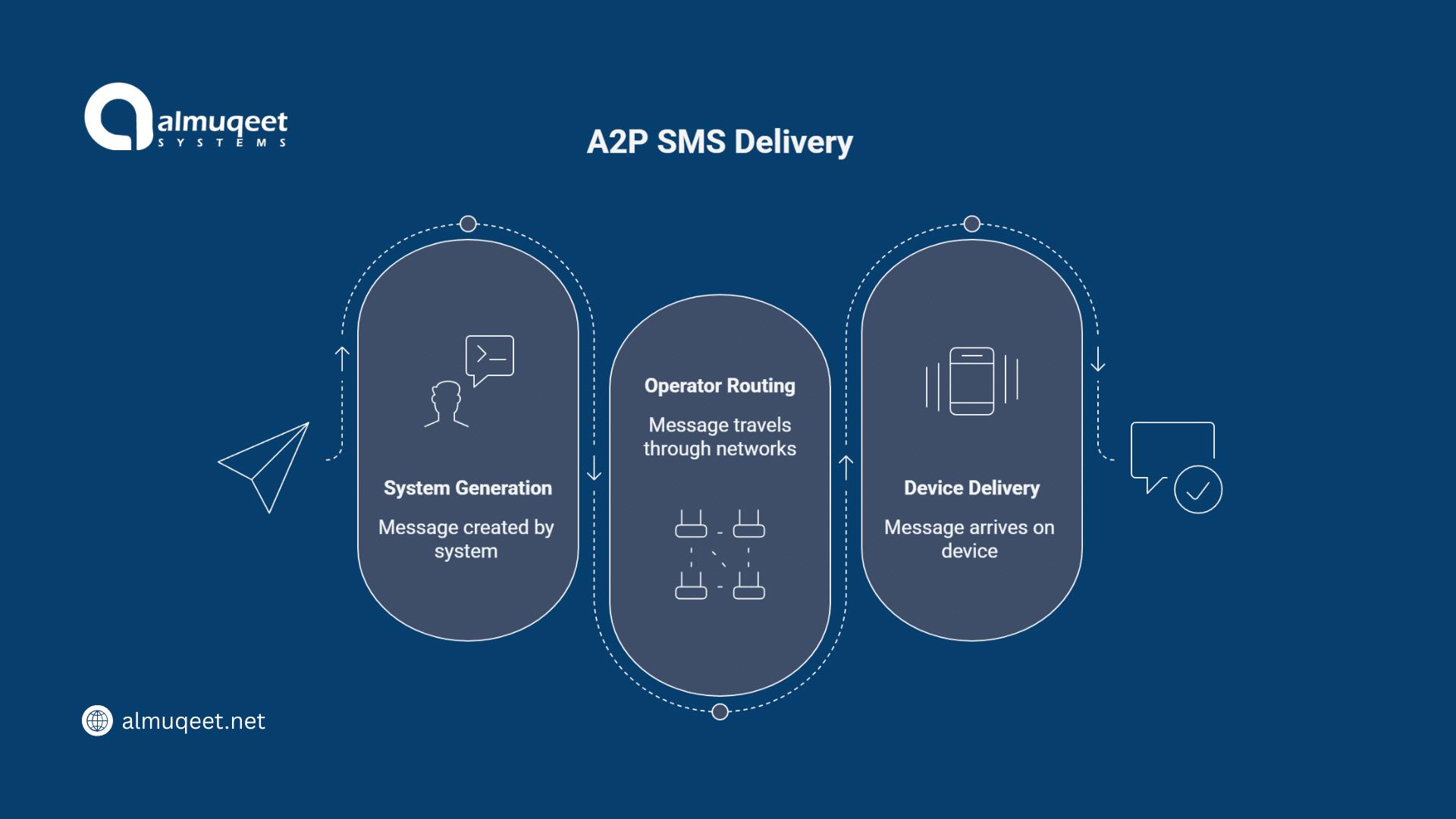 That simplicity is deceptive. Under the hood, routing decisions, signaling, and operator relationships determine whether delivery is instant, delayed, or dropped. Typical use cases are straightforward:
- Authentication (OTPs)
- Transaction alerts
- Service notifications
- High-volume campaigns
It’s different from P2P SMS because it’s not user-driven. It’s orchestrated, automated, and expected to work at scale without degradation.
OTT Messaging Looks Better Until It Doesn’t
Platforms like WhatsApp Business, Telegram, and Facebook Messenger have changed how businesses communicate. They’re interactive. They support the media. They feel closer to modern user behavior. But they come with conditions.
The user needs the app. The app needs to be active. The device needs data connectivity. And the platform needs to allow the message. Individually, these aren’t issues, at scale, they stack.
You start seeing inconsistent delivery patterns that aren’t always visible in reports. Messages marked “sent” but not actually seen. Delays vary by region, device, or network conditions. It’s not that OTT fails. It’s that it’s not built for guaranteed reach.
A2P SMS vs OTT Messaging: Where the Differences Show
| Factor | A2P SMS | OTT Messaging |
|---|---|---|
| Reach | Any active SIM | App-dependent |
| Delivery | Telecom network | Internet + platform |
| Latency | Consistent | Variable |
| Visibility | Detailed reports | Limited insights |
| Compliance | Operator-regulated | Platform policies |
| Integration | Stable APIs | Evolving constraints |
| Cost behavior | Predictable | Context-dependent |
On paper, OTT often looks more capable. In production, SMS tends to be more reliable.
Reach Still Decides Outcomes
There’s an assumption that everyone is reachable through apps now. That assumption breaks quickly outside controlled environments. In many markets, users:
- Switch devices frequently
- Use limited data plans
- Don’t install or actively use multiple apps
SMS ignores all of that. It doesn’t care about OS, app versions, or user preferences. It only needs a valid number connected to a network. That universality becomes critical when your audience isn’t uniform.
Why Carrier Networks Behave Differently
SMS travels through signaling systems like SS7. It’s a controlled environment. Routing paths are defined. Operators manage throughput and prioritization. OTT messaging runs over the public internet. That introduces variability:
- Network congestion
- Routing inefficiencies
- App-level throttling
Under normal conditions, both work fine. Under stress, peak traffic, outages, or regional instability, SMS tends to degrade more gracefully. OTT systems can become unpredictable in ways that are harder to diagnose.
What “98% Open Rate” Really Means
The often-quoted SMS open rate isn’t just a marketing statistic. It reflects behavior. SMS messages arrive in a space that isn’t crowded by feeds, ads, or background noise. When a message lands, it gets attention quickly.
OTT notifications compete with everything else happening on the device. They can be muted, delayed, or ignored depending on user settings. In operational terms, SMS is closer to an interrupt. OTT is closer to a notification. That distinction matters for time-sensitive communication.
Compliance Isn’t a Feature: It’s a Constraint
SMS operates inside telecom frameworks. Regulations from bodies like TRAI, GDPR, and TCPA define how messaging is sent, tracked, and controlled. It can feel restrictive.
But it also creates consistency. OTT platforms enforce their own rules. These can shift based on policy changes, regional enforcement, or platform priorities. For businesses in finance or healthcare, that variability becomes a risk.
The Quiet Role of HLR Lookup
One of the less visible layers in A2P SMS is number intelligence. Before sending, systems often perform HLR checks to confirm if a number is active and which network it belongs to. It sounds minor, but it directly affects:
- Delivery rates
- Routing accuracy
- Messaging cost
Skipping this step leads to wasted traffic and avoidable failures.
Integration Is Where SMS Feels Mature
SMS APIs have been stable for years. They plug into authentication systems, CRMs, and ERPs without much friction. OTT integrations are improving, but they come with layers:
- Template approvals
- Session rules
- Platform-specific limitations
If you’ve ever had a campaign blocked due to a template issue, you know how disruptive that can be. SMS doesn’t have that complexity.
Cost Looks Different at Scale
At low volume, OTT messaging often appears cheaper. At high volume, the picture changes. Costs start to include:
- Session-based pricing
- Template approvals
- Regional variations
SMS pricing is more linear. More importantly, it aligns closely with actual delivery. You’re paying for messages that are far more likely to arrive.
What This Looks Like in the Real World
Consider a payment platform during peak hours. Users are logging in, requesting OTPs, and retrying failed attempts. If messages are delayed by even a few seconds:
- Sessions expire
- Requests duplicate
- System load increases
Now multiply that across thousands of users. The issue isn’t just messaging anymore. It’s system stability. This is where A2P SMS tends to hold up better. Not perfectly, but predictably.
Where OTT Messaging Actually Wins
It’s worth being clear OTT isn’t inferior. It’s just different. It performs well in:
- Customer support conversations
- Rich media communication
- Ongoing engagement flows
If your goal is interaction, OTT is often the better choice. If your goal is guaranteed delivery, SMS still leads. Most mature systems use both.
Almuqeet Systems: Making Global Messaging Simple
Almuqeet Systems is one of the providers that allows such reliability. The company assists brands in sending large amounts of A2P SMS across the world, as direct connections to the carriers are made with HLR Lookup Services to confirm the correctness of the number before the release of a single message. The strategy is cost-effective, minimizes failed deliveries, and ensures security of customer information- all this, and businesses have one platform to handle worldwide communication.
Final Thoughts
OTT applications are good for personal conversations and sharing rich media. Nevertheless, A2P SMS has remained superior to all the other alternatives when a business requires certain delivery, compliance with regulations, and quantifiable interaction. Its unlimited availability, an abundance of open rates, and integration capability make it the most effective channel for all types of marketing campaigns to essential security warnings.
In companies where a single message counts, having an experienced provider such as Almuqeet Systems would be the way to get the message right, on time, and at a reasonable cost. A2P SMS is the medium in the busy business communication universe that you can always rely on to contact everybody, everywhere, every time.
FAQs
Is A2P SMS still relevant in 2026?
Yes, especially for critical communication. Its role has shifted from convenience to infrastructure.
Why do OTP systems still rely on SMS?
Because it works independently of apps and delivers consistently across devices and networks.
Can OTT messaging replace SMS completely?
Not in scenarios where reach and reliability are non-negotiable.
Does SMS guarantee delivery?
No system guarantees delivery, but SMS offers higher consistency due to its network-level routing.
How does HLR lookup improve messaging?
It ensures messages are sent to valid, reachable numbers, reducing cost and improving success rates.
Share this post