
Anyone who has spent enough time in the SMS industry has had this moment: a client calls in a panic because their OTPs aren’t landing, conversion rates are slipping, and customers are complaining. You pull the logs, check the routes, and there it is, traffic running through some sketchy path that looked great on paper because it was cheap. That’s usually the day people start asking serious questions about direct routes.
 This guide is really for the people who deal with this every day: banks, fintech teams, e-commerce platforms, SMS resellers, anyone who relies on messages reaching users exactly when they’re supposed to. Direct routing isn’t something people usually talk about, but it often decides whether your messaging setup actually works or slowly drains revenue without you noticing. Let’s get into it.
What Is a Direct Route in A2P SMS
A direct route is exactly what it sounds like: a clean, authorized path between an SMS aggregator and a mobile network operator. No middlemen pretending to be someone else. No traffic dressed up as something it isn’t. The aggregator has a formal agreement with the operator to deliver A2P traffic, declares it as A2P, pays the operator’s official rate, and hands the message over the front door.
Compare that to the alternative traffic squeezed through routes meant for person-to-person SMS, or hopped through three or four countries to dodge fees, those routes exist. They’re cheaper. They also collapse the moment an operator’s firewall gets serious.
 Think of it like shipping. You can send a package through the official courier with a tracking number and a signature on delivery, or you can hand it to a guy who knows a guy. Sometimes the second option works. Sometimes your package ends up in a warehouse in another country.
How Does a Direct Route Work (Step-by-Step)
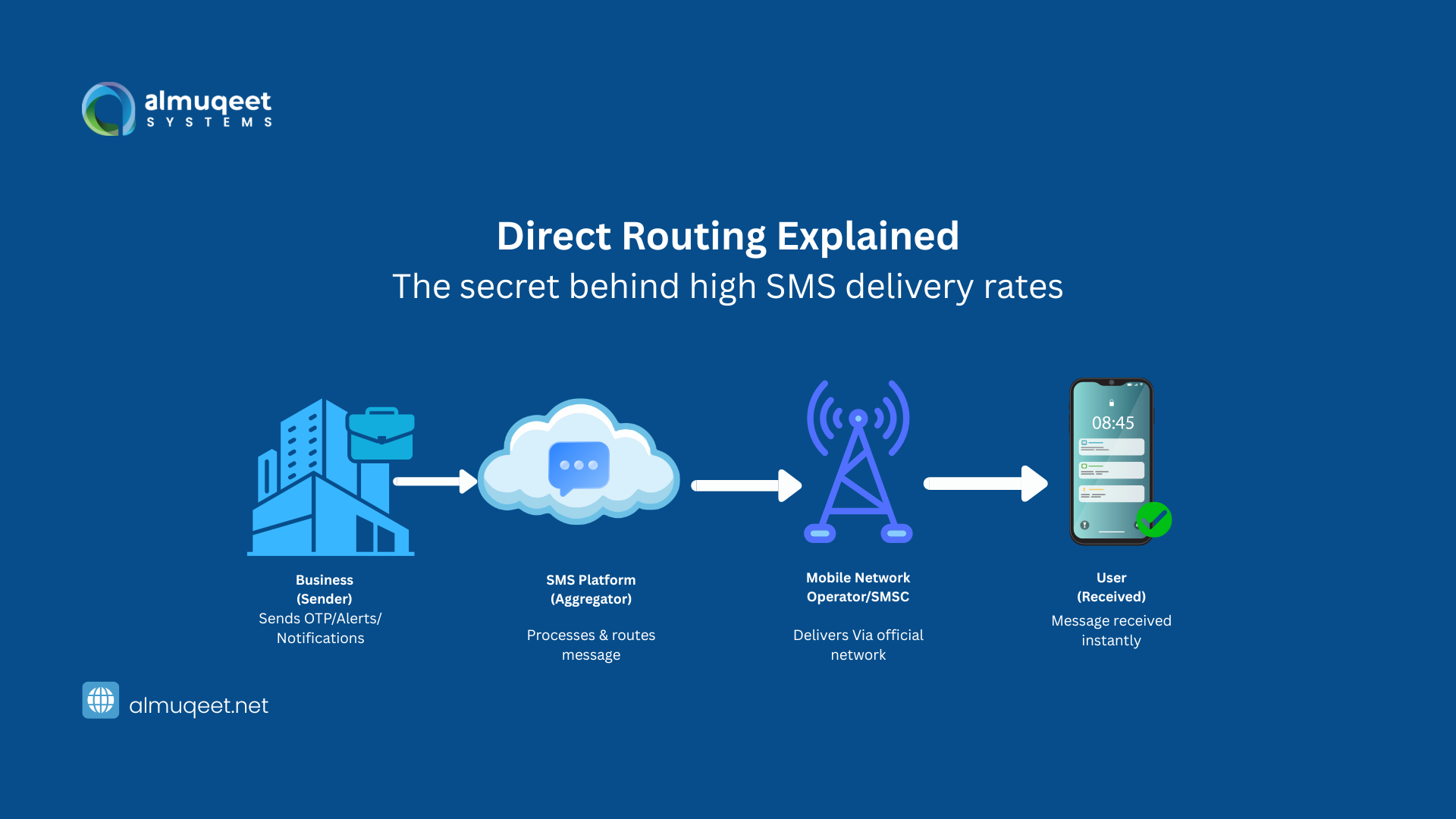
The flow is straightforward once you’ve watched it happen a few times. A business sends a message through its application, which could be an OTP, a delivery alert, or a marketing blast. That message hits an aggregator’s platform over SMPP. The aggregator, who has a direct contract with the destination operator, hands it off to the operator’s SMSC. From there, it lands on the recipient’s phone.
The technical layer underneath is mostly SMPP for the aggregator-to-operator connection, with SS7 still doing work in the background for signaling and delivery confirmation. Nothing exotic. What makes the route “direct” isn’t the protocol, it’s the contract.
The phrase “officially declared traffic” gets thrown around a lot, and it matters. When an aggregator declares traffic as A2P, the operator knows what it is, prices it accordingly, and treats it as legitimate enterprise messaging. That declaration is what protects the route from being filtered, blocked, or penalized down the line.
If you were drawing this on a whiteboard, it’d look like four boxes: sender, aggregator, operator’s SMSC, and recipient. One straight line through them. That’s it.
Direct Route vs Grey Route: Key Differences
Here’s where most of the real-world decisions happen. People know grey routes are problematic, but they keep using them because the cost difference is hard to ignore on a spreadsheet.
| Factor | Direct Route | Grey Route |
| Cost per SMS | Higher, predictable | Lower, volatile |
| Delivery rate | Consistently high | Drops without warning |
| Compliance | Fully sanctioned | Operates in violation of the operator terms |
| DLRs | Real and accurate | Often faked or unreliable |
| Sender ID | Preserved | Frequently stripped or replaced |
| Long-term reliability | Stable | Degrades as operators tighten filters |
The thing nobody tells you about grey routes is the slow degradation. They don’t fail dramatically. They just start failing a little more each month. Delivery drops from 95% to 88% to 76%, and by the time someone notices, you’ve already lost a quarter of your conversions. Operators are getting much better at spotting irregular traffic patterns, and once your traffic gets flagged, the route closes for everyone using it. For a deeper dive into how this filtering happens on the operator side, Grey Route Filtering covers the mechanics. The full comparison also lives in direct vs grey route SMS if you want a side-by-side view.
The brand reputation piece is harder to quantify, but real. Once your sender ID gets associated with traffic that operators don’t trust, getting it whitelisted again is a slow, painful process.
Why Businesses Choose Direct Routes
Higher delivery rates are the obvious one. When you’re sending an OTP and the customer is sitting on the checkout page waiting for it, the difference between 99% delivery and 92% delivery is the difference between a sale and an abandoned cart.
Speed matters almost as much. Direct routes don’t bounce through extra hops, so the message lands in seconds, not minutes. For two-factor authentication, that’s the entire game.
Then there’s sender ID preservation. On a direct route, the brand name stays intact. On grey routes, sender IDs get rewritten, replaced with random shortcodes, or stripped entirely, and customers stop trusting messages they don’t recognize.
DLRs are the quiet hero here. Real delivery receipts let you measure what’s actually happening. Fake DLRs, which grey routes love to generate, tell you everything was fine when half your messages never arrived. You can’t fix what you can’t see.
Compliance is the last big one, and the one most teams underestimate until a regulator shows up. Direct routes operate within the rules DLT, 10DLC, GDPR, TCPA, whatever applies in your market.
Industries That Rely on Direct Routes
Banking and fintech sit at the top of this list because they have no choice. An OTP that doesn’t arrive within ten seconds is a fraud window. Healthcare is similar; appointment reminders and prescription alerts have real consequences when they fail, and patient privacy rules don’t tolerate routes you can’t audit. The case for SMS gateways in banking and fintech is essentially a case for direct routing.
E-commerce uses direct routes for order confirmations and shipping updates because abandoned-cart recovery and post-purchase trust both depend on messages actually landing. Government and emergency services obviously can’t be running disaster alerts through grey routes. Travel and hospitality lean on direct routes for boarding passes, gate changes, and check-in info, anything where a delayed message creates a logistics problem.
The pattern is consistent: any business where a missing message costs more than the SMS itself ends up on direct routes.
How Direct Routes Improve A2P SMS Delivery Rates
A direct route is a cleaner path, and clean paths get filtered less. Operator firewalls are designed to catch traffic that doesn’t match expected patterns. Direct traffic matches those patterns by definition.
The relationship between aggregator and operator is also a factor that people don’t talk about enough. Aggregators with strong operator relationships get better cooperation when issues come up, faster troubleshooting, better visibility into why messages failed, and sometimes even priority handling during congestion. Grey route providers don’t have that luxury.
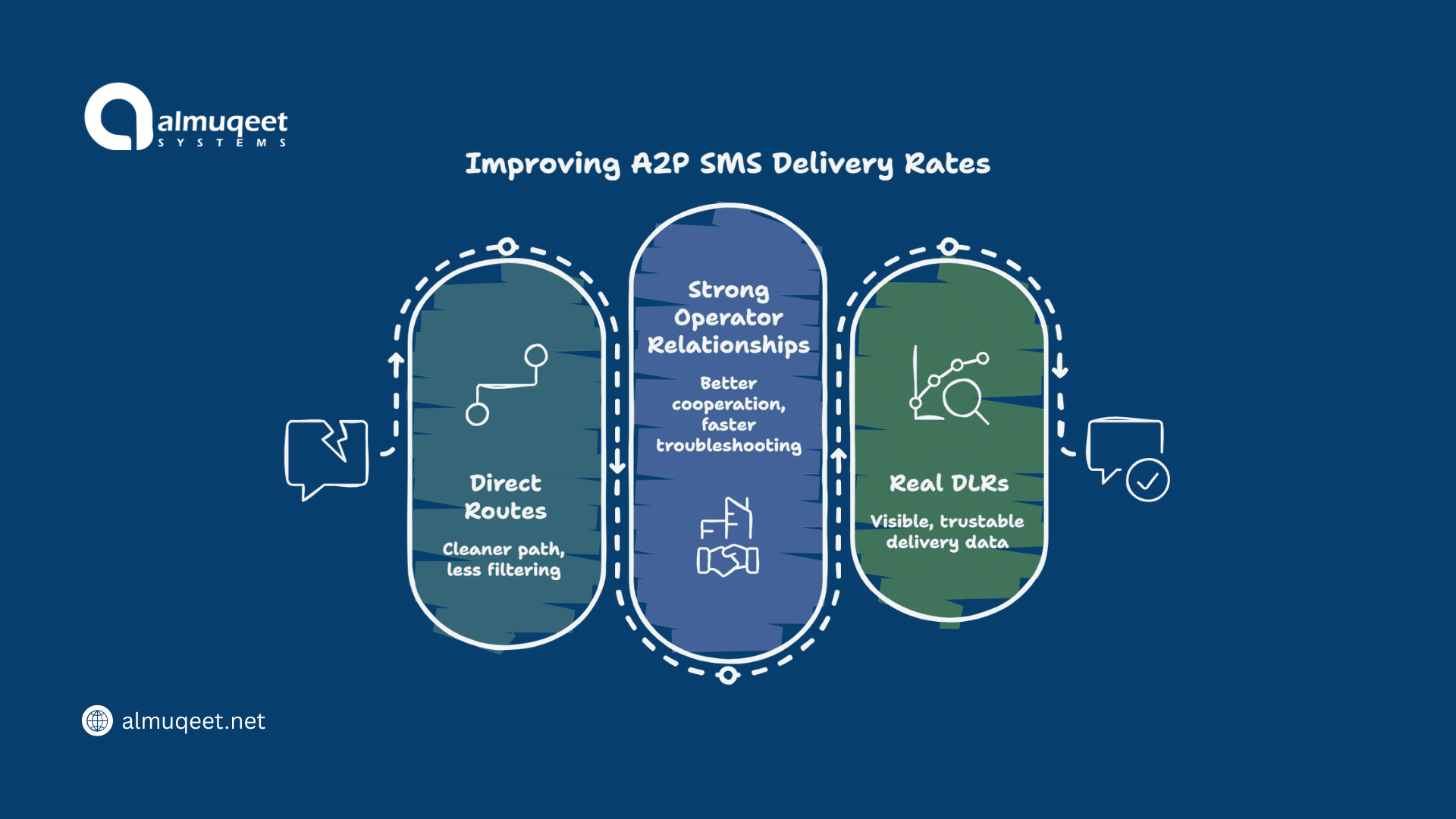 Real DLRs make the difference visible. When you can trust your delivery data, you can actually optimize. You can see which countries are underperforming, which time windows have issues, and which content patterns trigger filters. With fake DLRs, all of that work is wasted because you’re optimizing against fiction. The same logic explains why A2P SMS delivery rates drop on poorly-routed traffic.
Cost of Direct Routes vs Grey Routes
Direct routes cost more. There’s no point pretending otherwise. The price reflects an actual licensing arrangement, real network costs, and the operator’s cut. What the cost comparison misses is the hidden expense of cheap routing. A failed OTP isn’t a free message; it’s a lost transaction, a customer service ticket, and sometimes a churned customer. Multiply that across millions of messages a month, and the math flips quickly.
There’s also fraud exposure. Grey routes are notorious for traffic injection, in which messages are intercepted, modified, or duplicated. The cost of one serious SMS fraud incident usually exceeds years of premium routing fees. SMS fraud in telecom networks gets into the specifics of how this plays out. The honest framing isn’t “direct routes are expensive. Its direct routes are priced. Your failure rate subsidizes grey routes.”
How to Identify If You’re Using a Direct Route
Most providers won’t volunteer this information. You have to ask, and you have to ask the right way. Don’t ask “Do you use direct routes?” They’ll all say yes. Ask which operators they have direct agreements with, in which countries, and request documentation.
Some red flags surface quickly. Pricing that’s dramatically lower than the market rate is the obvious one. If a competitor is quoting you 30% below everyone else for the same destination, the route isn’t direct. Missing or inconsistent DLRs are another tell that real direct routes return clean, timely receipts. Sender ID swaps, where your brand name shows up replaced with a numeric shortcode on the recipient’s phone, are a giveaway.
Test methods are simple. Send messages to real test numbers across different operators in your target countries. Check delivery time, confirm sender ID, and verify DLRs against actual receipt. Do it across different times of day. A direct route performs consistently. A grey route shows visible variation.
The route documentation question is fair to ask. Reputable aggregators have it. If they can’t or won’t share it, that tells you what you need to know.
Direct Route Pricing Factors
Pricing varies more than people expect, and not always for obvious reasons. The destination country is the biggest variable. Tier-1 markets like the US, UK, and Germany cost differently from Tier-2 or Tier-3 markets, and operator pricing within each market varies again. The Tier 1 vs Tier 2 telecom messaging breakdown gets into why these tiers behave so differently.
Operator pricing tiers within a country can shift things significantly. The same SMS to two different operators in the same country can have different costs because each operator sets its own A2P termination rate.
Volume commitments matter. Aggregators offer better unit pricing to senders who commit to volume because it lets them negotiate better with operators. The quality of the aggregator’s underlying agreements also shapes price. An aggregator with direct Tier-1 contracts costs more than reselling someone else’s connections, but the delivery quality reflects that.
Challenges and Limitations of Direct Routes
Direct routing isn’t a magic answer. The cost is real, and for low-margin businesses sending high volumes of low-priority messages, that cost can be hard to justify.
Coverage gaps exist. Some operators in some countries don’t offer direct A2P agreements at all, or only offer them at impractical volume thresholds. In those markets, even reputable aggregators have to use semi-direct or alternative routes, and the honest providers will tell you that upfront.
Aggregator dependency is the other limitation. Your direct route is only as direct as your aggregator’s contract. If they lose an operator agreement, your traffic suddenly isn’t direct anymore, even if your contract with the aggregator hasn’t changed.
Compliance work is ongoing, not one-time. Sender ID registration, content templates, opt-in tracking, and direct routing come with paperwork.
How to Choose the Right Direct Route Provider
This is mostly a vetting exercise. The questions to ask are practical: which Tier-1 operators do you have direct agreements with, can you show documentation, what’s your DLR accuracy rate, what’s your average delivery time per market, what’s your NOC coverage, and do you have compliance certifications for my markets
A few things worth checking before signing anything:
- Transparent country-by-country pricing rather than vague averages
- Real-time reporting and dashboards, not weekly PDFs
- 24/7 NOC support with actual humans, not a ticket queue
- Compliance certifications matching your markets (DLT for India, 10DLC for US, etc.)
- Geographic coverage that matches where you actually send
Red flags are usually obvious in retrospect. Aggressive pricing without explanation. Reluctance to share operator names. Pressure to commit to long contracts before testing. Customer references that aren’t checkable.
Direct Routes and SMS Compliance
Compliance and direct routing are tied together more than people realize. Direct routes aren’t just better at delivering messages, they’re necessary for staying inside the regulatory envelope.
DLT registration in India requires that traffic be sent through registered, declared paths. 10DLC in the US has specific requirements about which numbers can send A2P traffic and how it must be registered. TRAI rules in India, GDPR in Europe, TCPA in the US, all of them assume you have visibility into and control over how your messages are being routed. Grey routes break that assumption.
Sender ID rules vary by country, but the principle is the same: the recipient should know who sent the message, and the sender should be accountable for the content. Direct routes preserve both. The full picture, market by market, lives in the global SMS compliance guide.
Future of Direct Routes in A2P Messaging
A few things are changing the landscape. RCS adoption is shifting some traffic toward richer formats, but RCS has its own routing requirements that look a lot like direct A2P SMS operator-sanctioned, declared, contractually defined. 5G doesn’t change the routing model fundamentally, but it does increase pressure on operators to keep their networks clean, which usually means tighter filtering and less tolerance for grey routes.
Operator regulation is tightening pretty much everywhere. Markets that used to look the other way on grey traffic are introducing firewalls, registration requirements, and audits. The window for unsanctioned routing is closing.
AI-driven route optimization is becoming more interesting, too. Aggregators are using real-time delivery data to switch between direct paths dynamically, picking the best-performing route per operator at any given moment. Done right, it improves delivery without compromising on the direct-route principle.
The direction of travel is clear. Direct routing is becoming less of a premium choice and more of a baseline.
FAQs
What is the difference between direct route and grey route SMS?
A direct route uses an officially authorized, contracted path between aggregator and operator, with traffic declared as A2P. A grey route uses unauthorized paths, often by routing traffic across borders or disguising A2P as P2P traffic to dodge fees. Direct routes are more reliable, more expensive, and fully compliant.
Are direct routes more expensive?
Yes, but the comparison is misleading. Grey route savings get eaten up by failed deliveries, fake DLRs, fraud exposure, and brand damage. Most businesses that calculate the true cost end up choosing direct routes.
How do I check if my SMS provider uses direct routes?
Ask for a list of their direct operator agreements with documentation. Run delivery tests with real numbers across operators. Check DLR accuracy and sender ID preservation. Watch for unusual price variation.
Do all countries support direct routes?
Most major markets do, but coverage varies. Some operators in smaller markets don’t offer direct A2P agreements or set unreachable volume thresholds. In those cases, even good aggregators have limited options.
Can a single provider offer 100% direct routes globally?
Realistically, no. The strongest aggregators have direct agreements covering most major markets, but global 100% direct coverage is more of a marketing claim than a reality. Honesty about coverage gaps is a good sign in a provider.
Why do OTPs fail on grey routes?
Operator firewalls increasingly detect and filter grey traffic in real time. When a route gets flagged, messages get dropped silently or delayed beyond their useful window. OTPs are the most visible casualty because they’re time-critical.