

There is a point every high-volume sender reaches where the messaging invoice stops being a rounding error and becomes a line item someone in finance wants explained. Usually it arrives quietly. Traffic grows, the per-message rate that looked trivial at fifty thousand messages a month starts to bite at fifty million, and the retail account that got you here is suddenly the most expensive part of the stack.
That is the moment the wholesale question comes up. Not because anyone wanted to learn about routing and termination rates, but because the retail way of buying SMS stopped making sense.
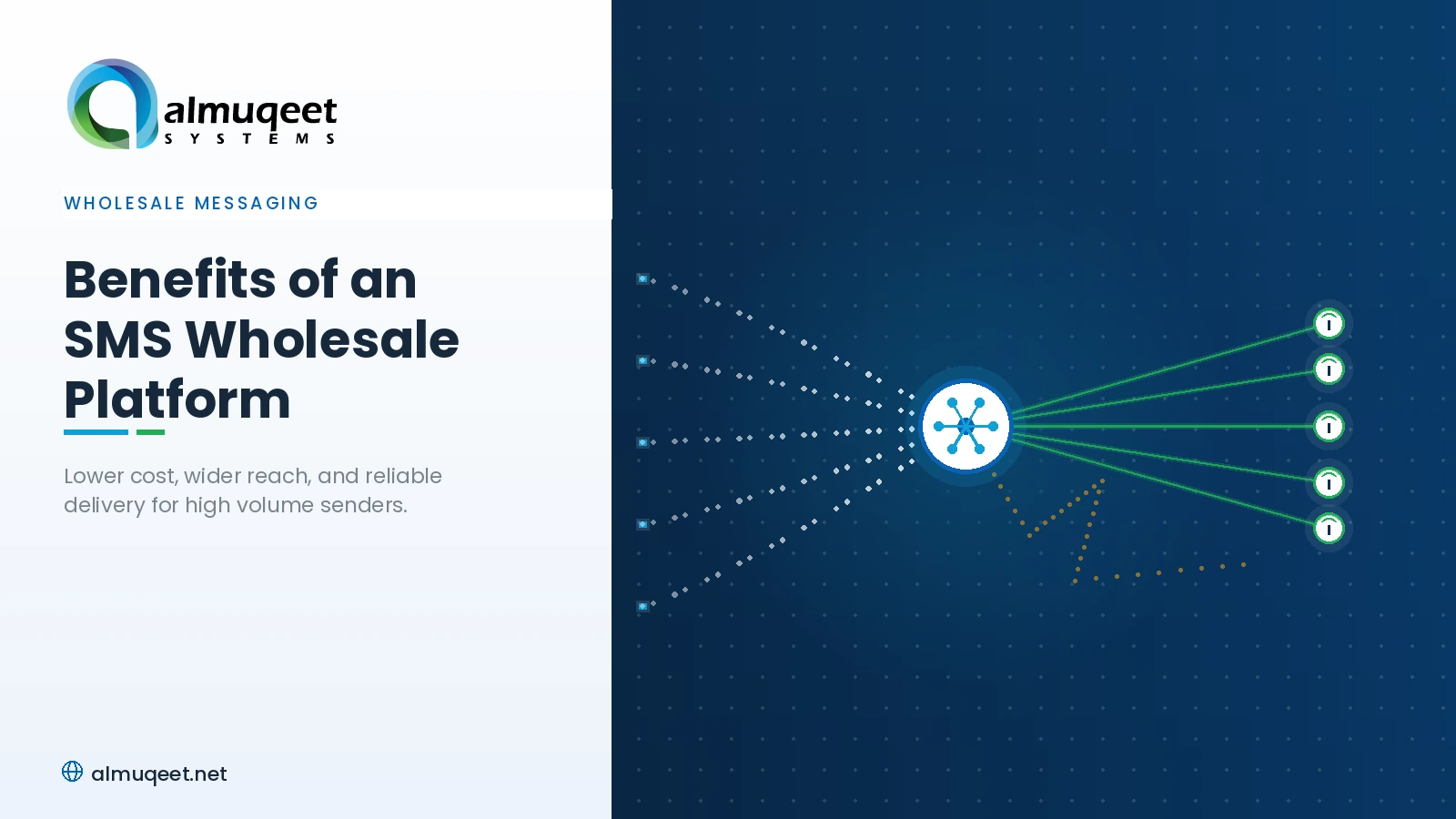
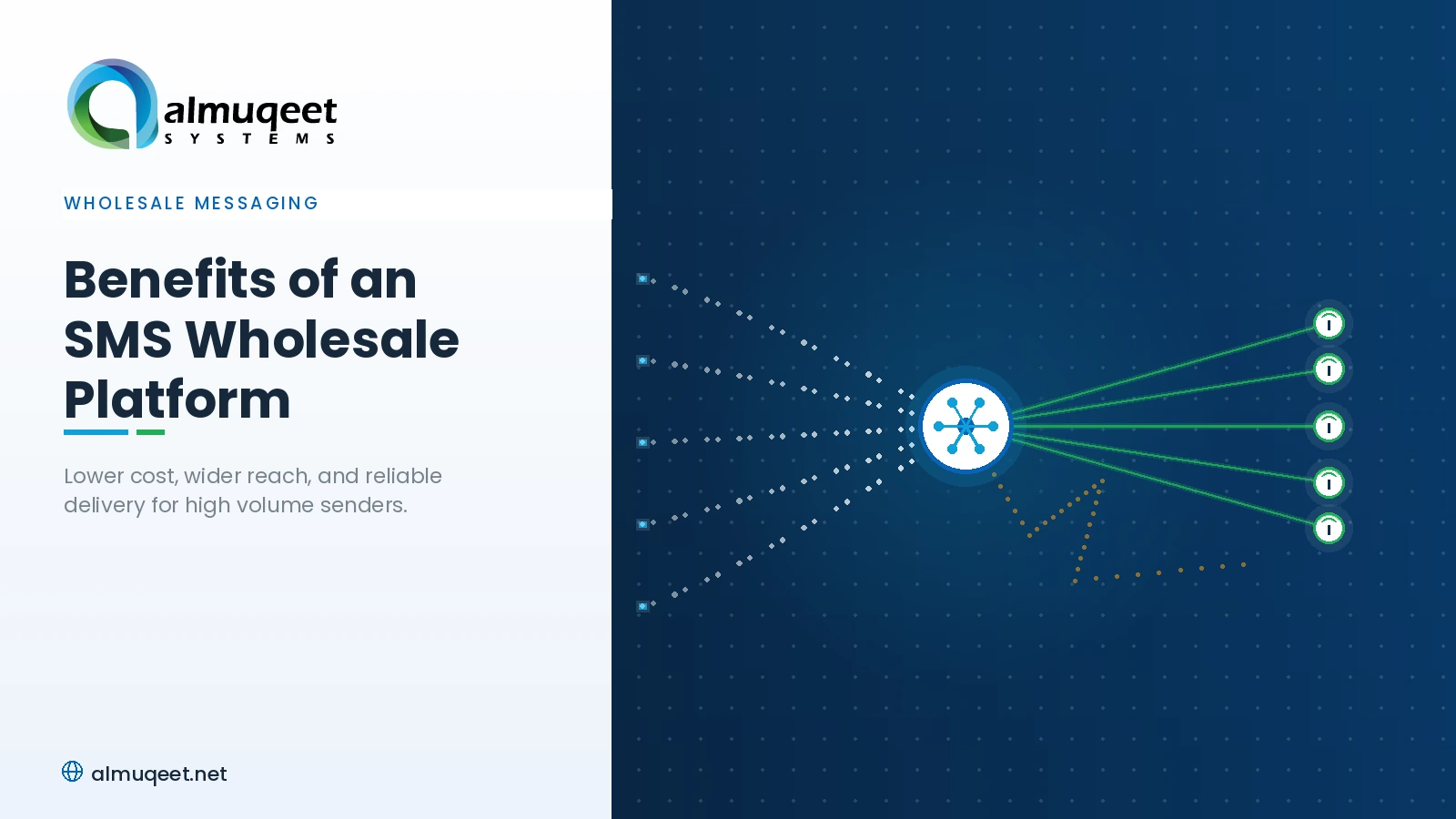
An SMS wholesale platform is the layer underneath the application. It connects a business directly to telecom carriers and aggregators instead of passing traffic down a chain of intermediaries, each of which adds cost and a place for delivery to fail. Get it right, and you stop thinking about it. Get it wrong, and you spend Mondays explaining why OTP delivery dropped in one country over the weekend.
This is a walkthrough of what a wholesale platform does, where the benefits actually come from, and who they apply to.
What an SMS Wholesale Platform Actually Does
An SMS wholesale platform sits between the business sending messages and the mobile networks that terminate them. Its job is to take large volumes of traffic and put each message onto a route that delivers it, at a price that works, without quietly losing messages along the way.
The reason this is harder than it sounds is that there is no single road from a sender to a handset. For any destination, there are dozens of possible paths, each with different pricing, different reliability, and different legitimacy. Some are direct agreements with the terminating operator. Some are aggregated hops through other carriers. Some are grey routes that deliver today and disappear tomorrow when the operator notices.
The platform is what chooses between them. A good one makes that choice per message, per destination, based on cost and delivery performance rather than a static route list somebody configured last year. The difference between the honest paths and the cheap ones is set out in direct versus grey route SMS, and it matters more at wholesale volume than anywhere else, because a bad route at scale is not a small mistake. It is thousands of undelivered messages before anyone spots the pattern.
Why High Volume Senders Outgrow Retail SMS
Retail SMS pricing is built for convenience, not for volume. You pay a flat per-message rate, the provider handles the routing invisibly, and you never see what happens underneath. That trade works until it does not.
The first thing that breaks is cost. Retail rates carry a margin that is invisible at low volume and painful at high volume. At a few tens of thousands of messages a month, the markup is a coffee budget. At scale it is a headcount.
The second thing that breaks is control. Retail providers make routing decisions for you, and those decisions optimise for their margin, not your delivery rate. You find out about a route problem when customers complain, not before. A wholesale platform gives you visibility into which routes carry your traffic and the ability to move it when one degrades.
The third thing is the account structure itself. A sender running multiple brands, or a reseller supporting downstream customers, needs to separate traffic, apply different pricing per client, and report per account. Retail accounts do not bend that way, which is the case the wholesale SMS platform for high-volume models exists to answer.
The Cost Benefits of an SMS Wholesale Platform
Money is the reason most businesses move to wholesale, so it is worth being specific about where the savings come from, because it is not one thing.
Wholesale pricing removes the retail margin layer. You buy closer to the source and the per-message rate drops. That is the obvious part, and depending on the corridor and the volume committed, it is a meaningful reduction rather than a marginal one.
The less obvious part is route optimisation. A platform that picks the cheapest reliable route per destination, rather than pushing everything down one path, saves on every corridor independently. A message to Nigeria and a message to Germany have nothing in common commercially, and a platform that prices them separately beats one that averages across them.
Then there is the waste you stop paying for. Every message sent to a dead number, or to a ported number routed to the wrong network, is money spent for nothing. Validating destinations before sending, using HLR lookup to reduce messaging costs, removes a slice of spend that most senders never realise they carry. At retail volume it is invisible. At wholesale volume it is real money.
Predictable billing helps too. Wholesale arrangements can be structured around committed volume, which makes the monthly number something you can forecast rather than something you discover. For a bank or a ride-hailing business where OTP volume tracks customer activity, a predictable rate on a swinging volume is worth as much as the headline discount.
How Routing Intelligence Improves Delivery on a Wholesale Platform
Cost is easy to talk about. Delivery is what keeps customers, and it is the part a wholesale platform lives or dies on.
Every route has a delivery rate, and it does not stay still. A path delivering well this month can drop hard next month when the terminating operator changes its filtering or an aggregator loses an agreement. A platform routing on price alone will keep pushing traffic down that dying path because it is still cheap. A platform routing on delivery performance moves the traffic the moment the numbers slip.
That is the line between a wholesale platform and a price list. Real routing intelligence watches delivery per route, per destination, continuously, and rebalances without a human in the loop. How messages get steered is covered in A2P SMS routing explained, and the reasons delivery slips even on good routes are worth ruling out early, which is what why A2P SMS delivery rates drop is for.
Number portability makes this harder than it looks. A subscriber who changed networks years ago still carries a number that looks like their old operator. Route on the prefix and the message goes to the wrong network and fails, and the delivery report rarely tells you why. Resolving the current network with MNP lookup for SMS routing fixes a class of failure that is otherwise almost impossible to diagnose.
The Reach Benefits of an SMS Wholesale Platform
Reach at wholesale is not one number either. It is whether your traffic actually lands, in the markets you care about, at the quality your customers expect.
Direct carrier routes are the core of it. Every intermediary hop between you and the terminating network is a place for the message to slow down, get filtered, or have its sender ID rewritten. A platform holding direct operator agreements shortens that path, and the shorter the path, the fewer things go wrong. This matters most in the regions where messaging is hardest, which tend to be the fastest-growing ones.
Global coverage follows from those agreements. A serious wholesale platform reaches operators across continents through a single connection, so a business serving customers in several markets integrates once rather than stitching together regional providers. The commercial logic behind building on that layer, rather than reselling a retail account with a markup, sits in the wholesale SMS gateway service provider breakdown.
SMS itself carries a reach advantage worth remembering. It works on every handset ever made, with no app and no internet connection required, which is exactly why verification and alert traffic still defaults to it despite years of predictions that something else would replace it.
The Reliability Benefits of an SMS Wholesale Platform
Reliability is not only whether a message arrives. It is when. An OTP that shows up four minutes late has already failed, because the user gave up and requested another one, and now you have paid for two.
Redundant routing is the first thing that protects against this. When one carrier path fails, the platform reroutes to another automatically instead of letting the message die. At high volume, where a single failing route can take out thousands of messages before anyone notices, automatic failover is the difference between a blip and an incident.
Real-time delivery reporting is the second. Delivery receipts, per-route performance, and failure reasons need to be visible while traffic is flowing, not summarised the next morning. By the time a daily report shows a problem, you have already sent a day of failing traffic.
Load balancing is the third. Spreading a high-volume campaign across multiple routes keeps any single path from congesting, which protects both delivery speed and the delivery rate itself. Sender ID integrity belongs here as well, because a route that rewrites your sender ID delivers a message your customer does not recognise, which for banking and verification traffic defeats the point entirely.
SMS Wholesale Platform Compared to Retail SMS
The practical differences line up cleanly enough to put side by side.
Feature | SMS Wholesale Platform | Retail SMS Provider |
Pricing | Lower wholesale rates, volume-based | Higher flat per-message charges |
Routing | Direct carrier routes | Multiple intermediaries |
Reliability | Failover and load balancing built in | Prone to delay, no failover |
Scalability | Handles millions without redesign | Limited beyond moderate volume |
Visibility | Real-time per-route reporting | Basic or none |
The pattern behind that table is why banks, healthcare providers, and government services tend to end up on wholesale platforms. When the messages are time-sensitive, and failure is expensive, the retail trade of convenience for control stops being worth it.
Which Industries Benefit Most from an SMS Wholesale Platform
The businesses that gain most from a wholesale platform are the ones where messaging is not marketing, it is operations.
Banking and finance run on OTPs for login and transaction verification, where late or failed delivery locks a customer out of their own account. E-commerce depends on order and shipping confirmations, and on verification codes at checkout. Healthcare uses appointment reminders and patient portal logins. Logistics runs on delivery alerts and driver verification. Ride-hailing verifies both riders and drivers before a trip begins. Government services handle citizen verification and emergency alerts, where reach has to be genuinely universal.
What these have in common is that the message is part of the workflow, not an add-on to it. That is exactly the traffic a wholesale platform is built to carry, and exactly the traffic that suffers most on a retail account when a route quietly degrades.
Why Resellers Depend on an SMS Wholesale Platform
Resellers use a wholesale platform differently from direct senders, and it is worth calling out separately.
A reseller is not sending their own traffic. They buy capacity and sell it on to downstream customers, each with their own volume, destinations, and expectations. That means the platform has to separate accounts, apply different rate cards per client, meter usage accurately enough to bill on, and report per customer without the operator reconciling it by hand.
Margin lives in the gap between the wholesale rate and what the reseller charges. Poor routing eats that margin through failed messages and support tickets. Clean routing and honest reporting protect it. The features that separate a workable reseller setup from a leaky one are gathered in top features of a reliable SMS reseller platform.
Best Practices for Running Traffic on an SMS Wholesale Platform
A wholesale platform rewards a bit of operational discipline, and most of it is cheap to do.
Segment your traffic so that OTPs and other time-sensitive messages take priority over promotional sends, which can wait during peak hours. Watch delivery reports as a standing habit rather than a post-incident activity, because per-route delivery is the earliest signal that something moved. Keep fallback routes configured and tested, so failover is a setting that works rather than a setting you assumed was on. Stay inside local telecom and data protection rules per market, since the regulatory picture differs by country and does not stay still. And for teams that would rather not staff a routing and fraud desk around the clock, managed messaging operations put someone who can read the signaling on the other end of the 2am delivery drop.
Frequently Asked Questions
What is an SMS wholesale platform?
It is the infrastructure layer that carries large volumes of SMS between a sender and the mobile networks that terminate it, choosing routes on cost and delivery performance. It sits underneath the application and handles the routing that retail providers keep hidden.
When does moving from retail to wholesale SMS pay off?
There is no exact threshold, but the move usually makes sense once the monthly invoice is large enough that finance starts asking about it. At that point, the retail margin you are paying outweighs the effort of managing routing, and the delivery control becomes worth having on its own.
Does a wholesale platform improve delivery or only cut cost?
Both, and delivery is often the bigger win. Wholesale platforms route on delivery performance rather than a fixed path, so traffic moves off a degrading route automatically. Retail accounts rarely give you that, so you keep sending down a failing path until customers complain.
Can resellers use an SMS wholesale platform?
Yes, and they are one of the main users. The platform separates downstream customer accounts, applies per-client pricing, and meters usage accurately enough to bill on. Running a reselling business on a single retail account is close to impossible without that structure.
How does number validation lower wholesale messaging cost?
Validating a destination before sending, with HLR and MNP lookups, filters out dead numbers and routes ported ones to the right network. That removes messages you would otherwise pay to send into a void, and improves delivery accuracy at the same time. At high volume, the savings are real rather than marginal.
Closing
The reason to move onto an SMS wholesale platform is rarely one dramatic thing. It is the accumulation of small ones. A margin you stop paying. Routes you can finally see. Delivery that recovers on its own instead of waiting for a complaint. Dead numbers you stop funding. Reporting clean enough to bill a downstream customer without a spreadsheet argument.
None of that is visible from inside a retail account, which is the whole problem. You cannot fix routing you cannot see, and you cannot optimise cost you were never shown.
Almuqeet operates wholesale messaging infrastructure for high-volume senders and resellers, with direct carrier connectivity across Africa, Asia, and the Middle East, HLR and MNP validation, and managed delivery for teams that want the volume without staffing the operations desk. The fastest way to find out what your current setup is costing is to compare a month of your delivery data against what direct routing would have delivered. Most senders find the gap larger than they expected.
Share this post