
Every day, billions of people connect differently thanks to the first wave of 5G networks. More than just faster downloads, the Impact of 5G on Messaging is redefining how we send SMS, make voice calls, and use OTT apps like WhatsApp and WeChat. It is actively redefining communication rather than being a distant upgrade. This includes the speed of OTT messaging apps like WhatsApp and WeChat, the clarity of voice calls, and the dependability of SMS. In short, the 5G messaging impact is already being felt worldwide.
Understanding the Impact of 5G on Messaging for operators, businesses, and regular users is less about hype and more about identifying real changes that impact enterprise and personal communication.
Understanding the Impact of 5G on Messaging
To truly understand the Impact of 5G on Messaging, it’s important to see how ultra-low latency, higher speeds, and massive connectivity are transforming SMS, voice, and OTT channels. 5G is more than just “faster internet.” It is a completely new wireless communication framework. 5G transforms the technical underpinnings that SMS, voice, and over-the-top (OTT) apps depend on by providing ultra-low latency, speeds up to ten times faster than 4G, and the ability to support millions of devices per square kilometre.
This development affects messaging in many ways:
- Reduced delays: Messages and calls reach recipients almost instantly.
- Improved reliability: Even in crowded events or urban areas, congestion drops significantly.
- Richer services: Operators can integrate multimedia into traditional channels.
These are the foundational elements of the upcoming digital communication generation, not just theoretical enhancements.
The Impact of 5G on SMS Communication
SMS remains one of the most trusted channels, and the Impact of 5G on Messaging is evident in faster delivery and the rise of RCS. In fact, the 5G messaging impact ensures that texts arrive almost instantly, even during peak usage.
SMS has endured over time. Even after more than 25 years, it is still essential for enterprise notifications, banking alerts, and authentication codes. However, 5G presents this channel with both opportunities and challenges.
Quicker and More Dependable Delivery
Congestion may impact SMS delivery in a 4G world, particularly on major occasions like New Year’s Eve or sporting events. Due to 5G’s ability to support far more simultaneous connections, the likelihood of delays drastically drops.
Enhancement of Rich Communication Services (RCS)
5G is being used by operators to market RCS (Rich Communication Services) as an updated SMS. RCS essentially gives companies a way to offer “app-like” experiences without requiring downloads by supporting interactive buttons, carousels, images, and location sharing.
For instance, retailers can enable in-message checkout, and airlines can send boarding passes straight through RCS. The speed and dependability of 5G are closely related to this evolution, guaranteeing that such rich interactions don’t lag.
Security and Spam Concerns
While 5G improves delivery, attackers may also try to exploit higher bandwidth for phishing attempts. This means SMS firewalls and spam filters will remain critical. Businesses implementing RCS in 5G environments need to be vigilant about security.
The Impact of 5G on Voice Messaging and Calls
Voice remains critical in business and emergency communication, and the Impact of 5G on Messaging is especially clear in crystal-clear VoNR calls. This messaging in the 5G era experience reduces latency to nearly zero.
Superior Audio Quality
5G networks provide crystal-clear audio through VoNR (Voice over New Radio). With VoLTE (Voice over LTE), the “metallic” distortion or lag that is frequently present decreases. Imagine making international calls in which every pause, tone, and inflection is maintained, nearly as if you were speaking face-to-face.
Decreased Latency for Conversations in Real Time
Latency reduction is the largest improvement. The round-trip delay for typical 4G calls is between 30 and 50 milliseconds. This can be reduced to less than 10 milliseconds with 5G. As a result, there are no awkward pauses or overlaps in the conversation, which is ideal for business meetings and emergency situations.
Prioritising Voices through Network Slicing
With the introduction of network slicing in 5G, operators can now set aside bandwidth for particular services. This means that even with thousands of devices operating in the vicinity, quality can be guaranteed for emergency services or high-priority business lines.
5G’s Effect on OTT Messaging Apps
Platforms like WhatsApp and WeChat highlight the 5G messaging impact by enabling richer media sharing, instant video calls, and immersive AR experiences. As OTT messaging in 5G networks grows, enterprises are shifting more customer engagement to these platforms.
Richer Media Experiences
OTT platforms thrive on media sharing. 5G makes it easier and almost instantaneous to send large video files or take part in group video calls. With 5G, for example, a 1GB video clip that takes several minutes to upload can be transferred in less than a minute.
Growth of AR and VR Messaging
Some OTT providers are experimenting with augmented reality (AR) and virtual reality (VR) features. Imagine sending a 3D product demo directly in a messaging app or hosting a virtual hangout with friends. 5G’s bandwidth makes this realistic.
Enterprise OTT Adoption
Businesses are using OTT channels for customer support and marketing. With 5G, chatbots powered by AI respond faster, while live agents can handle multimedia-rich queries with minimal lag. For instance, a bank’s WhatsApp bot could guide customers through a video-based KYC process smoothly.
Comparing SMS, Voice, and OTT: The Real Impact of 5G on Messaging
The table below illustrates the real Impact of 5G on Messaging across SMS, voice, and OTT channels.
| Feature | SMS in 5G | Voice in 5G | OTT in 5G |
|---|---|---|---|
| Latency | Reduced delays | <10 ms lag | Almost instant, even for large files |
| Quality | RCS with rich media | Ultra-HD VoNR audio | High-resolution video and media sharing |
| Reliability | Consistent, less congestion | Prioritized with slicing | Stable even in high-traffic conditions |
| Enterprise Use | Alerts, authentication, RCS bots | Business voice and call centers | Customer support, AI chat, multimedia |
The table shows how the 5G messaging impact differs across channels. Rather than replacing one another, SMS, voice, and OTT are evolving in parallel, offering users multiple choices depending on the context
How 5G Reshapes Telecom Routing and Infrastructure
Behind every message is a chain of routing decisions: which carrier handles it, which gateway it passes through, whether it goes through a clean direct route or gets dumped onto a cheaper grey route. As 5G expands and traffic volumes climb, the pressure on this infrastructure goes up, too. Operators have to rethink how they handle A2P SMS routing and how they protect A2P revenue from leakage.
For enterprises sending high volumes, this means:
- More accurate number intelligence: knowing where a number lives and which network it’s on becomes critical when latency is measured in single-digit milliseconds. Tools like HLR lookup and MNP lookup become more valuable over time.
- Stronger compliance hygiene: 5G doesn’t change the rules around consent and opt-ins. If anything, regulators are watching new messaging formats more closely. Enterprises need to stay aligned with evolving compliance requirements.
- Better signaling protection: faster networks expose more attack surface. Signaling firewalls and strong SS7 security practices are essential in a 5G environment where threats can scale just as quickly as legitimate traffic.
Real-World Examples of the Impact of 5G on Messaging
Telecom operators in South Korea are implementing 5G messaging to provide alerts nationwide almost instantaneously with no lag time caused by data overload, particularly during times of adverse weather and natural disasters.
- United States: Delta and other airlines are testing RCS boarding passes as a new technology to allow travelers to receive live updates when they arrive at the gate, without having to download a new app.
- China: WeChat is introducing AR filters on live video calls, using 5G technology that is being adapted to many cities.
- Europe: Vodafone is testing a program for enterprise voice with network slicing that allows for prioritizing major financial institutions in trading hours.
These examples illustrate that the experience of 5G via Messaging is already occurring in the world around us. Several countries already showcase the Impact of 5G on Messaging, from South Korea’s instant disaster alerts to China’s AR-enabled WeChat calls.
Potential Issues and Considerations
While the Impact of 5G on Messaging is largely positive, adoption comes with challenges such as limited coverage, device compatibility, and privacy concerns. These hurdles shape the future 5G messaging impact for enterprises and consumers.
- Structure Rollout: Many areas have not had widespread deployment of 5G, which restricts the benefit of 5G messaging. Even rural areas still have areas of 4G to rely on for many years to come.
- Device Compatibility: Not all handsets support VoNR or advanced RCS features. Upgrading devices is necessary to unlock the benefits.
- Regulation and Privacy: Richer OTT and RCS services raise questions about data collection, encryption, and compliance with laws like GDPR.
- Security Threats: Faster networks may accelerate phishing or spam attempts, requiring robust firewalls and monitoring.
- Cost for Operators: The introduction of a 5G network takes considerable investment, and not all telecommunications providers can move at the same pace.
The Future Impact of 5G on Messaging and Communication
The future Impact of 5G on Messaging will see SMS, voice, and OTT working together seamlessly. This messaging in the 5G era will allow businesses to interact across channels without users noticing.
- SMS/RCS for secure alerts and enterprise messages;
- Voice for real-time conversations with superior quality.
- OTT apps for multimedia-rich, personalized interactions.
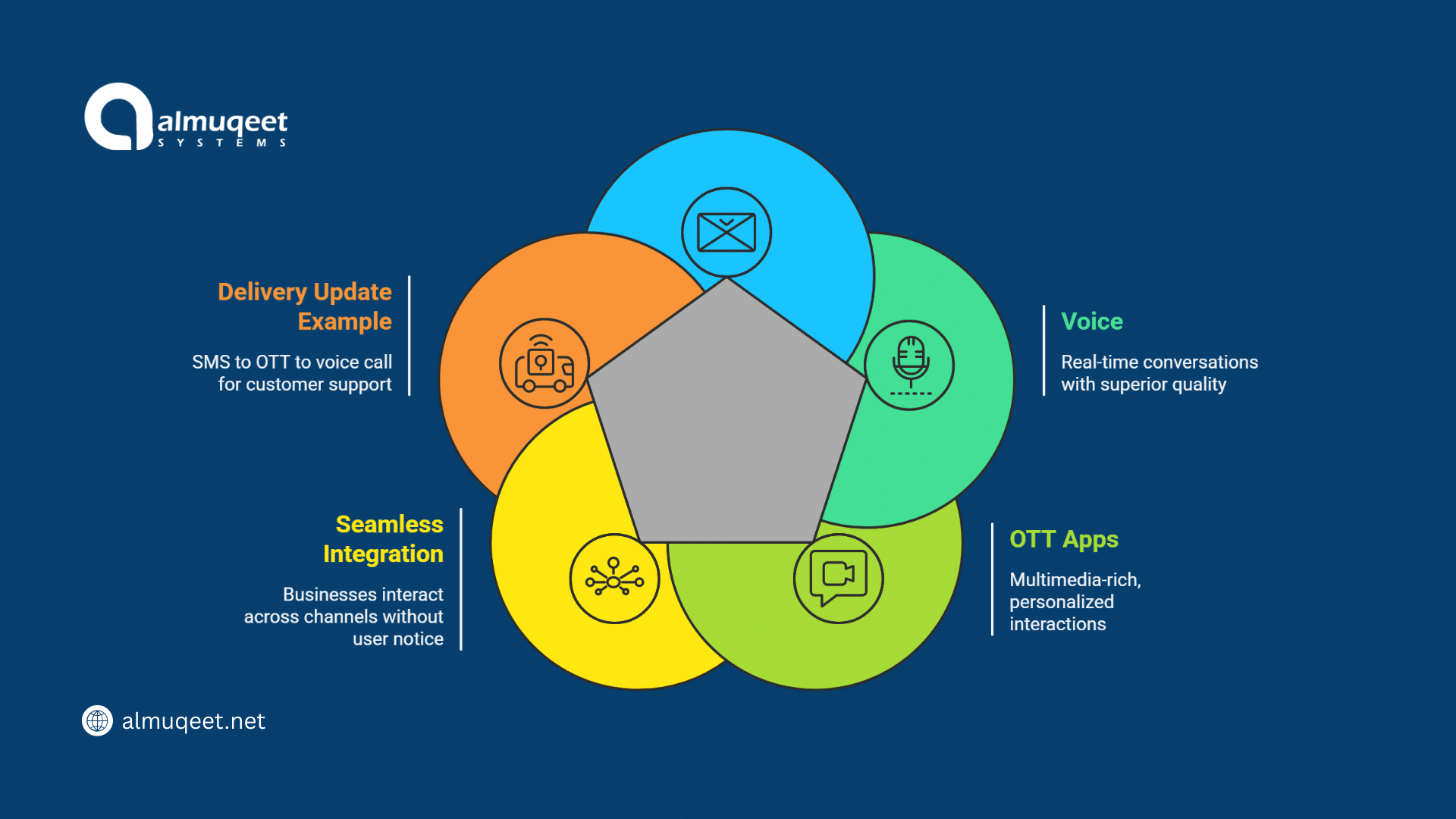 As adoption expands, messaging will become more integrated, where businesses can interact across multiple channels without users noticing the backend complexity. For instance, a delivery update might start as an SMS, escalate into an OTT conversation with live tracking, and finally shift into a voice call for customer support, all powered by 5G networks.
Conclusion
The effect of 5G on messaging is more than just quicker downloads or better streaming; it is redefining the underpinnings of SMS, voice, and OTT messaging. 5G, through ultra-low latency, reliable connections, and rich media, delivers more meaningful options to businesses and consumers in how to connect and communicate.
Businesses will need to ensure they are using RCS for customer engagement, check that OTT strategies are optimized for 5G, and look to VoNR for essential voice services. Consumers will witness conversations becoming more natural, messages becoming richer, and delays becoming virtually nonexistent.
Finally, the Impact of 5G on Messaging is not limited to speed. It makes it possible to have richer SMS using RCS, voice calls of higher quality, and immersive OTT interactions. Both businesses and consumers will have communication become closer, more dependable, and more personal than ever.