
Telecom networks are transporting billions of text messages and mobile connections every day, and not many people outside of the industry know how easy this traffic is to be compromised. Attackers are now always looking to test the weak links, whether it is a signaling protocol such as SS7 or attempting to bypass SMS paths to send spam and phishing messages. Mobile operators, aggregators, and enterprises are left asking one key question: what’s the difference between an SS7 firewall and an SMS firewall—and which one do I actually need?
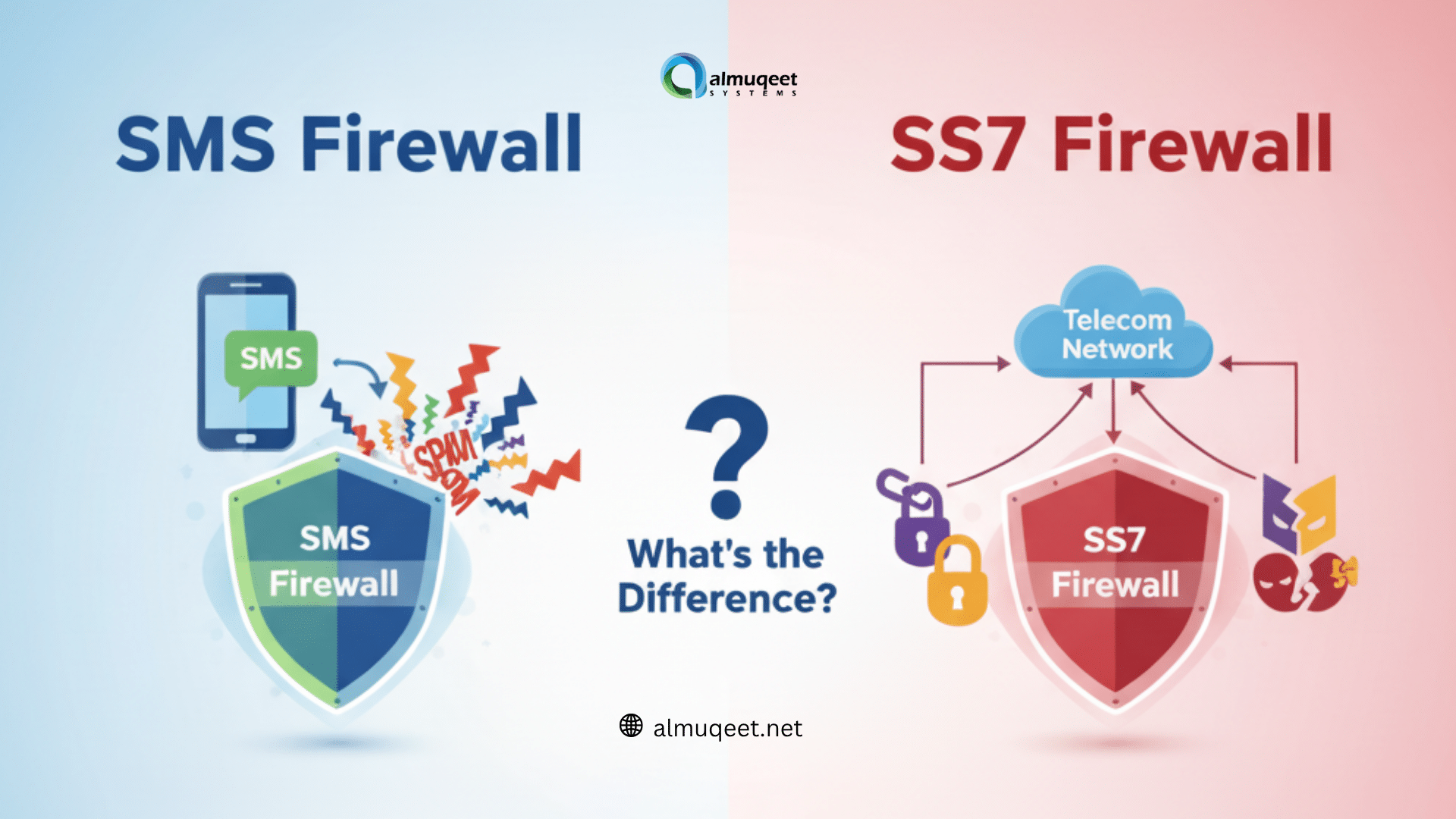
This guide breaks it down in plain language. At the end of it, you will not only learn the SS7 firewall vs SMS firewall but also get to know how each falls in the wider picture against telecom fraud, spam, and revenue leakage.
What is an SMS Firewall?
An SMS firewall works at the messaging layer. Its job is to monitor and control text message traffic, ensuring that operators and enterprises don’t lose money or reputation to fraudulent SMS practices.
Here’s what an SMS firewall typically does:
- Grey route blocking: Prevents international A2P messages from bypassing official paid channels.
- Spam filtering: Prevent spamming, phishing, and smishing activities from accessing subscribers.
- Traffic shaping: This is to enforce local laws on sender IDs and messages.
- Revenue assurance: Seals revenue that otherwise would be leaked through back holes.
Imagine you’re an operator. To send A2P SMS (such as OTPs or banking alerts), enterprises pay aggregators. In the absence of an SMS firewall, the fraudsters take advantage of the loopholes, sending the message via unpaid channels. The operator misses out on revenue, the enterprise receives less quality delivery, and subscribers face a potential risk of receiving malicious links.
What is an SS7 Firewall?
The analogous to SS7 is the nervous system of legacy telecom networks. Signaling System 7 (SS7) protocol has been in global use since the 1970s to facilitate connections of calls, provide texts, and roaming. Regrettably, it was never intended to be very secure.
- SS7 firewall is a security checkpoint of all signalling traffic, either entering or leaving a mobile network. It blocks, filters, and analyzes suspicious requests. For example:
- A hacker tries to locate a subscriber’s phone by exploiting an SS7 command → firewall blocks it.
- A fraudulent request attempts to reroute a one-time password SMS → firewall denies it.
- An attacker seeks to hijack international roaming traffic → firewall filters it.
To the point, the SS7 firewall safeguards signaling security. In its absence, attackers will be able to spy on and intercept banking OTPs and impersonate subscribers.
SS7 Firewall vs SMS Firewall: Core Differences
To make things crystal clear, here’s a side-by-side view:
| Feature | SS7 Firewall | SMS Firewall |
| Layer of Operation | Signaling (SS7 protocol) | Messaging (SMS traffic) |
| Primary Purpose | Protects against signaling fraud (location tracking, call/SMS interception, impersonation) | Protects SMS ecosystem (spam, grey routes, revenue leakage) |
| Threats Blocked | Call/SMS interception, fake roaming requests, subscriber impersonation | Spam SMS, phishing, grey route bypass, fake sender IDs |
| Stakeholders Benefiting | Operators, regulators, subscribers | Operators, enterprises, subscribers |
| Revenue Focus | Security & subscriber trust | Security + revenue assurance |
SS7 firewall vs SMS firewall is not an either/or choice. They complement each other. One defends the backbone of signaling; the other protects the revenue and integrity of SMS traffic.
Real-World Example
Let’s put this into perspective with a case study.
Without an SS7 firewall: A European operator was targeted by attackers who intercepted banking OTPs sent to roaming subscribers. Customers lost money, banks blamed the operator, and regulators stepped in. Deploying an SS7 firewall stopped the signaling abuse.
Without an SMS firewall: An Asian operator lost millions in revenue each month due to grey routes. Enterprises sending A2P traffic (like ride-hailing apps) unknowingly used unmonitored paths. Once an SMS firewall was deployed, the operator recaptured lost revenue and reduced spam complaints.
Why One is Not a Replacement for the Other
Both scenarios show that relying on only one type of firewall leaves a huge gap.
It is easy to believe that the installation of one firewall might address all problems related to telecom security. Comparing the SS7 firewall and the SMS firewall, however, reveals that each is defending a totally different aspect of the network. One cannot just take the place of the other.
Here’s why:
Different attack surfaces:
Where attackers intercept calls or spy on subscribers, SS7 firewalls protect the signaling layer, which contains vulnerabilities. SMS firewalls, on the other hand, protect the messaging layer against spam, grey routes, and phishing. These are two distinct battlefields.
Impacted different stakeholders:
Subscriber privacy and security of banking are the main areas of frailty because of signaling fraud. Messaging fraud has a direct impact on the revenues of the enterprise and the trust of the operators. One firewall will not be able to cover either.
Revenue vs. trust focus:
SS7 firewalls are concerned with customer data protection, national security, and fraud prevention on the protocol level. SMS firewalls are equally important, but are more revenue assurance-based and reliability of A2P messaging.
Imagine it this way: an SS7 firewall is an analogy to locking the front door of the house, whereas an SMS firewall is the lock on the mail slot against undesirable deliveries. You would never leave one to take the other since they insure against very different things.
This is why operators all over the world are investing in multi-layer defenses, as they know that an SS7 firewall/ SMS firewall is not one or the other, but a complementary strategy.
Deployment Challenges
Firewalls are powerful, but they’re not “plug and play.” Operators face challenges such as:
- Integration complexity: SS7 firewalls must align with legacy switching systems.
- False positives: SMS firewalls should be able to differentiate legitimate bulk traffic and spam.
- Cost justification: Smaller operators are hesitant because of the start-up cost, although the ROI is high.
- Changing threats: Attackers are always innovative, and there is a need to update firewall rules regularly.
This is where deployment is commonly provided through specialist vendors that have worldwide threat intelligence.
Challenges & Considerations
Installing new hardware or software is only one aspect of deploying telecom firewalls; other considerations include cost, complexity, and changing threats. There are significant considerations to make before implementing either solution, whether you’re considering an SMS firewall or an SS7 firewall.
1. Legacy System Integration
The majority of mobile operators continue to use a combination of current LTE or even 5G infrastructure with legacy SS7 networks. It takes careful planning and vendor expertise to integrate an SS7 firewall without interfering with current services. Similar to this, SMS firewalls need to adjust to various routing configurations, regional laws, and connections to third-party aggregators.
2. False Positives vs. User Experience
Both kinds of firewalls require precise filtering. While an overly aggressive SMS firewall may delay or reject valid A2P messages, like banking OTPs, an overly strict SS7 firewall may block legitimate roaming requests. One of the most difficult factors is finding the ideal balance between fraud detection and customer experience.
3. Cost and ROI
Due to financial limitations, smaller operators may be hesitant to invest in firewalls. However, the truth is that the cost of deployment is frequently greatly outweighed by the fraud losses resulting from signalling attacks or SMS grey routes. Operators have to balance upfront costs with subscriber trust and long-term revenue assurance.
4. A Changing Threat Environment
Fraudsters are never still. From SS7 to Diameter, from SMS spam to SIM box fraud, they are always looking for flaws. A firewall that is only installed once and is never updated soon becomes outdated. Vendor support, worldwide threat intelligence feeds, and regular updates are essential.
5. Adherence to Regulations
Different regions impose different rules on message filtering, subscriber privacy, and lawful interception. Both SS7 firewalls and SMS firewalls must be configured to meet local telecom compliance requirements while still blocking malicious traffic.
6. Vendor Dependence
Selecting the appropriate vendor is important. While some providers excel at preventing SMS fraud, others specialise in signalling security. Operators frequently deploy solutions from several vendors, which, if improperly coordinated, can lead to operational difficulties.
Future Outlook
5G networks are introducing new protocols (like HTTP/2 for signaling), but SS7 and SMS are far from dead. Billions of devices, especially in developing markets, still rely on them daily. This means the SS7 firewall vs the SMS firewall will remain relevant for years to come.
What’s changing is the sophistication of firewalls:
- AI-driven filtering for SMS spam detection.
- Threat intelligence sharing across operators.
- Unified platforms covering SS7, Diameter, SIP, and SMS in a single console.
Operators that adapt quickly will not only reduce fraud but also build trust with enterprises relying on A2P messaging.
Conclusion
Comparing the SS7 firewall vs the SMS firewall is like comparing airport security at immigration versus baggage scanning. One checks who’s allowed to enter the country (signaling). The other makes sure no dangerous or unauthorized goods slip through (messaging). Both are essential, and one without the other leaves the entire system exposed.
For operators, the real question isn’t which firewall to deploy but how to integrate both into a cohesive fraud prevention strategy. For enterprises, the impact is felt in better delivery, reduced spam, and safer customer communication.
The telecom ecosystem may evolve, but one truth stands firm: SS7 firewalls protect the foundation, SMS firewalls protect the business. Together, they safeguard trust in mobile communication.