
Most messaging systems look stable from the outside. Messages go out, delivery reports come back, dashboards show healthy numbers. For a while, everything feels predictable. Then volume increases, or traffic patterns shift, or a new market gets added, and small inconsistencies begin to surface. Not failures, just irregularities. A delay here. A missing receipt there. That’s usually when teams start asking where control actually sits in their messaging flow.
In most cases, the answer leads back to the same place: the SMS aggregator. Not as a simple connector, but as the layer quietly deciding how messages move across networks, which routes get used, and how delivery behaves when conditions aren’t ideal.
 The role of an SMS aggregator has changed over the years. What used to be a convenience layer is now part of core infrastructure, shaping delivery speed, reliability, and even cost in ways that aren’t always visible until something shifts.
The Role of an SMS Aggregator
At a surface level, an SMS aggregator connects enterprises to mobile operators. It provides APIs, handles message submission, and routes traffic across networks. That’s the part everyone knows. What’s less visible is how much decision-making happens inside that layer.
An aggregator doesn’t just pass messages forward. It evaluates routes in real time, balancing cost, delivery speed, network availability, and regulatory constraints. In some cases, it reroutes traffic midstream when a carrier path degrades. In others, it queues or throttles messages to avoid filtering or blocking.
This becomes especially relevant when businesses scale across regions. A route that works perfectly in one country may degrade unpredictably in another. Operators apply different filtering rules. Latency behaves differently. Pricing shifts based on agreements that aren’t visible externally. The aggregator absorbs that complexity, or at least, it’s supposed to.
How SMS Aggregators Actually Work in Production
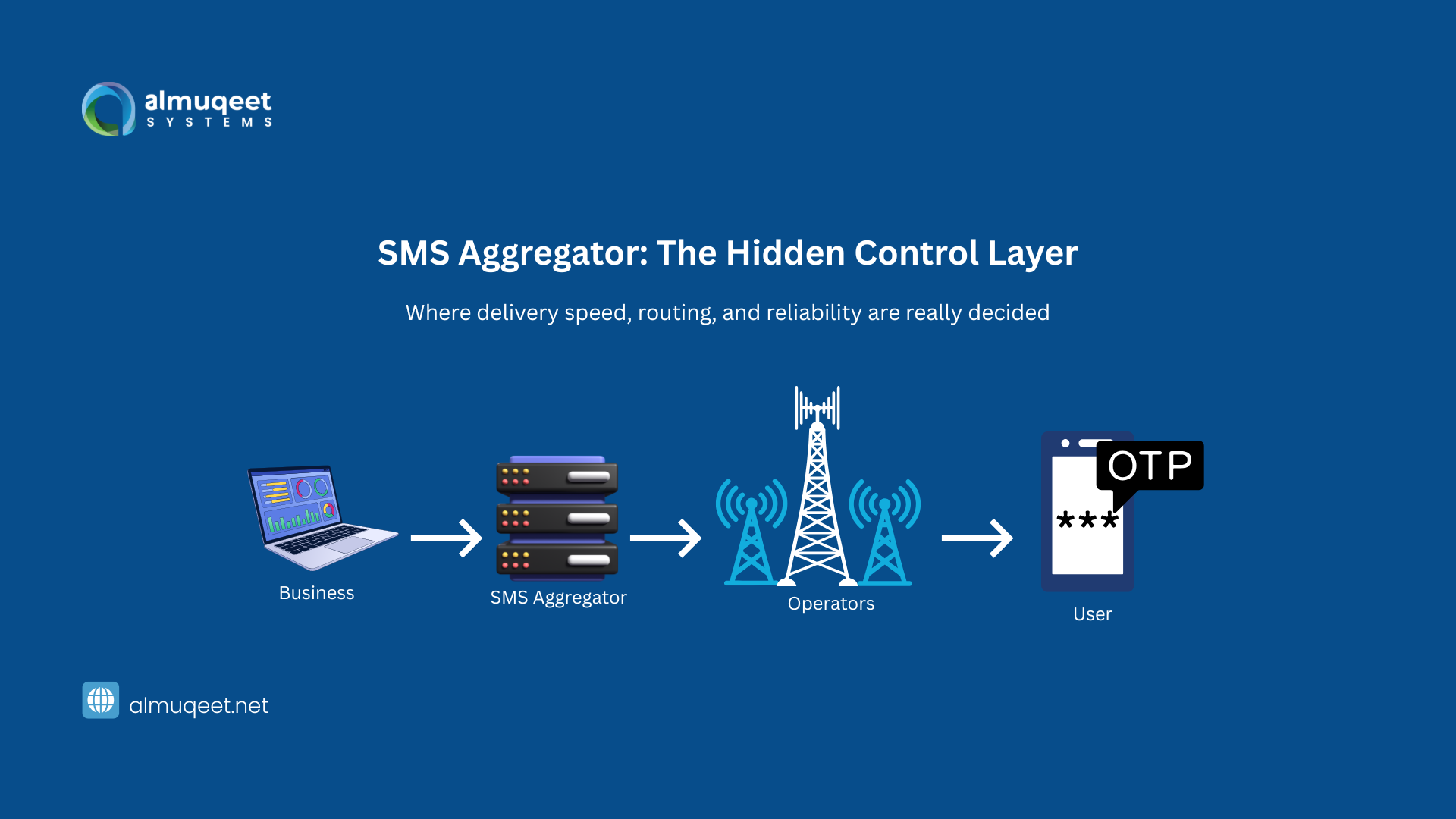
The clean diagram version is simple: API – aggregator – operator – handset. The real system is layered.
When a message hits an aggregator, several things typically happen within milliseconds:
- The system validates the request (format, sender ID, compliance rules)
- It checks routing tables based on the destination number
- It evaluates available routes (direct operator links, wholesale routes, backup paths)
- It applies delivery policies (priority, retry logic, throttling)
- It submits the message via protocols like SMPP or HTTP
From there, delivery is no longer fully in the aggregator’s control, but the path it chose determines most of what happens next. This is where experience starts to matter. A good aggregator doesn’t just choose the cheapest route. It learns from historical delivery patterns, failure rates, and latency behavior. Over time, routing becomes less static and more adaptive. If you’ve ever seen delivery reports arriving out of order or messages taking different times for similar destinations, you’ve already seen this in action.
Where Aggregators Start to Break Under Pressure
Most aggregators perform well under moderate load. The cracks show when scale introduces unpredictability. It’s not usually a single failure. It’s a combination of small issues that compound:
- One upstream operator starts delaying acknowledgments
- Another route silently drops delivery receipts
- A pricing-based route performs inconsistently under load
- Retry logic begins amplifying traffic instead of stabilizing it
Individually, these are manageable. Together, they create noise in the system. And this is where many businesses misdiagnose the problem. They assume “SMS delivery is unreliable,” when in reality, the routing layer isn’t adapting fast enough.
We’ve seen this clearly in OTP-heavy environments like fintech. A verification flow that works at 5,000 messages per hour behaves very differently at 100,000. Latency variance becomes the real issue, not outright failure. Users don’t complain about missing messages. They complain about waiting, that’s a different kind of reliability problem.
Aggregator vs Direct Operator Connectivity
There’s a natural question that comes up as systems scale: why not connect directly to operators? It sounds appealing more control, fewer intermediaries. In practice, it’s rarely that simple. Direct connectivity requires individual agreements with operators, region-specific compliance handling, infrastructure to manage multiple SMPP sessions, and constant monitoring of route performance. Even large enterprises struggle to maintain this efficiently across dozens of countries.
Aggregators exist because they centralize that complexity. That said, not all aggregators operate at the same level. Some rely heavily on indirect routes, which can introduce variability. Others invest in direct operator relationships and more stable routing. The difference shows up under stress, not in sales conversations.
The Hidden Economics of SMS Aggregation
Pricing in SMS aggregation is often misunderstood. Lower cost per message doesn’t always mean lower total cost. If a cheaper route introduces even slight delivery delays, the downstream impact can be significant, especially in time-sensitive use cases like authentication or transactional alerts. Failed or delayed messages trigger retries, increase traffic volume, and sometimes lead to lost conversions.
This is where concepts like grey route filtering come into play. If you’re unfamiliar with how these routes affect delivery quality and revenue, it’s worth understanding why operators actively filter them, something explored in discussions around grey route control and telecom routing behavior. A mature aggregator doesn’t just optimize for price. It balances cost with delivery integrity. And that balance shifts constantly.
Compliance Is No Longer a Side Concern
A few years ago, compliance was something teams dealt with during onboarding. Register sender IDs, follow basic guidelines, and move on. That’s changed. Markets like India have introduced frameworks such as DLT, where message templates, headers, and consent records are tightly controlled. Other regions are following similar patterns, each with its own variations. Aggregators now act as enforcement layers for these requirements.
They validate content, enforce template matching, and sometimes block messages before they even leave the system. This can feel restrictive, especially when campaigns fail unexpectedly due to formatting issues. But without this layer, delivery wouldn’t just degrade, it would be rejected outright at the operator level.
For a deeper look at how compliance layers are evolving in messaging ecosystems, topics like messaging compliance services have become increasingly relevant for enterprise workflows.
A Real-World Scenario: When Traffic Doesn’t Behave
Consider a retail platform running a flash sale. Traffic builds gradually, then spikes sharply within a 10-minute window. OTP requests surge as users attempt to log in simultaneously. The system isn’t overloaded the infrastructure can handle the volume. But the messaging layer behaves differently.
One route starts throttling. Another introduces slight delays. The aggregator shifts traffic dynamically, but the fallback routes aren’t as performant. Delivery times stretch just enough to affect user sessions. Nothing fails completely. But enough friction builds that conversion rates dip. This is the kind of scenario where aggregator quality becomes visible. Not in whether messages are delivered, but in how consistently they’re delivered under pressure.
Where SMS Aggregators Fit in a Modern Messaging Stack
As messaging ecosystems evolve with RCS, OTT channels, and richer communication formats, SMS remains the fallback channel that everything depends on, which alone makes the aggregator layer critical. It’s not just a connector anymore. It’s part of your reliability architecture. In many cases, this layer is supported by a dedicated messaging platform designed to handle routing, scalability, and operational control.
When businesses evaluate messaging infrastructure today, they’re not just asking:
“Can we send messages?”
They’re asking:
- Can we maintain delivery consistency during spikes?
- Can we control routing behavior when networks degrade?
- Can we adapt to compliance changes without breaking workflows?
These are aggregator-level concerns. And they don’t show up until systems are under real pressure.
Final Thoughts
SMS aggregators don’t usually get attention when things are working. They sit quietly in the background, moving traffic, balancing routes, absorbing edge cases. But when delivery becomes inconsistent, not broken, just unpredictable, that’s when their role becomes clear.
Choosing an aggregator isn’t about features. It’s about how the system behaves when conditions aren’t ideal. That’s where most of the real work happens. If your messaging infrastructure is starting to show signs of strain, such as rising latency, inconsistent delivery, or unpredictable routing, it’s usually worth looking at the aggregation layer first. Small improvements there tend to have a disproportionate impact.
FAQs
What does an SMS aggregator actually do?
An SMS aggregator connects businesses to mobile network operators and manages how messages are routed, delivered, and optimized across different networks.
How is an SMS aggregator different from an SMS gateway?
A gateway typically refers to the API interface for sending messages, while an aggregator includes the underlying routing infrastructure and operator relationships.
Do SMS aggregators guarantee delivery?
No system can guarantee delivery. Aggregators can optimize routing and improve success rates, but final delivery depends on operator networks and handset availability.
Why do SMS delivery times vary?
Delivery time depends on route selection, network congestion, operator filtering, and retry behavior. Aggregators influence most of these factors but don’t control them entirely.
Is direct operator connectivity better than using an aggregator?
It depends on scale and resources. Direct connections offer more control but require significant infrastructure and operational overhead. Aggregators simplify this at the cost of some abstraction.
How do I choose the right SMS aggregator?
Look beyond pricing. Evaluate delivery consistency, route transparency, compliance handling, and how the system behaves under load. Those factors matter more over time.