
There’s a moment most product teams hit, usually not at launch, but somewhere after growth starts to feel real, when communication stops being a feature and starts behaving like infrastructure. At first, sending an OTP or a delivery update feels straightforward. You plug into an API, messages go out, users respond, and everything appears stable. But then traffic spikes. Latency creeps in. Messages arrive out of order. A regional operator starts throttling routes. Suddenly, what felt like a simple integration becomes a system you have to think about, that’s where a CPaaS platform quietly moves from convenience to necessity.
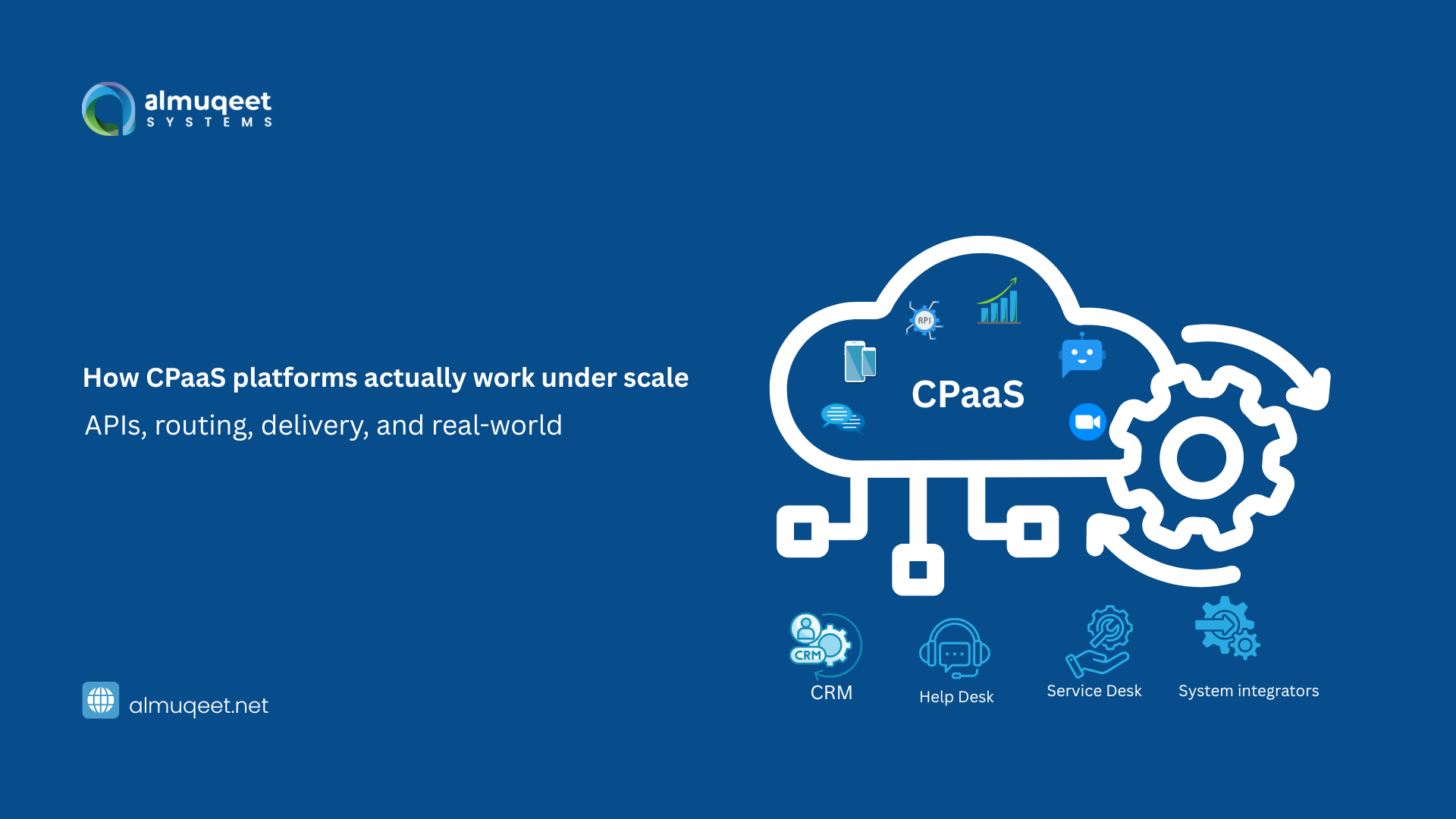 Not because it adds more features but because it absorbs complexity that most teams don’t have the time or telecom expertise to manage. Routing decisions, fallback logic, regulatory compliance, and delivery optimization are not things you want to build from scratch when your product depends on messages arriving on time. This isn’t a category defined by APIs alone. It’s defined by how those APIs behave under pressure.
What Is CPaaS?
A CPaaS platform (Communications Platform as a Service) gives developers programmable access to communication channels, SMS, voice, video, and authentication through APIs. That definition is accurate, but incomplete. In practice, CPaaS is less about “adding messaging” and more about outsourcing the hardest parts of telecom infrastructure: carrier connectivity, message routing, global compliance, delivery monitoring, and scaling behavior.
You’re not just calling an API. You’re tapping into a system that has already negotiated with operators, optimized delivery paths, and built safeguards against failure modes you haven’t seen yet. And those failure modes always show up eventually.
How Does CPaaS Actually Work?
The Role of APIs in Cloud Communications
At the surface level, everything starts with an API request. A developer triggers an event to send an OTP, initiate a voice call, or deliver a notification. The request hits the CPaaS layer, which translates that into telecom-level instructions. What matters is what happens next.
The API doesn’t just “send a message.” It decides how to send it, which route, which operator, and which fallback path if delivery fails. It evaluates cost, latency, and reliability in milliseconds. This is where most standalone API setups begin to struggle.
How Messaging, Voice, and Video Services Are Integrated
In isolation, each communication channel is manageable, but systems rarely stay isolated. A logistics platform might send an SMS, trigger a voice fallback if delivery fails, and update status over WhatsApp all within the same workflow. CPaaS platforms unify these channels under a single orchestration layer.
That matters because coordination between channels is where things break. Without unified logic, you get duplicated messages, conflicting notifications, or worse, silence when one channel fails, and nothing takes over.
The Infrastructure Behind CPaaS Platforms
This is the part most documentation skips behind every API call sits a network of carrier agreements, SMPP connections, routing engines, and compliance filters. Messages don’t travel in straight lines. They move through negotiated paths, sometimes changing routes mid-stream depending on congestion or operator behavior.
In high-volume environments, routing decisions can change minute to minute. A route that performs well at 2 PM might degrade at 6 PM due to traffic spikes or operator throttling. A well-built CPaaS platform continuously adjusts, prioritizing delivery rates over theoretical cost efficiency.
This is where concepts like HLR lookup, intelligent routing, and firewall filtering start to matter. If you’ve explored systems like mobile number intelligence or filtering layers, such as those discussed in SMS firewall architectures, you’ll recognize how much of messaging reliability happens before a message is even sent.
Advantages of CPaaS Technologies
Most teams adopt CPaaS for speed. They stay for stability. A few advantages consistently show up once systems begin to scale:
- Faster development of communication features
- Scalable cloud-based messaging infrastructure
- Multi-channel customer engagement
- Reduced telecom infrastructure costs
These aren’t just product benefits, they’re operational shifts.
Faster development isn’t just about APIs being easy to use. It’s about removing the need to understand telecom protocols deeply. You don’t need to negotiate with carriers or manage routing logic manually.
Scalability becomes less about handling traffic volume and more about handling unpredictability. Campaign spikes, OTP bursts, and regional surges, CPaaS platforms absorb these patterns without forcing teams to redesign their systems.
Multi-channel engagement becomes practical only when channels are coordinated. Otherwise, adding more channels increases complexity instead of improving reach.
Cost reduction is subtle. It’s not just infrastructure savings, it’s the cost of not dealing with failed deliveries, customer complaints, or compliance penalties.
CPaaS Features and Communications APIs
SMS and Messaging APIs
SMS remains the backbone of CPaaS, not because it’s modern, but because it’s reliable. Even in 2026, OTP delivery, alerts, and critical notifications still depend on SMS. What’s changed is how much optimization happens behind the scenes.
Delivery timing, route selection, sender ID handling, and DLT compliance aren’t visible in the API, but they define whether your message actually reaches the user.
Voice and Video APIs
Voice becomes relevant when messaging fails. A well-designed CPaaS setup treats voice as a fallback channel, especially in high-stakes scenarios like banking alerts or healthcare notifications. Video, on the other hand, is less about scale and more about experience. It’s used selectively, where interaction quality matters more than delivery certainty.
Authentication and Security APIs
OTP systems look simple until they fail. Delayed messages, expired tokens, and mismatched retries are common failure patterns when authentication is treated as a basic feature instead of a critical system. CPaaS platforms integrate retry logic, fallback routing, and delivery monitoring to stabilize authentication flows under load.
AI and Automation APIs
Automation has moved beyond chatbots. CPaaS platforms now incorporate AI for routing optimization, fraud detection, and conversational workflows. But the real value isn’t automation itself, it’s reducing decision latency in systems where milliseconds matter.
CPaaS Examples and Real-World Use Cases
Customer Service and Support Automation: Support systems often start with email or chat, then expand into messaging. The challenge isn’t sending responses, it’s maintaining context across channels. CPaaS platforms allow interactions to persist, even when users switch mediums.
Logistics and Delivery Notifications: This is where scale becomes visible. A delivery platform pushing millions of updates per day doesn’t just need throughput, it needs timing precision. A late message can be as problematic as a failed one.
Healthcare and Appointment Reminders: Reliability matters more than speed here. Missed reminders translate directly into operational inefficiencies. CPaaS systems prioritize delivery certainty over cost in these scenarios.
Retail and E-commerce Customer Engagement: Promotional messaging operates under different constraints, compliance, opt-outs, and regional regulations all come into play. This is where understanding messaging compliance frameworks becomes essential, especially in regulated markets.
Education and Virtual Collaboration: Educational platforms rely on messaging for continuity alerts, updates, and reminders. Consistency matters more than sophistication.
CPaaS and Individual APIs
There’s a point where stitching together multiple APIs starts to feel fragile. Different vendors handle different parts one for SMS, another for voice, another for authentication. On paper, it works. In practice, integration overhead grows quickly. Latency mismatches, inconsistent delivery reporting, and fragmented logs these issues don’t show up immediately, but they accumulate.
A CPaaS platform consolidates these layers. Not perfectly, but enough to reduce operational friction. One system, one reporting layer, one routing logic, fewer moving parts to debug when something goes wrong.
CPaaS vs UCaaS
The distinction is often misunderstood. CPaaS is built for developers. It’s programmable, flexible, and embedded into applications, while UCaaS (Unified Communications as a Service) is built for teams. It provides ready-to-use tools for calling, messaging, and conferencing without requiring development effort.
They solve different problems. If you’re building a product that depends on communication, CPaaS is the foundation. If you’re enabling internal collaboration, UCaaS is usually sufficient.
Explore CPaaS Technology
CPaaS isn’t a trend. It’s a response to complexity that most teams eventually encounter. The shift happens quietly from sending messages to managing communication systems. And once you cross that line, the question isn’t whether you need a CPaaS platform.
It’s whether your current setup can handle the kind of scale and unpredictability your product is moving toward.
FAQs
- What makes a CPaaS platform different from a basic SMS API?
A basic SMS API sends messages. A CPaaS platform manages routing, fallback logic, compliance, and multi-channel coordination, especially under scale. - Can CPaaS handle high-volume OTP traffic reliably?
Yes, but reliability depends on routing intelligence, operator relationships, and retry mechanisms, not just API performance. - Is CPaaS suitable for small businesses or only large enterprises?
It’s often more valuable for growing businesses, where communication starts simple but scales quickly. - How does CPaaS improve message delivery rates?
By dynamically selecting routes, monitoring delivery performance, and adjusting paths based on real-time network behavior. - Do CPaaS platforms help with compliance?
Most platforms integrate compliance layers such as regional regulations and filtering systems to reduce the risk of message blocking. - When should a company migrate to a full CPaaS solution?
Usually, when messaging delays, delivery failures, or scaling issues start affecting user experience or operations.