
At first, messaging feels predictable. You send a request, the message goes out, and delivery looks clean. Nothing surprising. Then volume grows, and things stop behaving the same way. You start noticing small inconsistencies. A delay here, a drop there. Certain routes that were fine last week suddenly feel slower. Costs don’t jump overnight, you don’t wake up to a shocking bill. It’s quieter than that. Margins start thinning without a clear reason. A route that used to be economical isn’t anymore. You find yourself double-checking numbers that you used just to make sense.
Nothing is outright broken. But something isn’t as clean as it was. That’s usually when it clicks. This isn’t just a feature you plugged into your product anymore. It’s something you’re now depending on, something that needs attention, decisions, and a bit of respect. Messaging, at that point, starts behaving like infrastructure. And somewhere in that shift, the difference between Tier-1 vs Tier-2 telecom operators becomes very real.
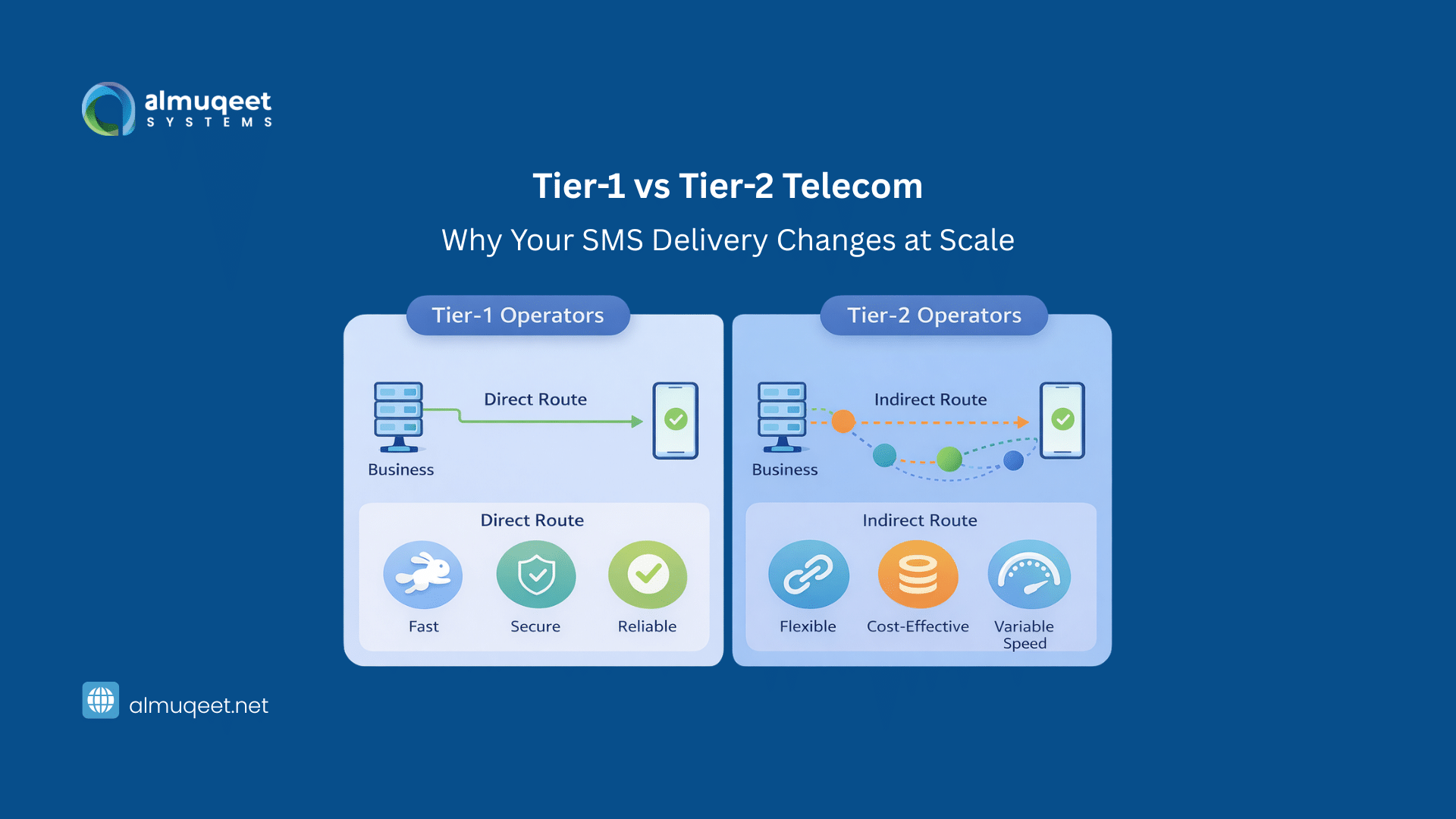 Because now you’re not just sending messages, you’re depending on paths, agreements, and systems that sit outside your control. And the way those layers are built, whether direct or indirect, starts to shape every outcome you see.
Tier-1 Telecom Operators
Tier-1 operators sit at the core of the telecom ecosystem, they own infrastructure. They manage national networks. They operate their own SMSCs, signaling layers, and direct interconnect agreements with other operators globally. This isn’t just about size, it’s about control.
When a message enters a Tier-1 network, it doesn’t need to “find its way” through multiple intermediaries. The operator already has direct visibility into subscriber status, routing conditions, and delivery paths. That control shows up in ways that matter under pressure:
- Fewer routing hops
- Lower latency variability
- Better delivery predictability
- Stronger compliance enforcement
But the trade-off is real. Tier-1 operators are not optimized for flexibility. Their systems are built for stability, regulation, and scalability, not for experimentation or aggressive pricing. Integration can be slower.
Commercial terms are stricter, and access is often gated behind volume commitments or regional restrictions. If you’ve ever worked directly with a Tier-1 connection, you know this feeling: Everything is solid, but nothing is fast to change.
Tier-2 Telecom Operators
Tier-2 operators exist in the space between infrastructure and access. They don’t typically own full national networks, but they operate through a mix of leased infrastructure, interconnect agreements, and aggregator relationships.
In many cases, they act as bridges connecting businesses to networks that would otherwise be difficult to access directly. This is where most messaging platforms actually operate. Tier-2 players bring something Tier-1s often don’t: adaptability.
They can:
- Onboard faster
- Offer competitive pricing through route optimization
- Provide access to multiple destinations without direct contracts
- Adjust routing dynamically based on performance or cost
But this flexibility comes with a layer of uncertainty. Because when you’re working through Tier-2 routes, you’re often relying on chains of connectivity, some visible, some not. A message might pass through multiple networks before reaching the end user. Each hop introduces potential delay, filtering risk, or delivery inconsistency.
This doesn’t mean Tier-2 is unreliable. In fact, many Tier-2 operators run highly optimized, performance-driven routing systems. But the reliability is constructed, not inherent. And under stress, high traffic spikes, regulatory changes, or network disruptions, that difference becomes visible.
Tier 1 vs Tier 2 Telecom: The Difference in Practice
The easiest way to understand tier 1 vs tier 2 telecom is not through definitions, but through behavior. Here’s how they differ when systems are under real load:
| Aspect | Tier-1 Operators | Tier-2 Operators |
| Network Ownership | Full infrastructure ownership | Partial or no direct ownership |
| Routing | Direct interconnects | Multi-hop routing paths |
| Delivery Speed | Consistent, predictable | Can vary depending on the route |
| Cost | Higher, stable pricing | Lower, variable pricing |
| Scalability | High, but rigid | High, with flexibility |
| Compliance | Strict, enforced at the network level | Dependent on routing partners |
| Adaptability | Slower to change | Faster to adjust routes |
This table is useful, but it’s still abstract. The real difference shows up when something breaks.
Tier 1 vs Tier 2 Telecom: What Happens Under Scale
Consider a fintech platform sending OTPs during peak hours. At low volume, everything works. Messages route quickly. Delivery rates look clean, no alarms. Then traffic increases, maybe due to a campaign, maybe due to seasonal demand. If the platform is relying heavily on Tier-2 routes:
- Some routes start slowing down due to congestion
- Certain destinations experience filtering or throttling
- Failover routing kicks in, but with added latency
- Delivery reports become less predictable
From the outside, it looks like a temporary glitch. From the inside, it’s a routing cascade. Now compare that to a Tier-1 route.
The same spike happens, but the network absorbs it differently:
- Traffic is handled within a controlled infrastructure
- Congestion is managed at the operator level
- Delivery behavior remains more stable
The difference isn’t perfection vs failure. It’s controlled degradation vs unpredictable variation. And that distinction matters when your messages are tied to logins, payments, or time-sensitive actions.
Where Each Tier Actually Works Best
There’s a tendency to frame this as a “which is better” decision. That’s usually the wrong question. Because most real-world messaging systems don’t choose one, they combine both. Tier-1 operators make sense when:
- You need guaranteed delivery for critical flows (OTP, alerts, compliance messages)
- You operate in regulated environments (fintech, healthcare)
- You can justify higher costs for reliability
Tier-2 operators make sense when:
- You need broad geographic coverage quickly
- Cost optimization is a priority
- You’re running campaigns, promotions, or non-critical messaging
The reality is that mature messaging infrastructure uses a hybrid model. Not because it’s ideal, but because it’s necessary.
The Hidden Layer: Routing Strategy
Most businesses don’t fail because they chose Tier-1 or Tier-2. They fail because they didn’t think about a routing strategy at all. Routing isn’t just about choosing a provider. It’s about deciding:
- Which traffic goes through which routes
- When to prioritize cost vs reliability
- How to detect and respond to degradation
- How to avoid over-dependence on a single path
This is where concepts like grey route filtering, signaling control, and number intelligence start to matter, not as features, but as safeguards.
If you’ve read discussions around routing risks and filtering challenges, like those explored in grey route filtering strategies or SMS firewall architectures, you’ve already seen how quickly things can go wrong when visibility is limited. Messaging doesn’t break loudly. It drifts. And by the time you notice, users already have.
When Messaging Becomes Infrastructure
Early on, messaging feels like a feature. An API call, a delivery report. A dashboard metric. But at scale, it becomes infrastructure. It starts behaving like a system you need to monitor, optimize, and sometimes defend. This is where the Tier-1 vs Tier-2 distinction becomes operational, not conceptual. Because now you’re not just asking: “Can we send messages?”
You’re asking:
- What happens if this route fails?
- How quickly can we reroute traffic?
- Which messages are allowed to degrade and which are not?
And those questions don’t have simple answers. They require architecture.
Tier 1 vs Tier 2 Telecom: A More Practical Way to Think About It
Instead of choosing between Tier-1 and Tier-2, it’s more useful to think in layers:
- Core layer (Tier-1): Stability, compliance, critical delivery
- Flexible layer (Tier-2): Coverage, cost efficiency, adaptability
The goal isn’t to eliminate risk. It’s to control where risk exists. Because in messaging, you don’t remove uncertainty, you distribute it intelligently.
Final Thoughts
The conversation around tier 1 vs tier 2 telecom often stays too high-level. In practice, it’s not about labels. It’s about behavior under load, visibility under failure, and control under pressure. If messaging is part of your business operations, not just an add-on, you’ll eventually need to treat routing decisions the same way you treat infrastructure decisions. Not as vendor choices. But as system design, that shift usually happens after something breaks. It doesn’t have to.
Frequently Asked Questions
What is the main difference between Tier-1 and Tier-2 telecom operators?
Tier-1 operators own and control their network infrastructure, offering direct routing and higher reliability. Tier-2 operators rely on partnerships and interconnects, providing flexibility and cost efficiency but with more routing variability.
Are Tier-2 operators unreliable for SMS delivery?
Not inherently. Many Tier-2 operators provide strong performance through optimized routing. However, reliability can fluctuate depending on route quality, network congestion, and intermediary dependencies.
Should businesses always choose Tier-1 routes for OTP messages?
For critical flows like OTP, Tier-1 routes are generally preferred due to their predictability and compliance alignment. That said, many systems use Tier-2 as a fallback or secondary route.
Why are Tier-1 routes more expensive?
They involve direct network access, controlled infrastructure, and fewer intermediaries. You’re paying for stability, compliance, and consistent delivery behavior.
Can a messaging platform use both Tier-1 and Tier-2 operators?
Yes, and most mature platforms do. A hybrid routing strategy allows businesses to balance cost, coverage, and reliability based on message type and priority.