
If you’ve ever looked at messaging logs long enough, you stop thinking in terms of “sent” and “delivered.” You start noticing timing patterns instead. Certain hours where delivery stretches slightly. Specific operators where reports come back slower. Messages that technically succeed, but not in the way you expected. Nothing dramatic, just enough variation to make you question what’s happening underneath. That’s usually the point where the SMSC stops being an abstract concept.
Because behind every message is a system making quiet decisions, when to push, when to wait, when to retry, and sometimes, when to give up, most of those decisions never surface unless something shifts in the network, but once they do, it becomes clear that messaging isn’t as linear as it looks from the outside.
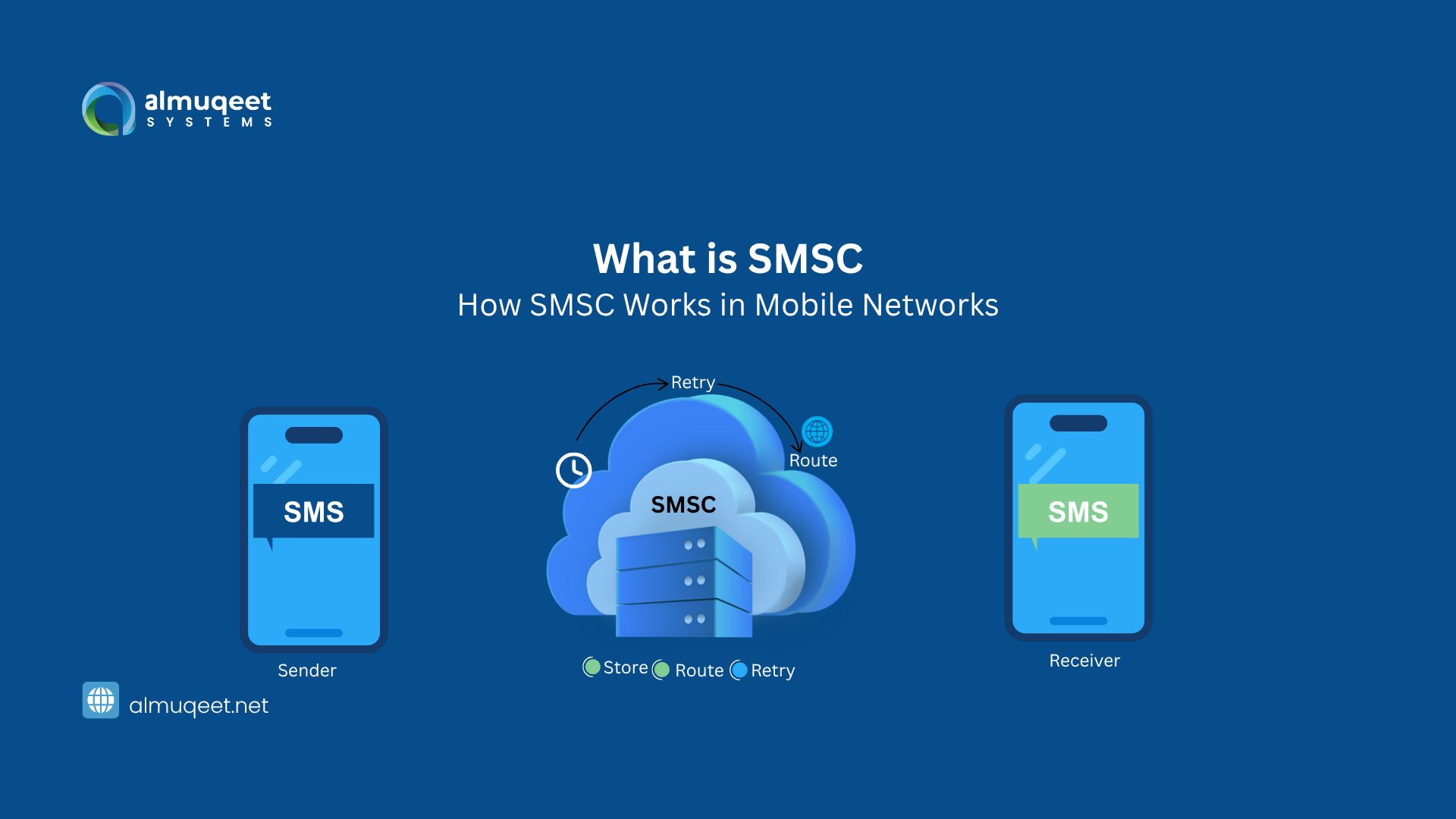 And understanding how the SMSC works is less about definitions and more about understanding those moments when the system behaves differently than expected.
What is SMSC
At its simplest, an SMSC is the system inside a mobile network that receives, stores, routes, and forwards SMS messages. But that definition misses what it actually does under pressure.
An SMSC is not just a relay. It behaves more like a traffic control system:
- It decides when to deliver a message
- It queues traffic during congestion
- It retries delivery if the recipient is unavailable
- It interfaces with other networks when messages cross borders
Every SMS, whether it’s a bank OTP or a delivery update, passes through an SMSC at least once. And in most real-world scenarios, more than once.
Core Function of an SMSC in Mobile Communication
At the system level, the SMSC is located between message senders (applications, aggregators, operators) and receive(s) (mobile devices). However, its actual task is to balance speed, reliability, and control in situations that are usually not foreseeable.
When traffic is low, delivery feels instant. When traffic spikes, the SMSC starts making decisions:
- Should this message be queued or dropped?
- Is the destination network reachable right now?
- Should it retry immediately or wait?
These decisions aren’t visible in dashboards, but they directly impact delivery outcomes. This is where many businesses misread messaging performance. They look at API success rates, not realizing that the actual delivery logic happens deeper inside the SMSC layer.
How Does SMSC Work
An SMSC operates on a store-and-forward model.
When a message is submitted:
- It is first accepted by the SMSC
- Stored temporarily if the recipient is unavailable
- Routed toward the destination network
- Delivered when the handset becomes reachable
If delivery fails, the SMSC doesn’t give up immediately. It retries sometimes multiple times, based on configured rules. That retry logic is often underestimated. It’s what allows SMS to remain reliable even when devices are switched off or temporarily unreachable. But it’s also where delays can creep in. If retry intervals are poorly configured or queues are overloaded, messages can arrive minutes late, which, for OTPs, is effectively a failure.
How SMSC Functions Within Mobile Network Infrastructure
Inside a telecom network, the SMSC doesn’t operate in isolation. It interacts with multiple elements:
- Subscriber databases (HLR/HSS) to check user availability
- Signaling systems like SS7 or Diameter for routing
- Interconnect gateways for cross-network delivery
This is where complexity increases. A message sent within the same network behaves very differently from one sent internationally. The SMSC must constantly query, validate, and route often within milliseconds.
Operators who don’t maintain tight control here tend to experience issues like grey routes, delivery uncertainty, or revenue leakage, something explored in depth when discussing telecom routing and filtering strategies across modern networks.
What is an SMSC Number
SMSC number-SMSC number is the address of the SMSC set up on a mobile phone. It informs the device of where to deliver messages sent in terms of SMS. The majority of users do not have any interaction with it as it is configured by the operator. However, when it is wrongly configured, it will not send messages out of the device. Put it in the form of the entrance into the messaging network.
SMSC Number vs SMSC
This distinction is often misunderstood.
- The SMSC is the actual network system handling messages
- The SMSC number is just the access point used by devices
Changing the number doesn’t change how messages are processed. It only affects whether they can enter the network. It’s a small detail, but one that becomes relevant when troubleshooting delivery failures at the device level
Types of SMS Supported by SMSC
Not all SMS traffic behaves the same, even though it flows through the same infrastructure.
SMSC systems typically handle:
- Transactional SMS: OTPs, alerts, system notifications
- Promotional SMS: campaigns, offers, bulk messaging
- P2P messages: user-to-user communication
Each type has different expectations. Transactional traffic demands low latency and high reliability. Promotional traffic prioritizes throughput and cost efficiency. P2P traffic sits somewhere in between. Balancing these within a single SMSC environment is where operational complexity starts to show.
International SMS Routing: How SMSCs Work Across Borders
Cross-border messaging introduces a different layer of unpredictability. A message doesn’t just pass through one SMSC, it may traverse multiple operators, interconnect agreements, and routing paths.
Each hop introduces:
- Potential delays
- Filtering rules
- Cost variations
- Delivery uncertainty
This is why international SMS performance often feels inconsistent. Operators and aggregators that rely on unstable routes can see delivery rates fluctuate without an obvious explanation. It’s not always a failure, sometimes it’s just routing inefficiency. This is also where infrastructure decisions like grey route filtering and intelligent routing start to matter not as optimization, but as necessity.
Which Industries Require an SMSC Platform
Most businesses don’t think about SMSC when they begin sending messages. It usually sits in the background, doing its job quietly. But in certain industries, that “background system” ends up carrying a lot more weight than expected. The moment messaging becomes time-sensitive or business-critical, the role of SMSC becomes very real.
Here’s how that plays out across different sectors
Banking & Financial Services
In banking, messages aren’t just notifications, they’re part of the security layer. OTPs, transaction alerts, fraud warnings… these are things users rely on instantly. If a message arrives late, it’s not just inconvenient, it can break the entire experience.
This is where the role of the SMSC comes in. The job of the SMSC is to make sure that the messages are sent with the highest priority and that they are retried if necessary. The goal is to get the messages across with the highest reliability possible.
E-commerce and Retail
In logistics, timing is everything. Customers expect updates at every stage: when the package is shipped out, when it’s out for delivery, and when it’s arrived. These updates might seem simple, but they are heavily dependent on the reliability of the message delivery. The role of the SMSC is to make sure that these updates are sent on time, especially in the last-mile delivery.
Healthcare
Updates in the healthcare system are not just information, but information that matters. It’s not just information that is inconsequential in and of itself, but information that is crucial to the progression of the patient’s care. It’s information that could be an appointment reminder, information that could be lab results, information that could be an alert related to medication management.
Telecom Operators & Aggregators
For telecom providers, SMSC isn’t just important, it’s the core of how messaging works. Every routing decision, every delivery report, every inter-network message passes through it.
Government & Public Services
SMS service is used by governments in situations where they need to communicate urgently and in large numbers. This are instances where time is of the essence, and there can be no delay. It does not matter whether the SMS service is for a country or a city, as SMSC will help in the timely delivery of the messages even if the number of people receiving them runs into millions.
Importance of SMSC in Modern Messaging Ecosystem
Even with the rise of messaging apps, SMS remains deeply embedded in critical workflows. Banks still rely on it for authentication. Logistics companies use it for last-mile updates. Healthcare systems depend on it for reminders.
The SMSC is what makes all of this possible, quietly handling:
- Message persistence when devices are offline
- Guaranteed delivery attempts
- Network-level interoperability
It’s not the fastest channel. It’s not the richest. But it’s still the most universally reachable.
Conclusion: SMSC as the Invisible Backbone of Messaging
SMSC isn’t something most businesses think about when they start sending messages. But at scale, it becomes impossible to ignore. It defines delivery speed, reliability, and consistency, often more than the API layer ever will.
Providers such as Almuqeet Systems target this layer not due to its visibility, but due to the fact that it is where messaging is either glued or disintegrated in silence. The focus with infrastructure like aSMSC moves more to smarter routing, higher throughput, and greater control of delivery results, particularly in complex and multi-network environments. If messaging is part of your core operations, then SMSC isn’t just a component. It’s the system you’re already relying on, whether you realize it or not.
FAQs
What happens if SMSC fails?
If the SMSC fails, messages cannot be processed or delivered. Depending on the setup, they may be queued temporarily or dropped entirely, leading to missed communications.
Can SMSC delay messages?
Yes. Delays typically occur due to queue congestion, retry mechanisms, or routing inefficiencies, especially during high traffic periods.
Is SMSC used in WhatsApp or RCS?
No. Platforms like WhatsApp and RCS use IP-based messaging systems. SMSC is specific to traditional SMS networks.
Why do some SMS messages arrive late even if sent instantly?
Because delivery depends on network conditions, routing paths, and SMSC queue behavior, not just the moment a message is sent.
Do all operators use the same SMSC setup?
No. Each operator configures its SMSC differently, which is why delivery performance can vary across regions and networks.